Small town, rural hospital, snapshot, tinge of the seventies.

Driving into the Dartmouth Hitchcock Medical Center, the soaring buildings with their blue-green windows inspire confidence. They’re just so darn topnotch, cream of the crest, but (in the cancer journey) I also use the nearby hospital, too.

At the local hospital, not far from our house, we arrive again in the dark, the crimson EMERGENCY sign glowing. My daughter leaves me at the door and disappears around the corner to park. Inside, it’s the same receptionist, who nods a little sadly to see me again. In the waiting room, there’s no one but me and the Mountain Dew machine, my reflection in the windows.

Months into this cancer, I’m familiar with the process (don’t ever put your feet on the ER floor without shoes!) of questions and fluids and meds, a room far away from the day’s flu and Covid patients. Here’s what has changed: the ER doctor and I know each other now. My brilliant oncologist calls me and thinks aloud, what’s going on now? and orders an unusual set of tests. The ER doctor listens, nods, yes, let’s try that. My daughter’s boyfriend appears. The three of us talk about xc skiing and DOGE.

I’ve crammed my backpack with my laptop and notebook, two books, and a few clothes. In the middle of the night, I’m admitted. The woman who takes me upstairs knows a longtime friend of mine. She tells me about growing up in eastern Montana. Wherever you go, she tells me, the sky is infinite. Vermont’s so small, I feel like I could put it in my pocket.

Having lived in the West, too, I sometimes chafe against the pocket-sidedness of Vermont but mostly I love it. I keep thinking of this woman’s description for these few days again, in this rural hospital that’s about the size of double pocket in the front of hoodie sweatshirt. The census is so low here the rooms are all singles. Each of the rooms where I’ve stayed seems to be finished with unique salvaged materials. Beadboard cabinets in my last room, painted glossy cobalt, line one entire wall. In this room, the window is trimmed with wooden rosette corners, the sill plastic faux marble.

The medical world is hurry up and wait, but this hospital leans back towards the 1970s. I drink Shasta ginger ale and chat with the LNA about the cold and maple sugaring. Here’s what changed in me: I see these people throwing everything they have at me. The hospitalist who advised me, just a day after the cancer was discovered, do not stay in bed; be part of the world. The social worker stops in and asks my daughter about her job. The chaplain and I talk Dostoyevsky and cats. The nurses who have survived their own savage cancers share their stories and let me ask my questions. I have so many questions. The questions narrow down to one: how will I survive?

Then I ask to leave. My daughter stops at the pharmacy for another prescription and texts that it will be a few minutes. I open the door and lean against her winter-salted car. I’ve been at this crossroads in this unremarkable section of town so many times. Across the road was the department store Ames where I bought this daughter her first pink ball so we could roll it between us, the baby version of Catch. In the Price Chopper parking lot, I used to meet people to exchange boxes of wedding favors in leaf or heart-shaped bottles, tied up with ribbons, for checks. Afterwards, I’d take my girls into Price Chopper and buy ice cream. Behind the pharmacy is a home center, where I’ll never go again, after my ex-husband absconded with his customers’ money and stiffed the home center… how many tens of thousands of dollars I never knew. I’d severed that cord by then. On the other side of the crossroads stands the hardware store where the girls and I used our pandemic stimulus money to buy a glass table and red umbrella for our back porch. We use those things every summer, nearly everyday.

Behind Price Chopper, craggy Elmore Mountain looms, where I and the girls and their friends have camped and hiked and swam for years. The gentlest of snowfalls sifts down, swirling. My long-legged daughter crosses the lot, shades on despite the overcast sky, grinning.

Survivors.

Friends appear at my kitchen door with a rose and gossip. Midwinter, and I’m happy to keep my cats sprawled belly up before the glowing wood stove. The creatures sleep on the hot metal floor guard, their fur gathering ashes and birch bark curls. The snow bends down my thorny rose bushes. My daughter texts with news of a robin sighting. We talk about the usual — town meeting day approaching, the strangeness of an administration determined to chop apart the country. In Vermont, we do our usual thing: heads together, we strategize how to endure, how to keep our hearts open.

The snow is no fresh news. The unbroken cold (and hardly that awful — I’ve seen 40 below, albeit just once and that was enough 40 below for this lifetime) is no news, either. The sun begins to return, the days spreading out at either end, although the icicles remain icy, dripless daggers.

For me, this winter is the most profound of my life, surely the most sacred. I’ve had my own lovely share of winters with my newborns nestled against my chest, of small children delighted with swirling snowflakes, of long skis through woods. On the night before the Presidential election, an ER doctor gently told me I had cancer. Months later, I’ve immersed myself in the mundaneness of insurance and how to navigate the multi-levered medical system. Beyond that, my life slowed, often to simply enduring an afternoon, a night….

I’m adding to my draft of this post, a day later, now hospitalized again. Let there be no mistaking one of the world’s realities: infection is a mighty (and frequently fatal) force. Now, my daughter and I have this down: fluids and pain meds, with the curve now of puzzling out with the oncologist why I’m back. I contracted Giardia last summer from swimming in unclean water. Although I’ve been treated, the question lingers… has this bizarrely lingered?

But I wanted to return to the beginning of this short piece, about the kindness of friends and strangers. Lymphoma is my disease to bear, my bone marrow and veins and intestines and organs. But now, I — who so long saw myself as a lone running wolf — have been humbled to realize I’ve never been apart from the world, all this time. All around me, strangers and loved ones alike hold me together.

From my friend Jo, who sends me an audio poem every night:

“Survivor”
Adele Kenny

A jay on the fence preaches to a
squirrel. I watch the squirrel quiver,
the way squirrels do – its whole
body flickers. I’m not sure why this
reminds me of when I was five and

something died in our drain spout.
Feather or fur, I watched my father
dig it out, knowing (as a child knows)
how much life matters. I have seen how
easily autumn shakes the yellow leaves,

how winter razes the shoals of heaven.
I have felt love’s thunder and moan, and
had my night on the wild river. I have
heard the cancer diagnosis with my name
in it. I know what mercy is and isn’t.

Morning breaks from sparrows’ wings
(life’s breezy business), and I’m still here,
still in love with the sorrows, the joys –
days like this, measured by memory, the
ticking crickets, the pulse in my wrist.

In-Between Season.

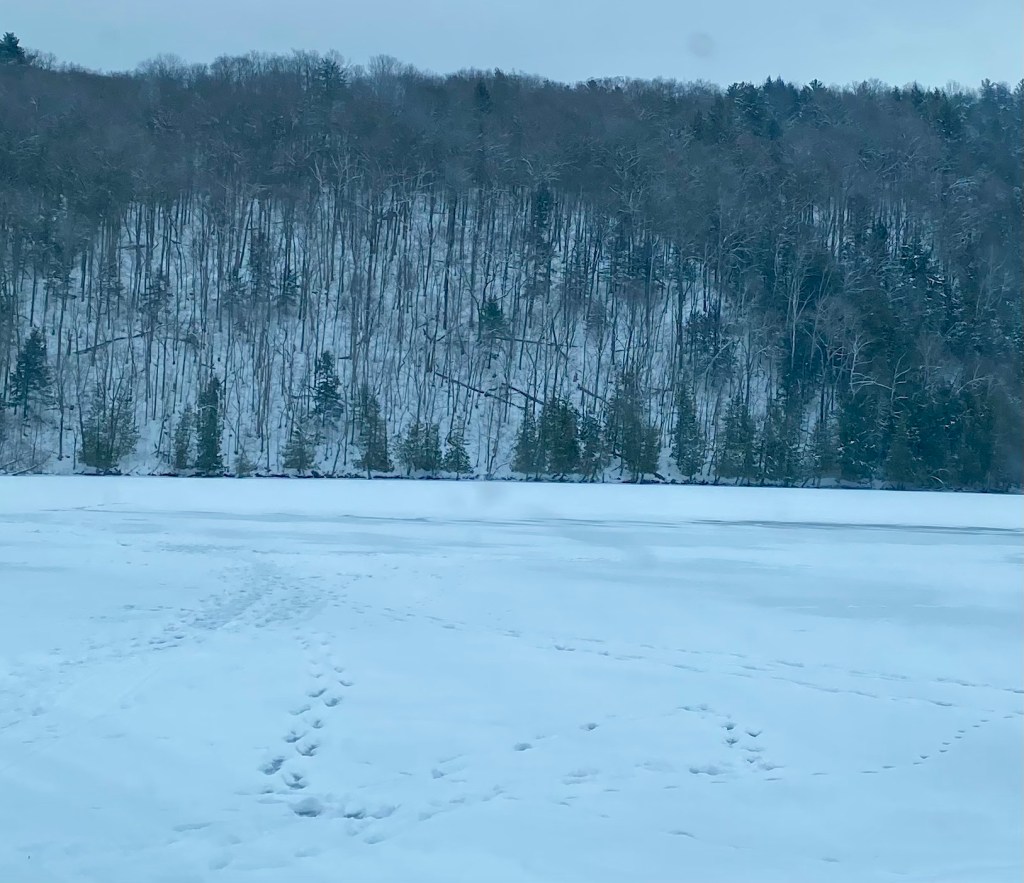
My daughter drives me to the high school where a few cars are parked, likely basketball players getting in a few extra workouts. We walk for a slow bit on the sidewalk and then drive north, up along the Black River towards Eligo Lake. At the boat launch, she turns off. We sit. Someone’s been out on the ice.

We are in the in-between season, neither Christmas nor New Year’s, 2024 finally spun down to nearly nothing, a whole new year, beginning with that wintry January looming large.

I am in the in-between season, too. Were it not for antibiotics and chemo, I would have passed from this world, or surely be heading that way. I am in the holding season, enduring, enduring, the chemo (and I’ll admit how terrifying chemo is, crimson red, fluorescent orange) destroying the lymphoma, draining my strength — and yet I’m still me, mellowed in many ways, stripped of patience with foolishness in other ways.

The December this daughter was two, snow fell every day. In January, the snow kept falling. The garden fence, the sugarhouse, the driveway and road, vanished in windswept white. This was before the age of internet. I stirred batch after batch of homemade play-doh. She had a doll stroller with a striped seat and pushed her babies around the house. Outside, I pulled her on a sled though the woods We looked for tracks, caught perfect snowflakes on our mittens. That winter seemed eternal, too, but it was not.

In the cancer world, or not, we’re always in the in-between season, life ebbing and rising, children growing, the snow pillowy but for a moment before settling to ice, washing away in rain.

Everything Is Made Of Labor
Farnaz Fatemi

The inchworm’s trajectory:
pulse of impulse. The worm
is tender. It won’t live
long. Its green glows.
It found a place to go.
Arrange us with meaning,
the words plead. Find the thread
through the dark.

Meeting the Red Devil.

In my foolish pre-cancer days, I pretty much covered up my ears when I heard about someone’s chemo treatment. That said, I’m not a complete jerk; my heart twinged, especially for parents of young children, and I offered sympathy, meals, a compassionate ear. But in some profoundly hidden place in my thinking, I tried to pretend that my garden squash and chard and those miles of walking would inoculate me. More likely, I was too cowardly to consider a possibility that hadn’t arrived.

This morning, I texted an acquaintance, I’ve now met the Red Devil, too. Looking forward to a long conversation over coffee this spring about your experience.

Yesterday, morning sunlight filled this Dartmouth-Hitchcock infusion room. Nuthatches and chickadees and juncos flitted around birdfeeders. Two wooden reindeer were linked by a red ribbon.

Without a port, the poison/healing infusion flowed into my vein. Remembering clearly my breathless and rigors! reaction to the rituximab, I burbled my fears to the nurse, who sought consult. She told me she only had good experiences with patients; I assured her I am a striving A+ patient. Then she worked her mojo and set up some black case that was never opened, assured me the nurses’ station was actually all of five feet where I was sitting, and then, drip, drip, drip, she released the poison that presumably will save my life into my vein. She stood talking to me and my daughter about the merits of studded snow tires and a recipe for gingerbread cookies, and then showed me that I was twenty minutes along with the rituximab. All was well.

Here’s the thing: there is no ease or comfort in this cancerland. The nurse is gowned and double-gloved to protect herself against these chemicals. I’ve read my chart thoroughly and know that innocuous word complications could rapidly spin my life into a dire Shackleton sea. And yet, in the warm rare-in-December sunlight, with my daughter and her stack of Christmas cards, my knitting, a novel I’d plucked from my shelf that I’d wanted to read, those downy birds flickering — a calm outside time’s relentlessness.

As for the Red Devil (the crimson of young Lucy’s magic potion in the Narnia books), the nurse injected a long fat vial into my arm. During this, she had me eat sherbet, pressing the icy substance against the roof of my mouth as the Red Devil would seek the tender places in my body and could erupt mouth sores. My daughter held the cup as I dug into the frozen substance. The nurse pushed the liquid slowly into arm, careful, careful not to burst the vein. The infusion would burn and destroy my arm, one of the nightmarish complications which would plague me for months, maybe years, to come. At the end, this confident nurse set down the empty vial and breathed deeply.

I thanked this woman for her steady hands.

Much later, 90 miles north by interstate and state roads, my daughter and her partner hold my hands as we walk up the path into my house. If I stumbled, I imagined them holding me between the two of them.

On the doorstep, my potter friend left a package with handmade yellow candles and a flower candle holder and a mug glazed the blue hues of the midsummer sky. So many happy days my kids spent in her studio — Mud Club, Clay Camp — and the cups of tea we’ve shared as mothers and crafters. A gift of light.

Losing hair, blue dawn, foreign objects in flesh.

Before dawn, brushing my hair I sing On the road again, just can’t wait to get on the road again, that old Willy Nelson song my mother loved. In the kitchen, making coffee, my daughter calls, Wait? You know that song? We played it everyday on our road trip last summer.

A thing to savor in this cancer: how my daughters and I discover these tiny things about each other.

My youngest cut the snarls from my hair that lingered from that hospital stay, when I couldn’t raise my arm to brush my long hair. Now, hanks of my hair slip out in my brush.

Outside, I stand for a moment, the waning moon hung over the neighbors’ roof, the emerging dawn a river-stone blue. A thaw’s set in, and the air is redolent with melting snow, a hint of loosening compost and soil. Raindrops hang from the three apple trees I planted.

We drive through the village, the coffee shop lit up where I’ve spent so many hours writing and talking, a young woman sweeping at the door. Colored lights string through the trees and over store windows. Out of town, day warms over farm fields and forests.

At the hospital, blood’s drawn for my chemo course this week. In my rudimentary cancer thinking, while doing the darnedest I can to forget about the orange fluids that will enter my body, I reckon that this week’s treatment means one third of the way through. If I can endure a third, I can endure half. If I can endure half, I can persevere to the finish. Talking with my daughter about December monochrome, I silently counsel myself to knock off my silly math. I’ve factored in no variables, and the variables are inviolate.

Before we leave, the nurse shows me a model of a port that may or may not be inserted in my chest. I hold the pad for needles, finger the plastic tube as she explains how it will lie under my chest. At the end, in the shape of a calla lily, is the opening that will drip the chemo beside my heart. The whole apparatus seems enormous to me, that plastic calla lily wider than my small finger. I hand it back to her. In the end, with the Good Doctor, how much of this will be my decision, and how much will be wisest course forward? In this age of truth/untruth, facts are powerful. I thank her, and we leave.

It’s a pleasure to be outside again, on this tiny road trip, my daughter at the wheel, drinking coffee. The fields and mountains and sky are layered quilt batting: blue and pearl and silver. Around the trees, rain’s pushed the snow away from the trunks, opening the earth again.

From Lauren Markham’s A Map of Future Ruins:

We don’t live steadily toward epiphany; our truest stories move back and forth in time, in space, in memory. Life is a mosaic, not a line.

A smidgen of writing.

The clocks cease meaning for me. To gird myself for an appointment, a call, I set an alarm, ask a daughter for a reminder. Counting backwards proves stupidly difficult: what hour to we need to leave? Write this on a sticky, please.

The flip side: I wake early one morning, kibble the cats, open my notebook and begin writing the pieces of this book I’m rewriting in my head. Daunted, I copy my draft into a folder. Someday whole sections might become another book, an essay, trash. Weeks before I heard the cancer diagnosis, I took a class with the remarkable Lauren Markham. All these weeks, these endless hours sleeping and half-dreaming, reading hungrily, much of this solitary but never lonely, much surrounded by skilled strangers who spill snippets of their own remarkable lives in the wee hours of the night, syringe in hand.

Now, aided perhaps by exhaustion, I envision the skeleton of this revised book, the joints that hold these stories together, beginning in a moldy basement, rising to a glass complex, surely, the endless firmament.

Neuropathy comes and goes, reappears in my fingertips. The knobby bones of my wrists and knees expand beyond my dwindling muscle mass. The prednisone prescription reappears for five chemo days, beginning next week. I try not to think of that, of the force these mighty drugs will weld over my body, how I will yield, pray for their power, try to keep to my feet at least marginally, moving my body, keeping in the everyday realm.

Like anyone, I’ve hard used this woman’s body I’ve been gifted, through pregnancies and nursing, decades of sugaring and the countless cords of firewood I lifted and burned each year, churning ice cream to sell with a baby on my back, fourteen years of peddling syrup spring to snowy autumn at farmers markets. The bleeding fissures on my fingers from washing wool filters. But so much pleasure, too, the ineffable joy of cuddling a daughter in my lap, of mountain climbing, intimacy, of lying on the dewy grass under the creamy rising moon. Women my age often complain about the indignity of hot flashes, but the real indignity for me has always been when the flush of my changing body courses through me in a male-centered meeting in my difficult work of budgeting for a town.

A rambly post here….. a variation of my inside-out world where the former rules are revealed as trite. Patience, patience. An hour of work. Half a cup of tea. Another half hour. December sunlight.