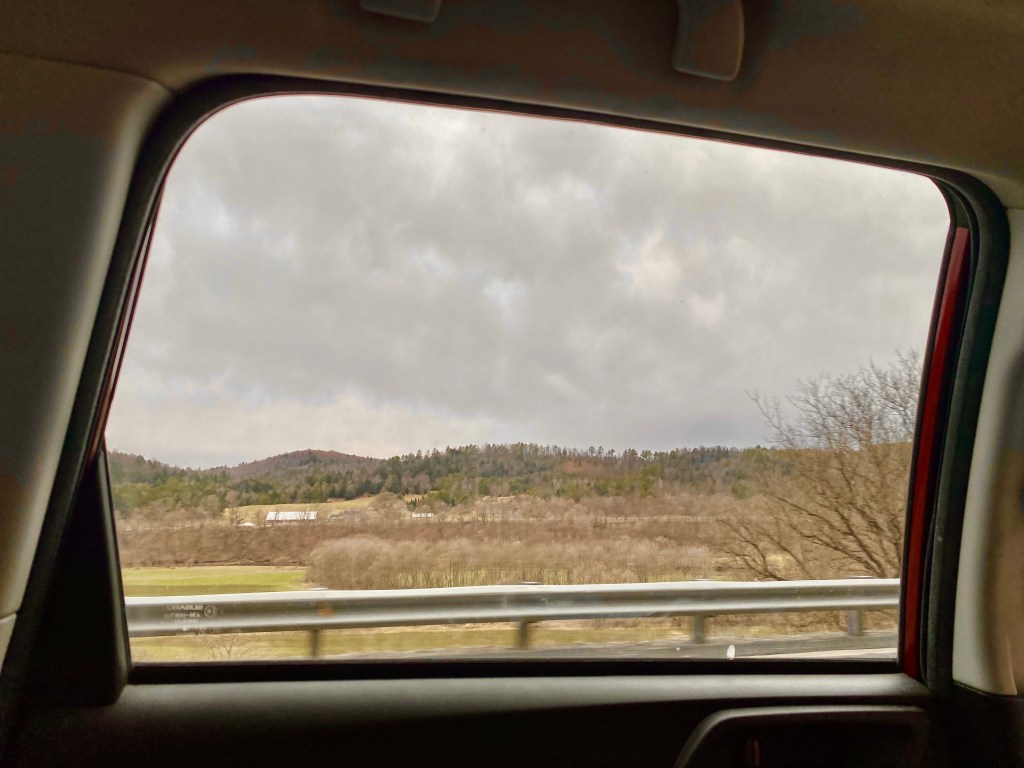
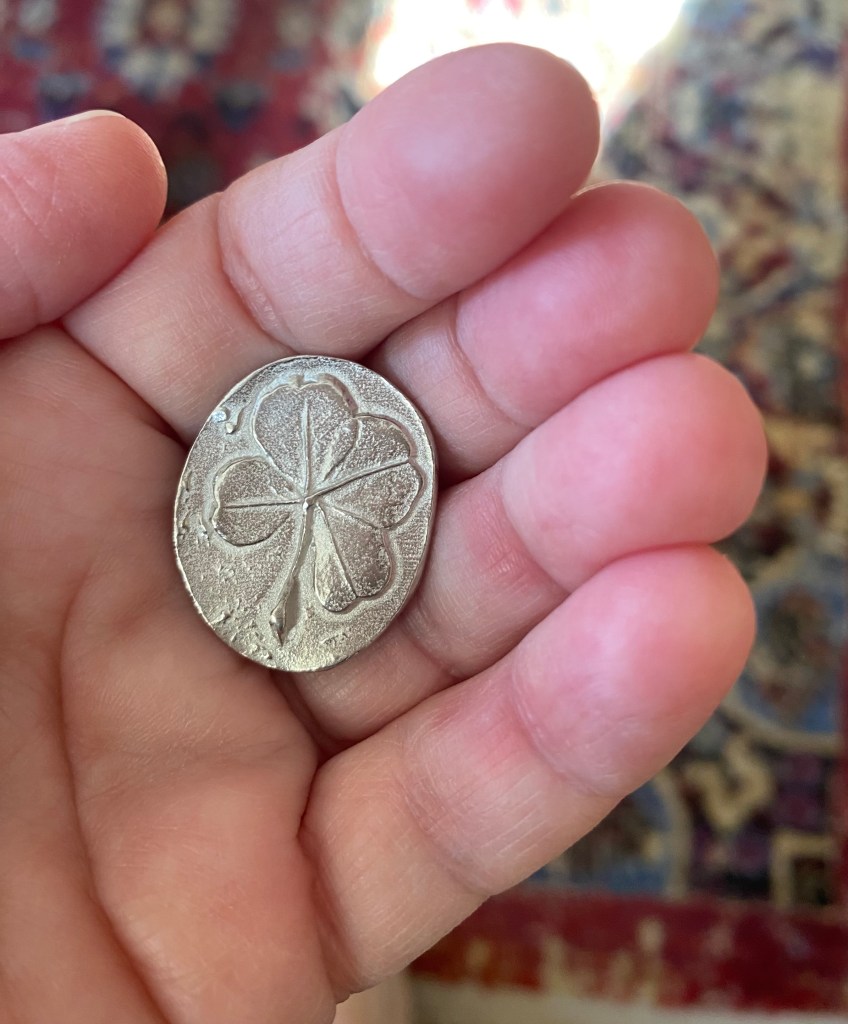
And another turn in the plot…

My body falls apart again, and my daughter drives me to Dartmouth. “My car only goes to this ER,” she tells me when I hint at negotiating a closer ER. She asks her blunt and even-toned questions, “What are you afraid of?”

Among other things, I’m afraid of waiting, in pain, which is what happens, and I survive that, of course. The hours in the ER waiting room introduce us to an intimate slice of others’ lives. The man who drove a screwdriver into his hand and didn’t seek antibiotics (not a good choice), another who crammed his hand between his two fighting dogs (the hand lost), a woman with a damaged foot who phones her mother on speakerphone. Across the large room, listening, I wince at the painful distance in that relationship.

Eventually, I’m given a bed in what’s labeled Hall 3. Shift change, a kind nurse hustles to give me meds. In the hallway, we are yet in the swirling mix of others’ lives. A hall mate (not a roommate) who I never see but who’s recently widowed; his companion struggles to figure out his meds. Later, my daughter steps outside and sees a prisoner who’s a patient run through the parking lot, high drama. She leaves after midnight. “Drive safely,” I say, “text me when you’re home.”

In the night, the surgeons stop in, and again the next morning, when the surgeons and the Good Doctor my oncologist meet in my room. Like a rushing train, surgery is coming rapidly and unavoidably towards me. Much as I’d rather not, really rather not, I begin to accept this. I think: get my tools together to survive this. Print out my manuscript, collect books and a knitting project. In all these countless hours in varying hospital rooms and hallways, I’ve never been bored. Frustrated and weeping, laughing and curious, but never dull. Another thing to be grateful for.

I’d rather not, but here’s another bend in my story, as with my hall mate and waiting room companions…

The crying moments…

I’ve written frequently in this space about living with cancer and cancer treatment since I was diagnosed with lymphoma last November. From the beginning, I was determined to hold myself together. Some of this was simply shock; I could not believe I had been walking around, working, going to birthday parties, hanging with family and my friends while cancer was devouring my body. By the time I ended up in the ER, telling the triage nurse I was circling the drain, the cancer had metastasized to stage four. I needed a moment. I was not about to get a moment.

In the long hours of yet another ER visit, my daughter told me that a longtime friend had asked her last November if I actually intended to undergo chemotherapy. I hadn’t heard about this inquiry, and the question stunned me. I’ve been my daughters’ sole parent for a decade now; even in the worst of these cancer nights and days, I remain foremost a mother, unable to relinquish my watchful eye. After diagnosis, it was immediately clear that the cancer was rapidly growing; without some kind of treatment I would die that winter. The lymphoma I have responds well to chemo. My other option, perhaps, was to seek an alternative treatment — where, for how much, and with what likelihood of success — was dubious at best. In my fifties, I was determined to live. My oncologist was clear that the chemo would shove me to the edge of demise. He told me, You are curable. So, in a rare action of trust, I stretched out my arms and said, Infuse me.

As the cancer was so advanced, I suffered numerous complications from the chemo, which resulted in all the hospital stays I’ve referred to in this blog — nearly a dozen — weeks and and weeks and weeks this winter.

Now, April, Easter rising tomorrow, I’m drinking a friend’s homegrown chamomile tea this morning at my kitchen table, watching the small rain feed spring’s green, alive, in remission.

From the get-go, too, I determined not to burrow into the rathole of despair that I’ve seen disease wreck upon individuals and spread to families. This recent ER visit, however, forced me to the crying day. I wept before the kind nurses, the warm hematologist with her sparkly hair, the PA who insisted I not leave even as I connived deals and plans for discharge. I did not cry before the elder hematologist, who had certainly been practicing medicine for most of my life. I said, yes, yes, I understand. And then I wiped my tears with my thumb when he left.

By the late hour when my daughter had left, and I was alone again in the darkened ER room, I’d taken stock of what I’d crammed in my backpack: two books, my laptop and charger, a handful of underwear, my notebook. I’d forgotten my knitting, which was unfortunate. The nightshift nurse brought me water and those eternal saltines. She was a traveler and had last worked in Iowa.

Much later the next night, two nurses wheeled me through the dim and empty hospital halls to another room. Of all the experiences I’ve had at Dartmouth-Hitchcock, I’ve oddly enjoyed these late night journeys through this huge building. So many stories here, so much living and dying, so much richness. By then, I’d finished with my weeping, joined the world again, all of us, doing what we’re doing.

A driving spring rain
gliding, wending through the trees
speaks in little drops

~ Bashō

Determined to do/the only thing you could do…

When I was six, I dropped a large wooden board on my toe, right where the nail emerges. My mother lifted me up and soaked my foot in the bathroom sink in Epsom salts. I cried fiercely, and my mother said she wished she could take the pain from me. Impossible, of course. Later, I lost the toenail.

The night before my last chemo infusion, I woke thinking of my mother who died nearly a year ago. She never knew I had cancer. Of all my family, only my mother endured chemotherapy, at age 80. Like so many mothers and daughters, we had a tangled and complicated relationship, sometimes fierce, sometimes outright silly and joyous. Not knowing about my cancer was one thing she was spared in her life, at least. No one seeks cancer, but in this long and snowy winter, I was spared the misfortune of being a parent of a sick child. Anything can change in this world, at any moment, but for now….

Recently finished with chemo treatments, how grateful I am to Dartmouth and its staff for their exquisite care. How humbled and thankful I am for the people who wrapped around me – some of whom I’d never met before. To write that cancer changed my life would sound trite. The deeper truth is that this disease will be with me for the remaining days of my life. But my life is in the present tense. I have not changed. I am changing. How blessed I am to be here.

… little by little…
the stars began to burn
through the sheets of clouds,
and there was a new voice
which you slowly
recognized as your own,
that kept you company
as you strode deeper and deeper
into the world,
determined to do
the only thing you could do —
determined to save
the only life you could save.

~ Mary Oliver

An umbrella walks past…

File this week under “the best-laid plans of mice and men go oft astray,” or, just because I desire something has no factual bearing on reality. (Is there a message for national politics here?)

My sixth and infusion has been delayed, as I’m admitted, again, at Dartmouth-Hitchcock. Two days before that scheduled infusion, I woke around 11 at night and phoned my older daughter who was just getting into bed. I said, “You’ll have to take me back to Dartmouth again.”

In a thick fog, she drove my mother’s blue Subaru down the interstate along the wide river, with sparse traffic and scant words from me. In the ER, late, late, we’re taken into a room, and the usual questions and IV and meds began. The nurse remembered me from my previous visits. In a rocking glider, my daughter slept a bit while I wondered at the light’s hue: amber, or tinged with orange, like heating lamp mixed with a gentle reading light.

Eventually, awake for over 24 hours, my daughter heads home to sleep. My oncologist appears and reassures me. “You’re getting there. A few days later, but getting there.” Our conversation drifts into where I’m heading in this new phase of disease – recovery, oh say that word again, recovery. What will this mean for me, and how will my life change? We talk a little about trust, and he mentions that, once trust is broken, it’s nearly impossible to mend that damage, a fine thing ruined.

So here I am, in yet another bend of this journey, learning patience, learning something more along the tenor of faith, that whatever is not within my sphere of influence is not mine to alter, such as these days here.

April. My younger daughter brings me blooming hyacinths and bulbs in a glass vase. The doctors talk with me about Donna Tartt’s The Goldfinch, and if the federal funding for Vermont’s interlibrary loan system is jeopardized. I tug at the strings of normalcy coming my way: a nurse’s trip to Des Moines a few springs ago and the city’s tulip beds; a friend’s email about dropping a car at airport for her husband; another friend reads Mary Oliver and sends me recordings; will my cat sitter eat whatever I’ve left in the fridge? Small things that stitch our lives together.

Spring rain:

telling stories,

a straw coat and umbrella walk past

~ Yosa Buson

A cup of tea, surrounded by ice, broken boards.

In the pale blue dawn, I wake with the taste of wild mushrooms in my mouth. In my dream, I’m eating tender stems from a soft paper bag. In the non-dreaming chemo world, I’m temporarily forbidden from dining on fresh anything from the produce world, but in this nubbly dream I munch on, relishing the residual taste of dirt, the forest itself.

I open my eyes. Day 4 – oh, I am counting these 21 days until the sixth of these six chemo sessions – Day 4, and through my window, geese wing across the sky. These past few days, spring blew in, fierce sun. On my back deck, broken by ice, a friend stopped by yesterday. I made tea, and we talked about this and that, kids and disease and politics, when we might plant spring peas. On my desk waits a cardboard box of wildflower seeds, a gift for this summer.

Spring is radiant light and also brokenness. The ash buckets trailing coals, the deck joists smashed by the roof’s ice, the barn still desperately in need of paint. Me, too, broken, with my few hours of clarity in the mornings, the stumbling way I’m heading towards this final treatment. Around me, too, the remains of this winter: people who have helped me more than I could have imagined, others who have distanced themselves, the disease itself, perhaps, too much, the leer of mortality a shivering thing. All that is neither here nor there. The cancer has stolen a share of my vitality, my economic steadiness, a winter of my life. And yet, all these pinwheeling days and nights as I’ve traversed this tunnel – what an infinitely rich journey, one I never would have booked a ticket to join.

My daughter sends word of singing redwing blackbirds. Spring, mightier than winter’s brawn. The season of planning, putting things back together, rearranging and cleaning, of tipping our eyes up to the sun, relishing the light.

…. Ariel Gore repeatedly quotes Audre Lorde’s The Cancer Journals in her Rehearsals for Dying. In these lines, I was reminded how we each respond to crisis in others’ lives, too, from the soil of our lives.

Each woman responds to the crisis that breast cancer brings to her life out of a whole pattern, which is the design of who she is and how her life has been lived.

After an absence, return.

Photo by Molly S.

A long while away from this space after a day last week that began easily enough in our kitchen with my daughter and transpired into another Dartmouth ER visit and a prolonged stay. Days and nights chopped into mosaic pieces. MDs and RNs, the revolving cast of the Dartmouth surgical team, my daughters, pain meds, ice chips, me sitting up and begging for a patch-up to get me to my next chemo appointment… Get me out of this chronic patient repeat.

Now, five of the six chemo treatments completed, I am in the final haul. While my in-box filled up (thank you for your patience), and I was moved from room to room by kind people, I kept thinking of this cancer in a narrative arc. I had hit the section of story where the impossible commences. Before, things looked grim. But now, as protagonist in my own story, the arc swerves sharply, the longed-for light-at-the-end of the tunnel snuffs out, the path is hidden.

I’m not a writer for naught, for make-believe or play. I’m a writer because I know our lives tread meaningful albeit sometimes horribly hard paths. Lean in, I counseled myself, my shoulders far skinnier now but just as fierce. Use math. Get to the fifth infusion. Get to the sixth. Count down the finite days to the end of this treatment, which is, thankfully, eradicating the cancer. In the mosaic: my two daughters, the plastic IV tubing, the doctors in their masks, the ER nurse who stayed long past his shift in the middle of the night, holding my hand and assuring me that, yes, indeed, I would endure.

This is my story, but also the human story, in all our infinite variations of human desire, choice, the immutability of fate.

Sunny morning in our kitchen, birdsong, the fierce thrust towards spring.