Trainwreck.

On the year anniversary of beginning chemotherapy, childishly I crab at my siblings. It’s a small thing—a bad internet connection, a request to make a phone call that might have taken 10 minutes—and I’m angry as all get-out, fury galloping in my blood. The common lingo is that chemo equals nausea, like a bad flu. That is not true, or was not true for me. Enduring chemo was like lying between two burning rails while a train sped over me. I held myself still as could be to survive that months-and-months-long train (how could something be so large?) rattling over me. Sure, there’s a few moments where the train slows, and you think maybe I’ll survive this, but steaming metal rushes right over your face, your mortality far closer than spitting distance. While the rest of the world is immersed in meetings or drinking wine in Spain or skiing, there you cringe, the pain so intense in your bone marrow that morphine means nothing.

In the first round, I had a common and horrific reaction to one of the drugs, rituximab, which stole my breath and shook my bones so hard the bed rattled. The room filled with people in scrubs. I did not know one person’s name. They kept talking to me, and I could not understand a single word. I was under that train, remember, the wheels hammering on tracks.

I never considered myself a warrior battling cancer. But my body was a war zone between two matched enemies: would the chemo quell the lymphoma, or would all of us go down together? A year later, in remission, I’m suffused with gratitude for my life, for so many people who got the train off me. And yet, a year later, there are days I’m still turning the pieces of my life over and over, wondering WTF? Like anyone, jab a shovel into the soil of my life, and the layers appear infinite. Twenty-two years ago, I left my crying four-year-old (“I want to come!”) behind and drove to the airport with my brother in my sister’s time of need. I had left in such a rush that I’d forgotten my driver’s license. It was not long after 9/11, and I had to cry to get on the plane without ID, but I finangled it. Coming home, we hit a snowstorm. My friend and her four-year-old drove over the White Mountains in a white-out to bring me home. At the crest of Franconia Notch, she pulled over. I got out to clean snow from the windshield and lights. No one else was on the road. Snow billowed through a freezing wind. I looked through the window at her son in his carseat between us. I had bought him a little toy, a hexagon of blue fluid with a yellow fish, and he was turning it around and around in his hand, so the fish would swim. It seemed like we were the last three souls on the planet. Such a long and treacherous way home to my little daughter and her twiggy braids. But my friend drove carefully in her red pickup. That story shook out into all’s-well, something that needs no bow-tie of a moral. Simply, all were saved. Our lives went on.

So many pieces of a life. On this Thanksgiving morning, how grateful I am to remain yet here, disease-and-treatment battered, broken by fate and my own rough actions. The terrain of the living.

… And last, I’m honored to have been nominated for a Pushcart Prize (a secret dream of mine) by Under the Sun for my essay “Weeds.”

Crazy-Making.

Yesterday, my oldest and I made that drive again down I-91 that flanks that Connecticut River. My knitting in my lap, I counted exits, St. Johnsbury first exit, then the second, the third that heads east to New Hampshire’s White Mountains, the fourth Barnet, which I took when I stayed at Karmê Chöling. We talked about fall colors and a meatball recipe and family, of course, all the way down to exit 13, the Norwich and Hanover exit, where we stopped for coffee and scones, as if a good luck charm. Coffee and sweets, not a dash to ER. We watched the time, careful not to be late for what I hoped would be a mere routine check-in.

All summer this day has hovered in my mind — what will this day reveal? — but this past week this coming journey was as near to me as something I held in my hand as I went about my days, doing what needs to be done. The day before, talking with friends, the fear of this day erupts and I hear myself on the verge of screeching, nearly crying. All summer, I’ve relished my good life, learning to walk again and eat again, to read on my back porch in that hand-me-down butterfly chair. To marvel that I am not in pain. That I might sleep and reasonably expect I might wake in the morning exactly as I want, in the pre-dawn darkness drink milky coffee and write. That I will witness the unexpected autumn buds on a yellow rose bush open, these final velvety blossoms of the season.

At Dartmouth, we wait again in 3K, in the cancer center. I am no longer one of the pallid-gray-faced chemo patients, hobbling, enduring. How desperately I never want to return here. My oncologist gently reminds me that he’d assured me I’d pull through this winter, even as I was admitted again and again and again, a dozen times. Add to that, more ER visits.

Later, a friend asks about the scan’s sign-off, but the only rules that matter are what the hidden mysteries of my blood and flesh reveal. The markers are that the lymphoma has not returned. I know that the reaper’s scythe heads towards me as that inarguable blade poises over each of us. But not this day for me. Not yet.

Driving home, people crowd the interstate bridges with RESIST signs. As our car sails beneath the metal and steel, we wave. I’d told the oncologist that my wellness plan was four-fold: eat real food, walk, do my work, and try not to go crazy.

He said, This is crazy-making. Just do your best.

There is only one heart in my body, have mercy
on me…

Thank You for letting me live for a little as one of the
sane; thank You for letting me know what this is
like. Thank You for letting me look at your frightening
blue sky without fear, and your terrible world without
terror, and your loveless psychotic and hopelessly
lost
with this love

~ Franz Wright

“Everything blooming bows down in the rain…”

We make the trek again to Dartmouth for a surgical consult, the sign-off after surgery. I’ve met numerous members of this team, but not this kind NP, who’s read my history and says, What an ordeal. I’m not expecting these words, and I pause. Last November, when was I first admitted to Dartmouth, I had unplanned surgery. That snowy November night, the surgeon spent so much time with me. Then her Fellow returned and answered my endless questions. In May, I had surgery again. Two bookends – that November night and this sultry summer day. I’ll be treated here for years, but my hope – and none of know squat about the future – is that I’ll never need a surgeon again.

I thank her and the surgical team and student entourage who appeared in all those ER and hospital floor rooms where I stayed – me, the reluctant patient, who tried to negotiate some other outcome than surgery. To my surprise, she’s grateful for my words, too. We try our best but it’s hard to know how we come across to patients. The surgeons who operated on me are trauma surgeons. My surgery was routine, but routine surgeries go south. Mine did not.

Afterwards, my daughter and I stop at Dartmouth College’s Hood Museum. There’s a Georgia O’Keefe painting we want to see and two Monets. The current exhibit has mesmerizing photographs. This is a good day and a good visit. We eat sandwiches in King Arthur Flour’s patio, where so many families have pudgy babies tucked into a parent’s arm. We linger, talking about my mother who would have loved eating here.

So many of those drives on the interstate home, I slept, nodding in and out of conversation. My weak days are long passed, and we keep talking, the interstate edging near the Connecticut River and up on the ridge again. In June’s green, the drive no longer seems so desolate. Traffic here is always sparse. We pass a trailer of hay bales, a pickup with three wheelbarrows.

Enduring cancer turned my world (and my family’s world) inside out. In the first five-day continuous course of chemo, I forced myself to wash every morning. In those days, my hair had not yet fallen out. I was too weak to brush my hair, so I tied it at the nape of my neck. That month, my daughter cut what snarled hair remained. Those miserable uncertain November mornings, how grateful I was for hot water and soap, to have access to a brutal but hugely effective treatment, in a sterile hospital in one of the richest states in a phenomenally country. I made my choices, but I had choices.

In the inside-out world where I am now, I’m ticking through my list: profusely thank my oncologists and surgeons for saving my sometimes-surly life, tend my garden, figure out my youngest’s college bill, finish my book, accept the ravenous roaming woodchucks….. my domestic realm.

In our little end-of-the-road neighborhood, visitors come and go on my back deck, gardens on three sides, the wild pressing in on the fourth. My own nexus.

Everything blooming bows down in the rain:

white irises, red peonies; and the poppies

with their black and secret centers

lie shattered on the lawn.

~ Jane Kenyon

Seeking the Something New.

A friend arrives with a box of seedlings, including tithonia, AKA Mexican sunflowers, a tall, brilliantly orange, hopeful plant. A few mornings later, more friends appear with seedlings and a pitchfork. Lucky, lucky me.

I am a gardener who allows the Johnny-jump-ups and forget-me-nots to spread where they like, pulling back a few and nestling in basil, scallions, poppies. Why unroot a flower? Eventually, I weed diligently, ruthlessly. The garden mirrors my approach to novel writing. My friends leave with their boxes filled with forget-me-nots as a gentle rain falls on the tender seedlings.

Every day is a further day from surgery and chemo, the days and night accumulating like pages read in a book. I put away the narcotics, the Tylenol, the ibuprofen. Mornings, I drink a single cup of café au lait. I sauté mushrooms, bake a quiche. I ask for a ride to drop off my car at the garage, worrying about walking up my hill, but picking it up is mostly downhill. I walk.

For a little bit yet, I’m a person of interest in this small town. The postmistress asks me, no, really, how are you? For months, the PO staff has stuffed my box with cards and books and sheaves of medical bills from two hospitals. I’m there to pick up a book of essays (a gift which quickens my heartbeat). I tell her I’m in remission, that word still awkward as it emerges from my throat. I want to add that remission does not mean cured, does not mean that this strange and uninvited cancer beast has left my body – and certainly not my soul. I don’t know this woman at all well, but she looks steadily at me, as if she understands what I’m thinking.

Here’s the thing: how afraid I was of cancer eight months ago; honestly, I’m still fearful of it. Yet, cancer rooted in me, infested my family, my friends, a great wide circle of people around me, including my readers here. This is not unique. In its myriad forms, cancer spreads widely. I lived for years with the putrifying secrets of addiction. I refuse to repeat that with cancer.

Last November, I thought I wouldn’t live to see spring. I did. If jaywalking doesn’t do me in, cancer certainly might. Or I might die as a scrawny old woman from a stroke or heart attack. In this rainy late spring/early summer, I’m grateful for the possibly random dice throw, for plants and gardeners, for an infinitude of people. Among these are the people who’ve shared their stories with me, of decades-ago cancer diagnoses, almost always offered sotte voce, as if not to tempt the fates. Their stories ring clearly: I endured, I transformed, I thrived. This possibility can be mine (maybe yours, too).

From Suleika Jaoad’s The Book of Alchemy:

But there are also moments when our internal compasses tell us it’s time to change course–to leave something behind and build something new…. Rebuilding is not easy…. But to me, rebuilding unfolds alongside becoming. It is crucial, if we want to keep evolving and flourishing, to get rid of things that are no longer serving us and make space for something new to grow.

Under a Thousand Stars.

Walking home, I spy a smattering of white blossoms among a stand of pines, off the path. That short stretch is a strange area, more sand than soil, unusual on my Vermont hillside. Running theory is that someone stripped the top soil, years ago. Although I haven’t energy in excess, I’ve enough that I wander from the path. The blossoms are wild strawberries. Sweet mark of June.

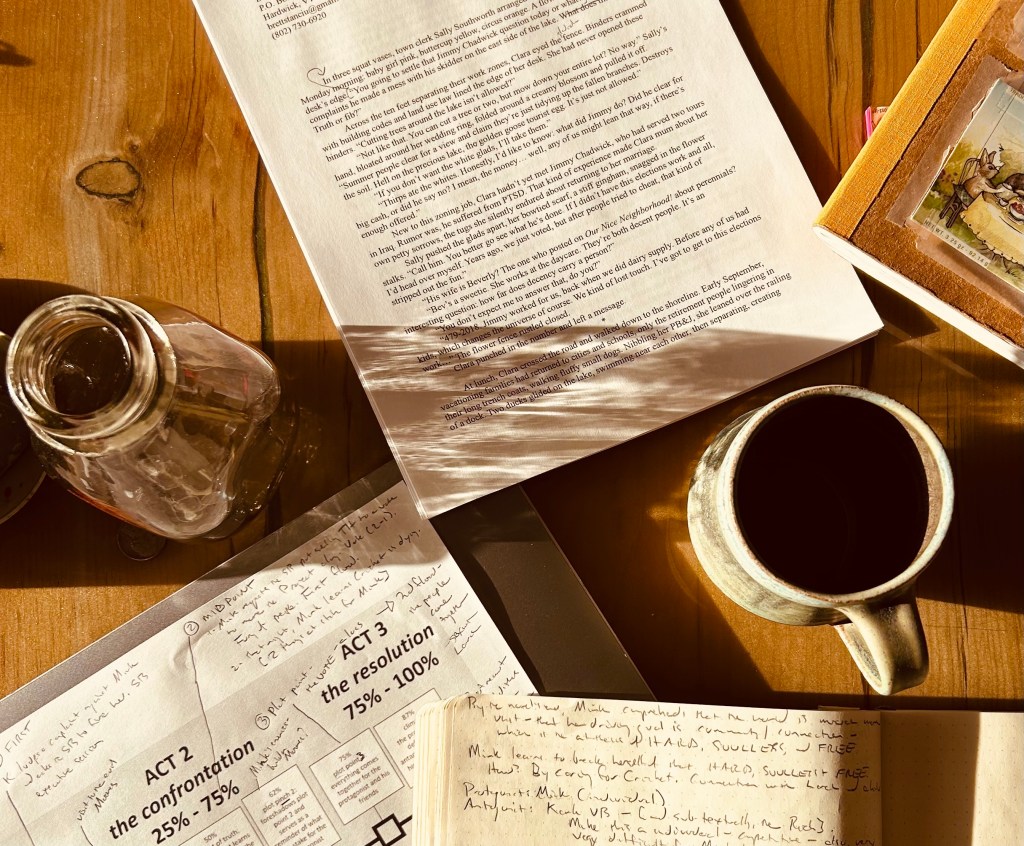
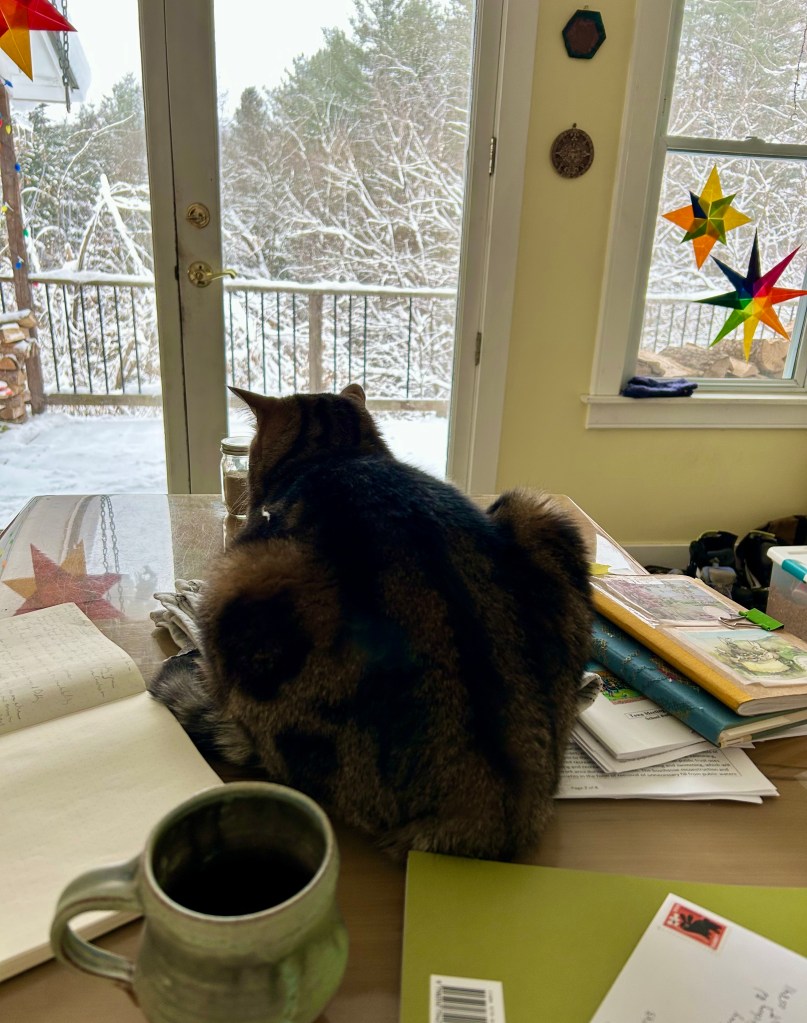
For those not in New England, the common gripe is the weather. Every weekend, rain. Figures are tossed that there’s not been a fully sunny weekend since December; then I hear November. As for me, recovering, the days and weeks merge. Now, three weeks out from surgery, I’m easing back into work. The cats wake me at early light. In recovery, my old worries rekindle, but so does my drive and curiosity. I get up, eat cereal and maple syrup, brew coffee. I spread the manuscript of my fourth book over the kitchen table, cut, rearrange, stitch.

What’s changed, though, is a new slowness, a willingness to let the course of things unfold, to crouch beside those strawberry blossoms, wondering which birds will snag the tiny crimson berries. In a few weeks, I may wander here and sample this sweet delicacy. Half of this May, I lived in a hospital. Finally, I limped out the door with my brother. While he drove me home, I kept saying, “I’m out, I’m out,” and “The trees are leafing, the forsythia is blooming, the lilacs are opening.”

That surgery and that stay might likely have saved my life, again; and again, how immeasurably capable and kind was the hospital staff. Nonetheless, it’s June. The sky this morning is scrimmed over with smoke from wildfires. Under that dome, I have work to do. A friend will visit. I’ll move through this day, this Wednesday, happy.

I want to lie out

on my back under the thousand stars and think   

my way up among them, through them,   

and a little distance past them, and attain   

a moment of absolute ignorance,

if I can, if human mentality lets us.

I have always intended to live forever;

but not until now, to live now.

~ Galway Kinnell, “The Sekonk Woods”

And another turn in the plot…

My body falls apart again, and my daughter drives me to Dartmouth. “My car only goes to this ER,” she tells me when I hint at negotiating a closer ER. She asks her blunt and even-toned questions, “What are you afraid of?”

Among other things, I’m afraid of waiting, in pain, which is what happens, and I survive that, of course. The hours in the ER waiting room introduce us to an intimate slice of others’ lives. The man who drove a screwdriver into his hand and didn’t seek antibiotics (not a good choice), another who crammed his hand between his two fighting dogs (the hand lost), a woman with a damaged foot who phones her mother on speakerphone. Across the large room, listening, I wince at the painful distance in that relationship.

Eventually, I’m given a bed in what’s labeled Hall 3. Shift change, a kind nurse hustles to give me meds. In the hallway, we are yet in the swirling mix of others’ lives. A hall mate (not a roommate) who I never see but who’s recently widowed; his companion struggles to figure out his meds. Later, my daughter steps outside and sees a prisoner who’s a patient run through the parking lot, high drama. She leaves after midnight. “Drive safely,” I say, “text me when you’re home.”

In the night, the surgeons stop in, and again the next morning, when the surgeons and the Good Doctor my oncologist meet in my room. Like a rushing train, surgery is coming rapidly and unavoidably towards me. Much as I’d rather not, really rather not, I begin to accept this. I think: get my tools together to survive this. Print out my manuscript, collect books and a knitting project. In all these countless hours in varying hospital rooms and hallways, I’ve never been bored. Frustrated and weeping, laughing and curious, but never dull. Another thing to be grateful for.

I’d rather not, but here’s another bend in my story, as with my hall mate and waiting room companions…