July, Sweet and Sour.

I read in the New York Times that Catcher in the Rye turns 75, a novel my mother first shared with me. My parents owned little fiction; our house was mostly filled with philosophy books, David Hume (who I never read) and Plato and Aristotle. In those shelves was jammed a copy of Huckleberry Finn and Salinger’s Catcher in the Rye and Ten Stories, drug-store paperbacks held together with rubber bands. Books I love — and maybe you do, too.

In this lushly lingering month of July — filled with sun and swimming, with work and chores — I’m lucky to have scheduled a dozen readings for Call It Madness, this novel about Vermont and family and how the sodden past shapes our lives. Of all the books that reflects my life, Long Day’s Journey into Night surely ranks at the top. A reader pointed out to me recently that Call It Madness moves forward linearly, but is packed with the past, events that happened decades ago that remain as vibrant as this morning’s news.

I write in the world of cause and effect — our actions always propel consequences — but the past with its radiant joy and unquenchable sadness propels us mightily. Nonetheless, the pear trees previous owners planted in my front yard bear reddening fruit. The bees suck globe thistle. Sunday evening, I walk far along the river, the running water sunk low among exposed rocks. The sunlight lingers — so much light in these days sugary with freshly-mown hay. I’d like to pocket a handful of July and return in January: humans, we can launch ourselves to the moon but July-in-January is impossible. Nothing to do but quaff the present while it exists.

hydrangeas
pale blue in the rain
blue in the moonlight

By Masaoka Shiki | Translation by Lucien Stryk

The crying moments…

I’ve written frequently in this space about living with cancer and cancer treatment since I was diagnosed with lymphoma last November. From the beginning, I was determined to hold myself together. Some of this was simply shock; I could not believe I had been walking around, working, going to birthday parties, hanging with family and my friends while cancer was devouring my body. By the time I ended up in the ER, telling the triage nurse I was circling the drain, the cancer had metastasized to stage four. I needed a moment. I was not about to get a moment.

In the long hours of yet another ER visit, my daughter told me that a longtime friend had asked her last November if I actually intended to undergo chemotherapy. I hadn’t heard about this inquiry, and the question stunned me. I’ve been my daughters’ sole parent for a decade now; even in the worst of these cancer nights and days, I remain foremost a mother, unable to relinquish my watchful eye. After diagnosis, it was immediately clear that the cancer was rapidly growing; without some kind of treatment I would die that winter. The lymphoma I have responds well to chemo. My other option, perhaps, was to seek an alternative treatment — where, for how much, and with what likelihood of success — was dubious at best. In my fifties, I was determined to live. My oncologist was clear that the chemo would shove me to the edge of demise. He told me, You are curable. So, in a rare action of trust, I stretched out my arms and said, Infuse me.

As the cancer was so advanced, I suffered numerous complications from the chemo, which resulted in all the hospital stays I’ve referred to in this blog — nearly a dozen — weeks and and weeks and weeks this winter.

Now, April, Easter rising tomorrow, I’m drinking a friend’s homegrown chamomile tea this morning at my kitchen table, watching the small rain feed spring’s green, alive, in remission.

From the get-go, too, I determined not to burrow into the rathole of despair that I’ve seen disease wreck upon individuals and spread to families. This recent ER visit, however, forced me to the crying day. I wept before the kind nurses, the warm hematologist with her sparkly hair, the PA who insisted I not leave even as I connived deals and plans for discharge. I did not cry before the elder hematologist, who had certainly been practicing medicine for most of my life. I said, yes, yes, I understand. And then I wiped my tears with my thumb when he left.

By the late hour when my daughter had left, and I was alone again in the darkened ER room, I’d taken stock of what I’d crammed in my backpack: two books, my laptop and charger, a handful of underwear, my notebook. I’d forgotten my knitting, which was unfortunate. The nightshift nurse brought me water and those eternal saltines. She was a traveler and had last worked in Iowa.

Much later the next night, two nurses wheeled me through the dim and empty hospital halls to another room. Of all the experiences I’ve had at Dartmouth-Hitchcock, I’ve oddly enjoyed these late night journeys through this huge building. So many stories here, so much living and dying, so much richness. By then, I’d finished with my weeping, joined the world again, all of us, doing what we’re doing.

A driving spring rain
gliding, wending through the trees
speaks in little drops

~ Bashō
Household chores and world events.

The last day of 2023, I let the fire in my wood stove extinguish, and I take my stove apart. The stove has been spitting ash and spark through a damper, a chore I’m driven to by sheer necessity.

I unscrew the stovepipe and the back heat shield and plate, and carefully remove the two honeycomb metal filters that are choked with fine ash. It’s a messy job, and I’m a messy woman. My curious cat walks through the cinders and leaves dirty paw prints on my white enamel kitchen sink.

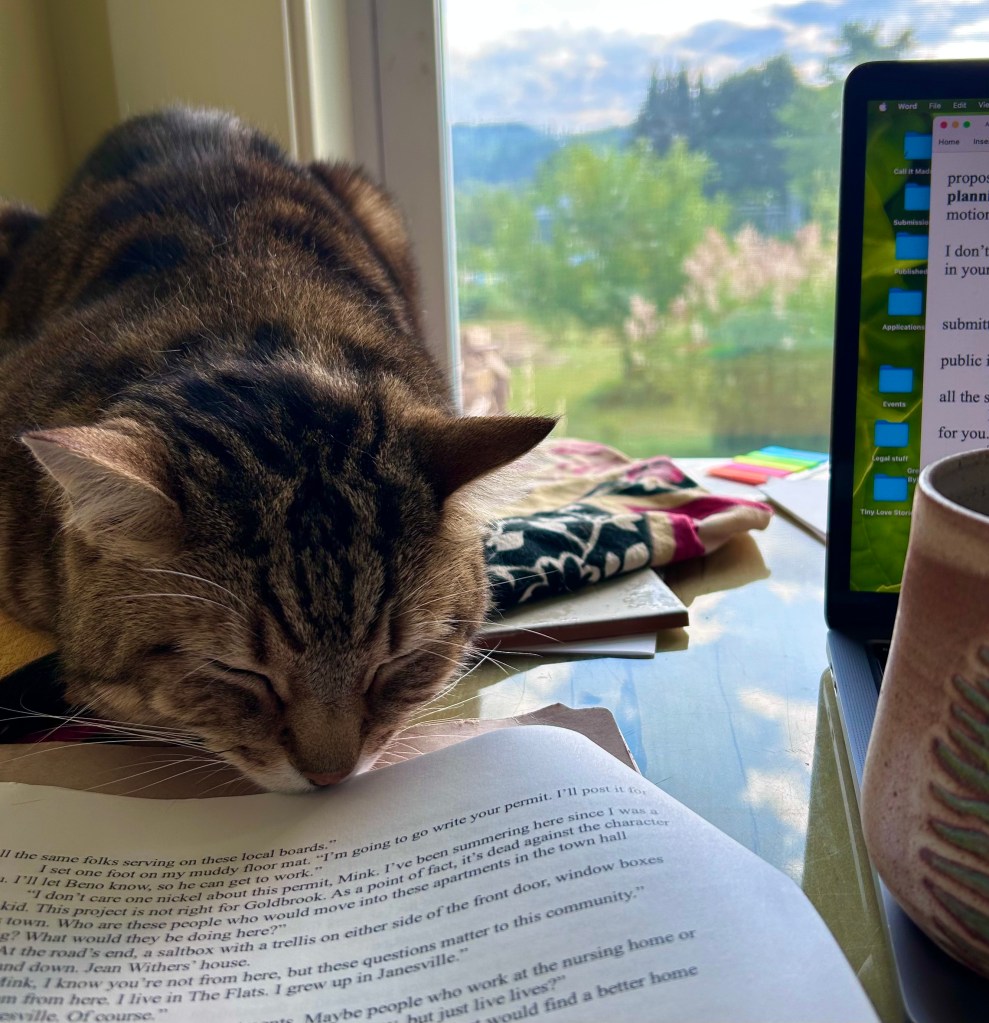
When I’ve put the stove together again, I find the driest kindling I can in my barn and build a small fire and slowly heat the stove again, kneeling before the glass where the flames ripple, listening to public radio hash over the year. I add wood, study the flames, murmur to my cat who is seriously invested in this warmth and the doubtless impending feline nap.

I’d once torn a photograph from a New Yorker issue and thumbtacked it near my desk of Marina Oswald, taken the morning after her husband Lee Harvey Oswald was arrested for assassinating President Kennedy. Her face twisted unhappily, she’s pinning cloth diapers on a line. So it goes: the necessity of domestic life as the great events of the world unfold.

My stove burns merrily. I bake spanakopita and invite a few dear ones who bring chocolate. This morning, January. A drift of snowflakes. The lean winter light.

The snow is melting
and the village is flooded
with children.

— Issa

The sound of wind.

Seems a little early, pre-solstice and all, to be citing winter haiku, but the thing is, winter haiku is just so darn good. In so many ways, winter brings out the New Englander in each of us, as we ramble on about previous winters (the year back in the mid-90s when antifreeze froze, or the year school was cancelled was for three days straight). Or how to survive with savviness: long quilted coat, chop wood, frying pan on the sheets. When a few strands of sun tumbled out of the clouds this afternoon, I dashed outside to fill my eyes with light. Hope the weather’s keeping you more interested than inconvenienced…..

Winter solitude—

In a world of one color

The sound of wind.

— Bashō

Round Earth.

Autumn reminds me the earth is a globe. The days shorten; dusk draws in earlier. The shadows hold a chill.

This year, purple asters spread prolifically — along roadsides, in the woods, in seemingly random sprigs around my house. The flowers flank the two pears in my front yard that someone planted years ago. One tree mightily growing, the other a persistent dwarf.

Autumn is the season of so it goes. What passed for summer this year is finished, the harvest wrapping up. In its own way, perhaps, the most poetic of all season.

Someone goes by wearing a hood
in his own darkness
not seeing the harvest moon

— Buson

Light Turning.

Walking into town, I pass a house that has been abandoned for the five years I’ve lived here. Last winter, a vehicle skidded off the road and smashed through the front window. Since then, plywood has covered the front.

There’s a few houses like this in that neighborhood, the paint gray, the windows filthy, tiny yards gone over to weeds or dirt. In the pandemic’s craze, people moved back into a few of these, converting abandoned places into homes again. The driver of a fuel truck stood outside this house yesterday with a young couple, the three of them talking seriously, nodding heads. Sheets of foam insulation leaned against the house. On the side wall, someone had ripped off the dirty plastic and exposed a large square window, its top edge red and blue stained glass. Without stopping, I wondered what else was inside the house.

End of January — and suddenly the sunlight returned in full force. Today may be cloudy, tomorrow, too, maybe for days to come, but the earth is tilting. Slow as spring is, we’re leaning that way.

Don’t say my hut has nothing to offer:

come and I will share with you

the cool breeze that fills my window.

— Ryōkan (trans. John Stevens)