Don’t confuse hunger with greed.

At breakfast, I mention to my daughter that June 6, today, is D-Day. I’ll write what perhaps she would not want me to write: that she’s standing at the counter making avocado toast and drinking yesterday’s cold coffee. She pours sriracha over the cut avocado. She’s 19, and, lord, a sheer miracle of youth, this gorgeous young woman.

I say, The soldiers were your age. Younger.

We stand staring at each other in our small kitchen of June sunlight. On our table lies a pile of unopened mail, our tabby cat Acer grooming his whiskers, car keys and lip balm, a hunting knife that could extract a man’s heart.

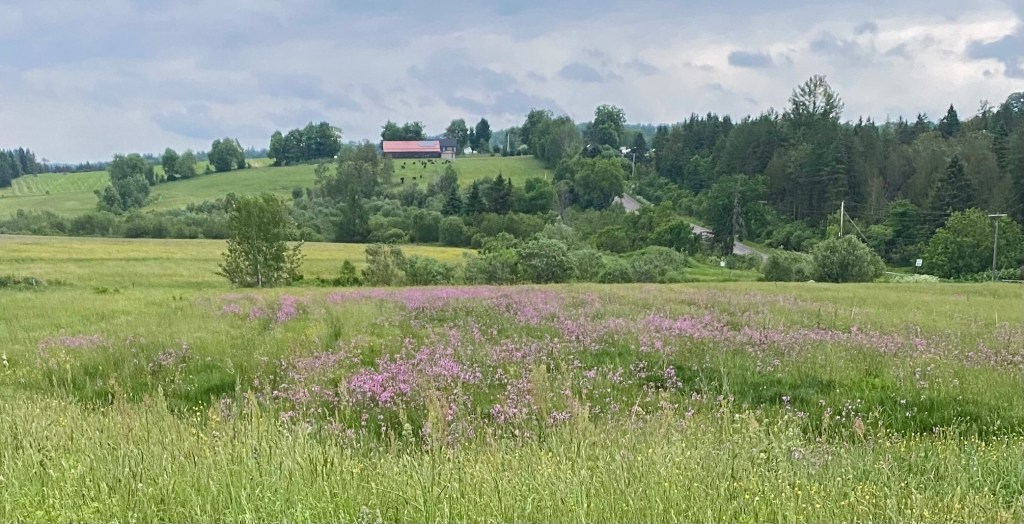
In the evening, I’m at the local arts center to see Nora Jacobson‘s documentary about poet Ruth Stone. The evening is still light when I drive home. I take the long way and pull over beside a field to admire the ragged robin, its pink spreading where the dandelions have gone to seed and green. In my Subaru, it’s me and that box of my mother’s ashes. I once knew a woman who kept her stepfather’s ashes for three years in a Datsun. Impossible, I thought. Now, I think, Sure, possible.

A day of such historical might, such profound sorrow. Yet, our own domestic dramas, the kitchen table stories: how real and meaningful these are, too. As a woman, as a writer, I’ve been thinking for weeks about Ruth Stone’s admonition: “Don’t confuse hunger with greed;/And don’t wait until you are dead.” In my garden, I grab a branch of lilac – the goregous white double blossoms, withering with rot – and breathe in the sweet fragrance.

There is only the wearing away,

The changing of means.

From Ruth Stone’s “Speculation”
Playing cards, considering remains.

In the darkness, I slide the barn door shut. The world is redolent with cut grass, the wet earth where I watered grape vines. Embers flicker in the fire pit; low laughter moves through the night. June, oh loveliest June, endless varieties of leaf and blossom.

On a hike, we meet a stranger from Maine, and we swap stories about climate change and marriage. He sees my brother’s dog has no water, and shares what he’s carried for his dog. The afternoon gleams with storybook colors of emerald, cobalt, gold. We drive to the lake, to the general store, to a brewery where we sit outside. My brother drinks beer. My daughter and I sip lemon sodas from stemmed glasses, so sweetly yellow I imagine my hand cups sunlight.

I have my mother’s ashes in my possession. Our conversation bends back again and again to her ashes and her life, and the very different relationship that each of us had with her. Lacking a religious framework, I’m treading in open water. My mother, in fact, might have been fiercely opposed to the chain of circumstances that landed me keeper of her remains, or not. I am her second daughter, her match in stubbornness.

All day long, this tender beginning to June, we do the things we love to do. We drink coffee and eat buttered toast, play cards. The sunlight crosses over my house. The day is both chilly and hot. The days spin on, rich with the illusion that there is no finality. Mercy, I think, shutting the barn door to keep the raccoons from the recycling. Another day, the nightsongs of frogs serenading.

The dark blossomings of chaos…

Again, this metaphor lens (how is it possible not to see the world in metaphors?) Paul and John’s Long and Winding Road, Dante’s gloomy forest, Sylvia Plath’s bees and beekeepers…

I lead a friend into a forest, a piece of Nature Conservancy land on a dirt road. We’re talking, talking, my eyes searching the forest floor for ephemerals (the trilliums folded shut, trout lilies still only leafy, no blossoms yet). I take one wrong turn, a second wrong turn. I backtrack, looking for the narrow stone steps. Our walking and talking — and my eventual smartening up to pay attention — takes us to Chickering Bog. In this pristine place, it’s just us and frog eggs, fat tadpoles, crimson pitcher plants — the confluence of ancient and freshly brand-new.

The strange thing is, I’ve walked to this bog half a dozen times, easily. Yet never in April when the sunlight drops down through the trees’ bare branches, when the winter-fall of broken branches strews over the paths. Or maybe I’ve never been here with this conversation about things tiny and great. The glassy water shimmers so clear the bog’s mucky bottom tantalizes, unreachable, so many centuries of so much life.

At the journey’s end, at the dirt road’s edge, the sprinkled gold coins of coltsfoot, a purple sprig of flowering Daphne.

On the reading front…..

“We must therefore be willing to get shaken up, to submit ourselves to the dark blossomings of chaos, in order to reap the blessings of growth.” — Gregg Levoy, Callings

A great fountain of white gossamer…

From New Mexico with its sheer light, I descend back to April Vermont, where miniature daffodils push their yellow faces through last year’s leaf mulch. How well I know Vermont spring — the sunny breezy days where the wind tosses the lake and the water is bluer than blue, the footpath sprinkled with the gold gems of coltsfoot.

After the desert’s sweeping beauty, Vermont is a mossy box, a jumble of the paint peeling from the back of my house, the bin of empty cat food cans in barn (quit kicking that dump run into the next week), the niggling college financial aid forms yet to be corrected, the working hours I string together, making some decent use of my time.

April is a month that goes on too long, lingers brown in northern Vermont, with its tease of green trout lily leaves, the flourish of wild ramps. Paradoxically, April has always seemed the most hopeful of seasons, too, the nesting songbirds sweeping out winter’s silence.

In the evening, my daughter and I walk her dogs across the cemetery to the ballfields. Off leash, the three of them run while I stand in the field’s center, listening to the robins’ chatter in the white pines. Back at my house, we stand by the woodpile, talking about little things — who will take the leftover garlic bread, did the butterfly bush survive the winter. The rising moon illuminates the clouding-up horizon with a glowing shaft. We linger, watching the full moon sail confidently, unstoppably, over the horizon. Later, I linger on the back porch, sipping tea. The moon has removed the lid of shoebox Vermont. The air’s sweet with wet soil.

Springtime, 1998

Our upstate April
        is cold and gray.
                 Nevertheless

yesterday I found
        up in our old
                 woods on the littered

ground dogtooth violets
        standing around
                 and blooming

wisely. And by the edge
        of the Bo’s road at the far
                 side of the meadow

where the limestone ledge
        crops out our wild
                 cherry trees

were making a great fountain
        of white gossamer.
                 Joe-Anne went

and snipped a few small boughs
        and made a beautiful
                 arrangement

in the kitchen window
        where I sit now
                 surrounded.

— Hayden Carruth

Round Earth.

Autumn reminds me the earth is a globe. The days shorten; dusk draws in earlier. The shadows hold a chill.

This year, purple asters spread prolifically — along roadsides, in the woods, in seemingly random sprigs around my house. The flowers flank the two pears in my front yard that someone planted years ago. One tree mightily growing, the other a persistent dwarf.

Autumn is the season of so it goes. What passed for summer this year is finished, the harvest wrapping up. In its own way, perhaps, the most poetic of all season.

Someone goes by wearing a hood
in his own darkness
not seeing the harvest moon

— Buson

November Is, What November Is.

By chance, I meet a woman who was a teacher in a nursery school my daughter attended. She’s partnered now and has a child of her own. We exchange a few words, back and forth about little things, facts and details, while waiting for coffee. As with all of us, she’s older now although fixed in my memory as that very young woman who adored my daughter and said she would gladly keep her. In this few minutes, I have no sense of which way her life has unfolded. It’s none of my business really but here I am, wondering, nosy as all get-out as my daughters claim. Her child isn’t with her, and I wonder about the child, too. Back in those days, I believed in simple formulas for happiness (2 parents plus 1 home equals happiness). As with so much else in my life, I’ve rethought all that.

…. Balmy November. In the evening, I walk in the dark, cutting down through the wild patch behind our house and around the school ballfield. The three-quarters moon rises, more luminescent than any earthly thing. The neighbors are fighting. A door slams, and then the late autumn silence wraps around. November moves on, doing what it will.

…. Last, I discovered Anderson Cooper’s podcast “All There Is” through The New Yorker. For Stephen Colbert fans, I particularly recommend the interview about how grief shaped this man’s life.

“Grief is its own thing. It’s not like it’s in me and I’m going to deal with it. It’s a thing, and you have to be okay with its presence. If you try to ignore it, it will be like a wolf at your door.”

— Stephen Colbert