The Illusion of the Ordinary.

A year ago, I entered the local ER with acute pain. I’d been there before with my kids for stitches and an allergic reaction, things that could be patched up and remedied. A year ago, an MD told me that a scan revealed metastatic cancer. It was the eve of a contentious election, the nation cracking apart. In my life, however, I suddenly had no time for beliefs or opinions. To survive, I had to lean on facts.

For years, I’d been running not so much as a lone wolf but a mangy coyote, hustling my single mama gig, utterly determined to nourish and protect. But there was no way I was going to weasel through this cancer alone. Almost immediately, I was forced to size up strangers — a surgeon, an oncologist, nurses — and do what I had never done before. I had to trust these strangers with my life. Divorce had school me to be wary; now, disease was forcing me to revise my life, rapidly, on the (incredibly painful) go.

A year later, I’m alive. Some was my stubbornness, the trait that enraged my mother — and yet she herself had taught me stubbornness. Back me into a corner, and, damn, will I fight. But that’s a scrap. The more profound reason I’m alive is that I had access to first world health care. I benefited from medicines and decades of trial-and-error, thanks to researchers and so many suffering patients before me. I had access to that small rural hospital who took me in, over and over, this winter, and to Dartmouth-Hitchcock, such a remarkable cancer center surrounded by New Hampshire woods. We drove down the interstate in multiple snowstorms, and always I was gladdened to see the crimson EMERGENGY sign that never turned off. Entering, I knew I would be treated with compassion, with unflagging skill.

I could not have been treated at Dartmouth without my daughters’ immediate willingness to relinquish nearly a year of their young lives to ferry me through the sheer wretchedness of chemo and the brutal complications, and to keep enduring when I finally broke. They had the patience to stay with me while I put myself together.

I was determined to endure all the chemo to gain the best chance of a cure — and I did, running and then limping and eventually crawling — but I received so much kindness from family, from friends old and new, from many of you here, and from strangers. People brought soup and pot roast, drove me to appointments and blood draws, took me outside on walks, carried in firewood and brewed tea, and insisted that I did not look so terrible at all when I couldn’t even sit up. My post office box filled with lovely cards that I taped on the wall over my bed. A friend texted me photographs nearly every day of the beautiful Vermont winter that I was missing; another dear friend texted me a poem she read every night. Boxes of books and cookies and stollen — such treasures. The end of the chemo was followed by a painful surgery. By then, I had no income, and a check from a friend carried me into the summer and recovery. All these well wishes — all this meant so much to me. Gratitude beyond gratitude.

On the day before this year anniversary, I walked down a dirt road as the darkness fell down. In the gloaming, I could see across the valley a tiny white square I knew was my house where my cats were hungry for dinner. The neighbors’ house glowed orange and yellow with their Halloween lights. An utterly ordinary November day.

What remains with me is a body weakened and damaged, but alive, and the steely secret that the ordinary is luminescent with the extraordinary. Here I was — this small woman stripped down to a t-shirt in a billowy warm November afternoon walking along an empty road. Overhead, a line of cacophonous geese arrowed through the sky. The road dipped down in a wet area, and the mud stunk of rank water and rotting leaves. Ahead of me, mist hovered. What luck! I thought. I strode into the mist. In the spring, Daphne plants grow in these roadside woods where someone too broke or too lazy keeps dumping household trash. By the time I was back at my car, I was in the solid dark, the stars and moon swallowed by clouds. Oh, this messy, unclear, uncertain, marvelous world. What luck.

Wonder…

About a decade ago, when I was first navigating single parenting (so many unfun challenges!), I held to the notion that every time a door slammed in my face, I’d scramble through a window. In my novel that will be published next year, a character says Really? We’re taking life advice from The Sound of Music? But it’s a darn useful approach. Small and scrappy, I’ve been tumbling through windows for years, although admittedly wounding myself on broken glass sometimes.

These balmy autumn days, raking leaves over garden beds, I’ve had a whole sun-rich summer of remission, of cancer survivor, of figuring out how to walk and eat, work and sleep again, these simple things that often eluded me all winter. A summer of learning to live within the bounds of this alive-but-more-broken body. By chance, I meet an old friend who comments about my short hair, and I spill a snippet of my lymphoma which she had not heard. Our lives, connected through kids now grown up, have taken different paths. I’m on the edge of saying that I don’t know how I survived last winter, but I hold back.

Last night, I stepped out of our warm house where the cats are again sprawled in their favorite place before a toasty wood stove and walked out to the nighttime garden to look at the half moon, hung in the sky among the constellations like a profound mystery, cream tinged with autumn’s gold, loveliness incarnate. The cold held me. One of my earliest small-child memories is looking through my father’s telescope at the pocked moon, wondering, wondering…

Mid-October, and the crickets are still singing. The elements for my survival include so many of you here, who sent me letters and cookies, books and cards; access to medical care (a great privilege); friends and colleagues and my dear family… and my own scrappiness, my fierce desire not to slip away from this world and this patch of acreage, the half-moon sailing silently over my frost-gnawed garden.

“You own everything that happened to you. Tell your stories.” ~ Anne Lamott

Vessels, Rooms, the Unbounded Sky.

16 degrees on this sun-kissed Sunday, my cat considering the squirrels.

In cancer land, still putting my muscles together, I’m outdoors only with someone else these days, the long solitary walks yet a future promise, again. Early mornings, I brew coffee, fill the cats’ bowls with their breakfast. All day long, we’re filling and emptying things: water glasses and soup bowls and cat dishes (again), filling a notebook page with penciled words, a suitcase with my daughter’s clean clothes as she heads back to college, a new lightbulb in an empty socket.

Likewise, this disease has filled my body for months, now emptying; illness has slipped into every crevice in my family’s life, too, like the power of freeze in a river, rearranging the flow.

In a year that’s begun with so many families losing their homes on the other side of the country, the sunlight on this morning, a chilly walk this afternoon, the cold scraping at my cheeks – yes, yes – a scrap of gratitude for January Vermont sunlight. Here’s line from one of my favorite writers, Andre Dubus, who knew loss keenly.

“We receive and we lose, and we must try to achieve gratitude; and with that gratitude to embrace with whole hearts whatever of life that remains after the losses.”

The awful, the reprieve, Maurice Sendak’s chicken soup with rice.

Snow falls early on this Thanksgiving morning. The nurse wakes me for meds and vitals. I am eighty-four miles from home. My window looks out into a courtyard with a fan of three white birches. In a wind, their papery bark ripples in the breeze. Nearby, an office window glows where someone is already working.

I am here for a haul. My daughter brought me the striped blue and green quilt from my bed, the worn hand-me-down that reminds of home.

Monday, the pain and awfulness returned. My daughters drove me not to the local ER this time, but down the interstate, the two of them in front, me in the back with a pillow staring out the window, to Dartmouth-Hitchcock. At the ER, they took blood, asked my story. Someone in the waiting room, who must have been a frequent flier, had been waiting for four hours was threatening to leave to get something to eat. The nurse said she couldn’t go. I was sent out, waited less than four minutes, and was taken in for antibiotics and saline and pain meds, another CT scan.

An MD, a second. An oncologist who explains slowly that the lymphoma I have often responds well to treatment, so reassuring. This raging infection. I am taken upstairs. My daughters, folding with exhaustion — it is now late again — head back up the interstate. Shortly afterwards, the oncologist returns and bends down to look directly at me, eye level. I know this position means bad news again. In the three-week span of CT to CT, the cancer has grown and possibly eaten into my bowel. Surgeons will be in shortly to speak with me about emergency surgery to remove a section of bowel. My thoughts immediately surge from Thank god, I may be alive in May with my family and see blue squill bloom to Are you fucking kidding me? It’s the middle of the night.

Middle of the night or no, the surgery team comes in and out, talking, talking. The lymphoma renders the CT scan unclear. Because my mind works this way, I size up the head surgeon: she’s long experienced in trauma and general surgery. Her fellow tells me he’s been working with her for six years. She tells me so much, all the terrible — and these are devastating — things that could go wrong me for in the next few hours. In the end, I trust my life to her. It is the only course.

I call my brother. We call my daughters, who have not yet slept. My brother gets in his black Subaru. My youngest drives our red Subaru and drinks a quart of cold coffee, a more experienced driver than her sister after a cross-country trip this summer. Is the moon guiding them? I don’t know.

In the OR, a woman whose name I don’t know holds my hand as I instantly go under. When I wake, so confused, in an enormous dark room — it’s the still the pitch of night — I immediately lift my jonny and look at my abdomen, asking what happened? My flat abdomen has no huge bandage. The surgeon had gone in with a camera and decided what remains is sufficient, for now perhaps, forever perhaps, to change perhaps. My oldest showed me a photo she snapped of my family curled in the empty ICU waiting room, sweatshirt hoods over their heads. Let me write this: what a hard awful night, and how much worse it might have gone.

….. Then, that morning, in and out with the surgery team, with phlebotomists, nurses. The lymphoma oncology team arrives in a pack. The lead pulls out a chair, tells us to record, and begins talking. He’s brilliant and confident without cockiness in his ability to cure me. He outlines that complications of infection and my bowel will keep me here for the first chemo run, deep into dark December. I decide to do exactly he tells me.

My family again leaves. My daughters refuel with fast-food chicken and sandwiches for their drive. I sleep and wake in a drenching fever, which creates a flurry among the nursing staff. They come in and out. Somewhere in the miasma, I really wake up and decide to pull myself together. I’m going to be here for month, and I need to quit feeling sorry for myself. A nurse tells me to eat some chicken soup with rice — remember Maurice Sendak? The soup is delicious. The fever breaks. I survive a ten p.m. MRI — a blind descent into a cave where dwarfs bang around me while Freddie Mercury sings.

This is a long way of writing a fragment of how I arrived here, medical center land, not a Thanksgiving morning where the kitchen is savory with sage dressing, and I’m out in my boots, admiring the first downy snowfall in my garden. Living is a nonstop risk, the whole she-bang, but we don’t always tread such a thin pinnacle. By chance, as I packed my laptop and socks for the ER trip, I stuffed in the Vermont Almanac that had arrived in that day’s mail. Later, when I had decided to embrace where I am now, I opened the envelope. This volume, as the others, is exquisitely beautiful. A phlebotomist arrived to take blood. She admired the cover — especially the view of the mountains through the window — and she told me a little of her story from rural Vermont to Lebanon, New Hampshire.

In editor Dave Mance’s opening, he writes, now post-election, how we might return to embracing the complexity, rugged and elegant, of the natural world and our very lives. (Gracious, when I’m able to untangle myself from cords, I’ll update with his poetic words from the book just out of reach on the windowsill.:)

Complexity is precisely where I am, enmeshing in this crazy mixed-up jumble of the medical system’s turbo drugs and powerful machinery, the stories of the people who labor here, a nurse training for her first half-marathon and another with three young sons, welcome news of a friend’s first grandchild, my own energetic and loving family.

All of you, too, on this Thanksgiving or perhaps just a plain old weekday morning — in our lives, how much we’ve chosen and so much we haven’t — gratitude for being alive in this world. For chicken soup with rice.

Cancer, Election.

In 2014, my sister was diagnosed with cancer (now healthily in remission), and I read The Emperor of All Maladies: a biography of cancer by Siddhartha Mukherjee. My marriage also fell apart that year, and I remember reading this fat library book in my car at school pickups, waiting for a job interview in Burlington, on benches waiting for court appearances. It’s a hefty book, with a lot of reading hours.

Three weeks into this flipped-upside-down world, my former life is already receding. I’ve been so surprised and grateful for the effusion of calls and emails, friends stopping by with food and gifts and simply to talk, to share news of their own world and listen to mine. I realize now how carelessly I had ebbed into a cynical place these last few months while the cancer was growing in me, weakening me.

Sure, it’s true that people sometimes give into the uglier strands of lying and cattiness and gossip, of insecurity and strange ways of playing people against each other — and sometimes engage in far worse things. In my Shire of Vermont, I see my decent state struggling with what’s playing out in national politics — and the looming threats. Which made me think, again, as I lay in bed listening to the rain this morning, how our individual lives reflect the greater society. Don’t waste your few days on junk and despair, those adolescent tricks. And thank you, all, for surrounding me with such light.

From Philip Larkin:

What are days for?

Days are where we live.   

They come, they wake us   

Time and time over.

They are to be happy in:   

Where can we live but days?

Our Perpetual Holiday

To practice night driving, my daughter and I set off after dinner, delivering a book and knitting needles to a friend. We’re laughing on the way there, and my daughter remarks, Why is it so dark?

I answer that I’m going to let that question lie.

At our friends’ house, we can see through the windows where the family is around the wood stove, talking, the walls painted yellow. I have a sudden flash of envy at the intactness of mother, father, two children, and then that passes quickly, too. At our house, warm and well-lit, with interior walls painted limoncello, we’re as intact as any family, too.

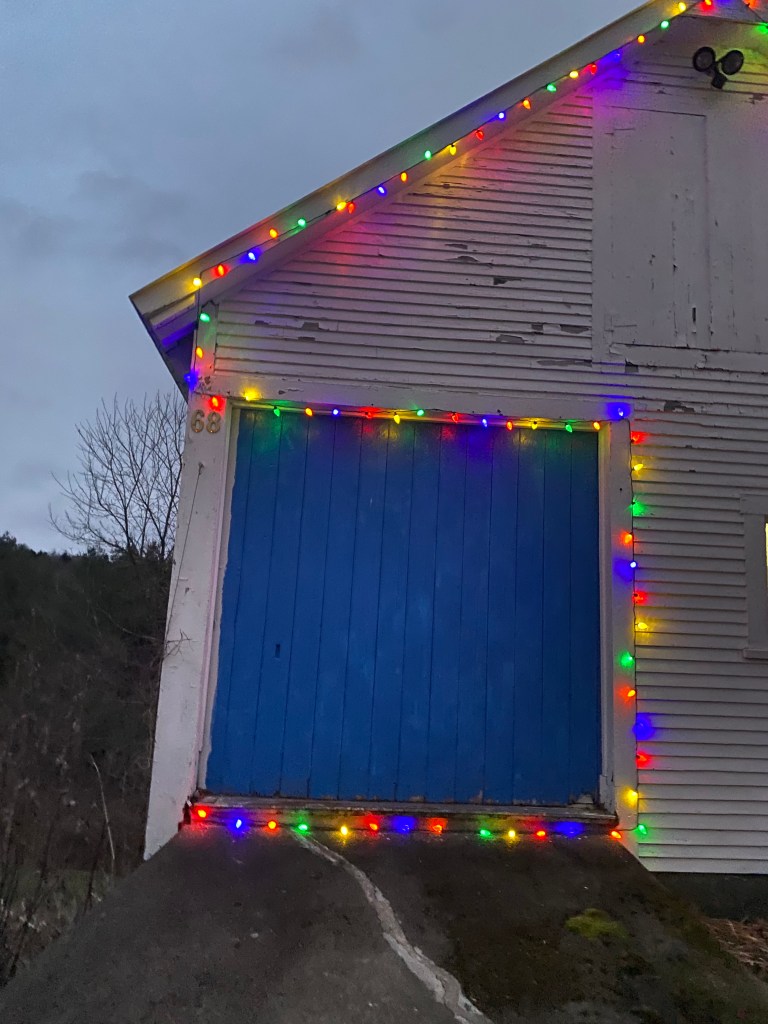
With my friend’s book in my lap, my daughter drives up the back roads, over ice and sand, through all that darkness. We reach the crest of hillside. There, as she drives and talks, I see across the valley to where a barn is lit in a long string of lights on the opposite hillside. Sporadic houses glow in the cold night, and not much more.

She drives down, then along the S curves along the river where I remember a terrible accident years ago. We stop and fill the gas tank. Beneath the bright gas station lights, it’s just us. I walk around the car, washing windows. In the driver’s seat, she watches me, and then I step back and bow. She shakes her head at me, amused.

Middle of February. Cold. A little chit in our collage.