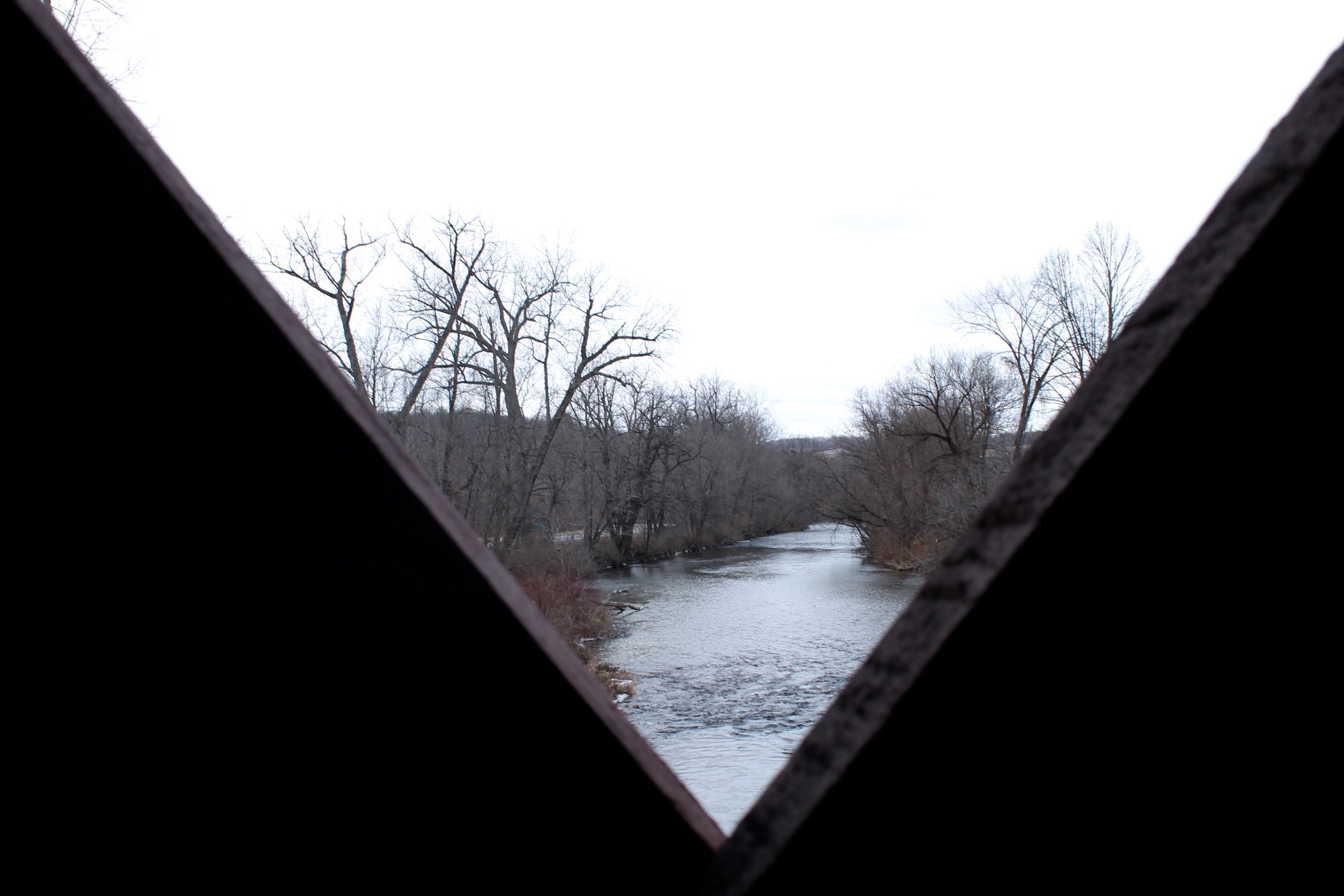
Geometry.

Strangely warm weather prevails. 28 years ago when I moved northward from southern Vermont, snow fell by the end of October and stayed until April. That April, I walked in a warm rain and wondered if I had made a mistake.

This afternoon, red clover in the fields, Johnny-jump-ups in the garden. I walked to the co-op and paid my tab and bought a loaf of bread for dinner with a crosshatch baked into its crust. At the register, we talked about the mysteries of calculus. Someone wondered if a radius calculation — r = √(A / π) — meant the center would never reach the edge of the circle, as π is an infinity? I volunteered to phone my brother or father and then steered the conversation to the surely more pressing question of color. Through the co-op’s wide windows, the autumn twilight sprinkled down in its charming way that intimated of the night’s stars yet to come, its gray scattershot with the remnants of this summer’s lingering gold leaves.

I went out and slipped through the side streets and up the hill behind the house that was once a nursery school. A woman with New York plates sat in her car at the ballfields, talking on her phone, staring up through the windshield at the turkey vultures circling over the pines where they nest.

Home again, I stood on the back porch and drank a glass of water. Dead curled leaves sprinkled the back deck.

Will the center reach the edge? Surely, a question of importance.

“Great things are not done by impulse, but by a series of small things brought together.” 

— Van Gogh

Bright Spot

Walking by my daughter’s room, I answer a math question, which delights me immensely. I can do math. More accurately, I did a lot of math in high school, some in college. This particular problem isn’t even all that challenging. But high school math class is somehow buried deep, deep, in my mind, and possibly no longer even accessible.

And yet, like so much else, I feel obligated as a parent to just know this stuff. I grew up in a household where, no matter what the homework, my physicist father could answer my questions — although he always made my siblings and I sharpen a pencil and show your work, legibly. 

I know I can do plenty of things as a mother, or at least competently enough — including keeping a solid roof over our heads — but still, there’s that glimmer of pleasure as I walk by with my arms full of laundry: can cook dinner and do geometry, too — at least for one evening.

The snow doesn’t give a soft white damn whom it touches.
E.E. Cummings
IMG_7062

Gnomon

When I was in high school, my father, sister, and I read Joyce’s short story, “The Sisters.” I was thinking of that story again today, in this kind of chilly and drab weather that intimates how I imagine Ireland. The opening paragraph is one of my most favorite in all literature. In the story’s opening lines are three words – paralysis, gnomon, simony – that are keys to understanding the story.

With my daughters today, we were talking about family, and patterns of behavior, and I began to wonder myself, What are the keys to understanding each of us? For one of my daughters, at the age of three, I would have used tricycle and rabbit as her own particular talisman; for my other child, the word sister.

We use language so easily, so freely, that we’re often careless with its power, misunderstanding and underestimating its capability, both for destruction and redemption – or as a key to see into deeper recesses of our inner lives.

THERE was no hope for him this time: it was the third stroke. Night after night I had passed the house (it was vacation time) and studied the lighted square of window: and night after night I had found it lighted in the same way, faintly and evenly. If he was dead, I thought, I would see the reflection of candles on the darkened blind for I knew that two candles must be set at the head of a corpse. He had often said to me: “I am not long for this world,” and I had thought his words idle. Now I knew they were true. Every night as I gazed up at the window I said softly to myself the word paralysis. It had always sounded strangely in my ears, like the word gnomon in the Euclid and the word simony in the Catechism. But now it sounded to me like the name of some maleficent and sinful being. It filled me with fear, and yet I longed to be nearer to it and to look upon its deadly work.

– James Joyce

IMG_9725

Photo by Molly S./North Bennington, Vermont