What twenty bucks brings.

My father asked me to include the whole W.H. Auden poem I quoted in the previous post. The poem reads:

Stop all the clocks, cut off the telephone, 
Prevent the dog from barking with a juicy bone,
Silence the pianos and with muffled drum
Bring out the coffin, let the mourners come.

Let aeroplanes circle moaning overhead
Scribbling on the sky the message He Is Dead,
Put crepe bows round the white necks of the public doves,
Let the traffic policemen wear black cotton gloves.

He was my North, my South, my East and West,
My working week and my Sunday rest,
My noon, my midnight, my talk, my song;
I thought that love would last for ever: I was wrong.

The stars are not wanted now: put out every one;
Pack up the moon and dismantle the sun;
Pour away the ocean and sweep up the wood;
For nothing now can ever come to any good.

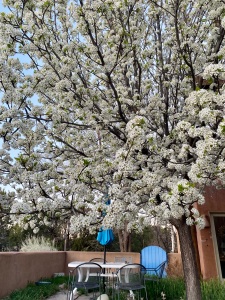
I’ll add this, too: a stunning blossom year for the plum tree my parents planted years ago. They bought the tree for twenty bucks. Would a fruit tree take in the desert, my mother wondered. My father reasoned, Heck, it’s twenty bucks. The tree will grow, or not. The tree thrived.

The Putting Back Together.

A coffee drinking companion, winding around at the end of our conversation, posits that our world appears to be unraveling. He notes that grass and dandelions break sidewalks: an act of defiance.

While I’m meticulous about certain things (keep mice out of the house, learn to use a comma), my garden this year obeys no orderly rules. Cosmos and calendula mingle with tomatoes. Amaranth reseeded among the dill and parsley. Forget-me-nots, to my great joy, blossom in random patches. I plant giant coneflower — Rudbeckia maxima — around my house. Have at it. Rage on. Rage.

End of August, the frogs and crickets keep singing. Overhead, a gibbous moon in the night, creamy light through roving clouds. Here’s a thousand action and more…. all alive, multi-faceted, full-throatedly in defiance….

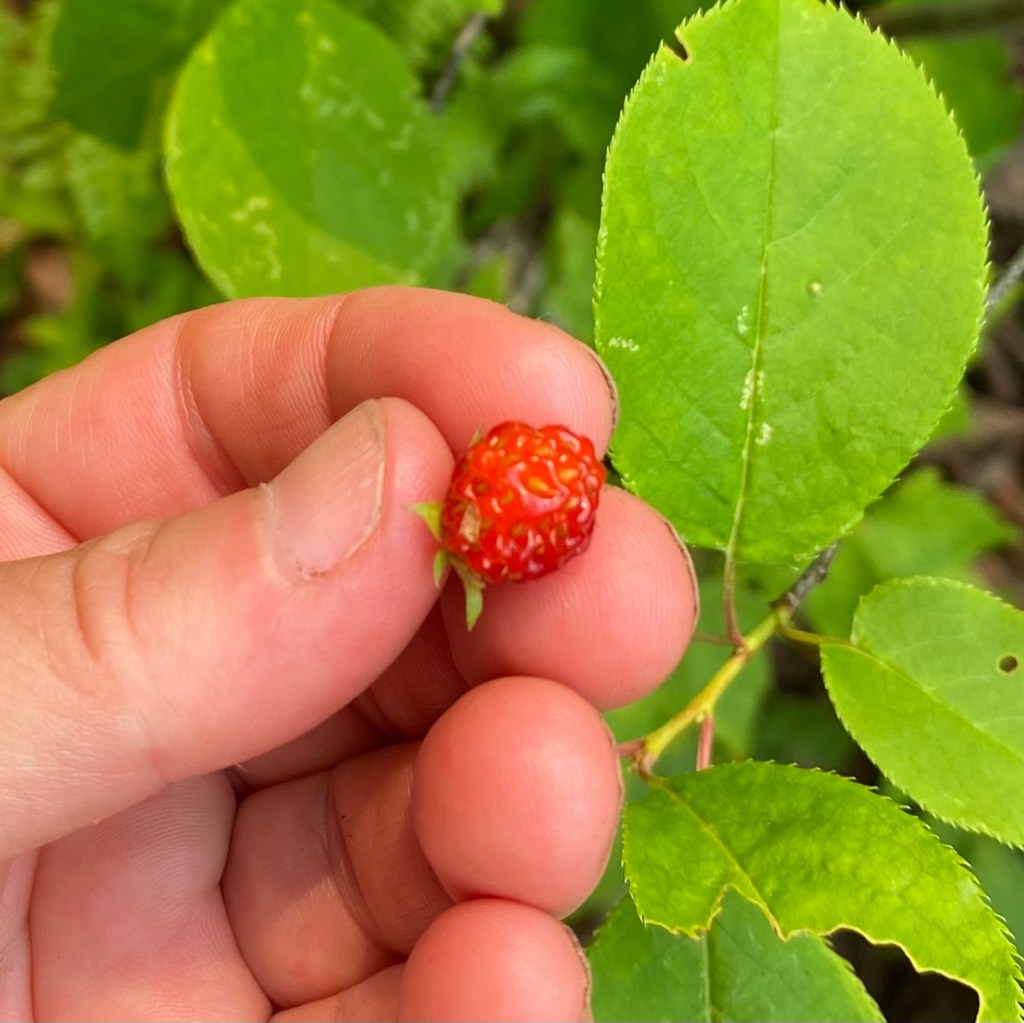
Wild Strawberries under Wildfire Smoke.

In Willey’s — the rambling general store where you can buy electrical supplies, French wine, local produce, bananas and darn near everything else except cigarettes — I turn a corner and find an old friend. She has a sunburn and I think: where have you been? We are both in some kind of rush that we talk, separate, and then knock up against each other again and again. The store is jammed to the ceiling with stuff, but it’s not that large. At the register and then out into the street, we keep talking. She’ll filled with such good energy I want to pocket some of her joy.

Every day, rain falls. Clotheslines droop. My feet are spongy in sandals. The Blundstones my daughter bought me a few years back split at the soles. It makes sense to wear these beloved shoes right down to wet scraps. I open and close the windows — is it hot? is it cold? The garden soaks up the water. The woods are lush and lovely, redolent with wet bark, the tanginess of split leaves.

The wild blackberries blossom profusely, the green berries now knotting. It’s nearly July, the season that means swimming and long lingering evenings watching the twilight drift down. Not so, this year. The pandemic made abundantly clear that we are connected to each other — both neighbors across the street and strangers around the globe — in ways that matter not one whit whether we like it, or not.

This summer breeds contemplation, more November than cusp of July. In that vein, here’s a few lines from the immortal T. S. Eliot in Four Quartets:

... The wild thyme unseen and the wild strawberry,
The laughter in the garden, echoed ecstasy
Not lost, but requiring, pointing to the agony
Of death and birth.

 You say I am repeating
Something I have said before.
 I shall say it again.

Shall I say it again? In order to arrive there,
To arrive where you are, to get from where you are not,
 You must go by a way wherein there is no ecstasy.

In order to arrive at what you do not know
 You must go by a way which is the way of ignorance.

In order to possess what you do not possess
 You must go by the way of dispossession.

In order to arrive at what you are not
 You must go through the way in which you are not.

And what you do not know is the only thing you know
And what you own is what you do not own
And where you are is where you are not...
Revision.

On the most perfect spring morning, I’m driving along route 107, a stretch of highway I’ve always loved that curves along the river. I’m listening to a This American Life story about two boys (and if you listen, listen all the way to the end, please), when the revision path for my novel abruptly unfolds before me, like a Jacob’s Ladder toy.

I’m in somewhat familiar territory, and so I pull over and scrawl down a few sentences. The day is suffused with dandelions and violets. I get a little lost to where I’m going, but not too lost. Later, I take a different road home, up route 100 along the White River Valley. Last year’s corn stubble patterns black fields that stretch to mountains where leaves freshen the gray with new green. The fruit trees are blossoming. I stop and finish the remains of my sandwich —pickles and sprouts and a coarse sharp mustard — keeping company with pink petals and pollinators.

My lunch companion remarked how a forest will do what a forest will. As I eat, I remember how poet David Budbill railed against writers taking themselves too seriously. He wrote, wrote hard, wrote productively, and revered the mystery of the imagination, the murkiness of creativity. His advice to writers, “Don’t think. Listen.”

On my way home, I listen to another This American Life story about a bird who sang to itself. I’m not making this up.

The Mail is a Real Thing.

Our post office box is crammed with mail. It’s been a few days, and I tug the mail out to see what’s there. Late afternoon, the PO has a steady stream of locals, some shuffling, others rushing. I take my turn at the table in the corner, chucking away what I didn’t request and don’t want, the sale flyers and offers. I keep a holiday card and the electric bill, The New Yorker. While I wait in line for two packages, the woman beside me strikes up a conversation about knitting hats and then we’re in the world of cables and color and yarn weight.

The PO is in the post office’s standard squat brick building, not at all quaint or cutesy. When staff changed over a few years ago, someone planted a flower garden in the front bed. By late summer, I kept admiring the flowering elecampane, taller than my head, bristly and mighty, a flower after my own heart. Late July is a long way off, but still. Elecampane is lodged in my garden plan.

“No two people knit alike, look alike, think alike; why should their projects be alike? Your sweater should be like your own favorite original recipes – like nobody else’s on earth. 
And a good thing too.” 

— Elizabeth Zimmerman

A few garden words…

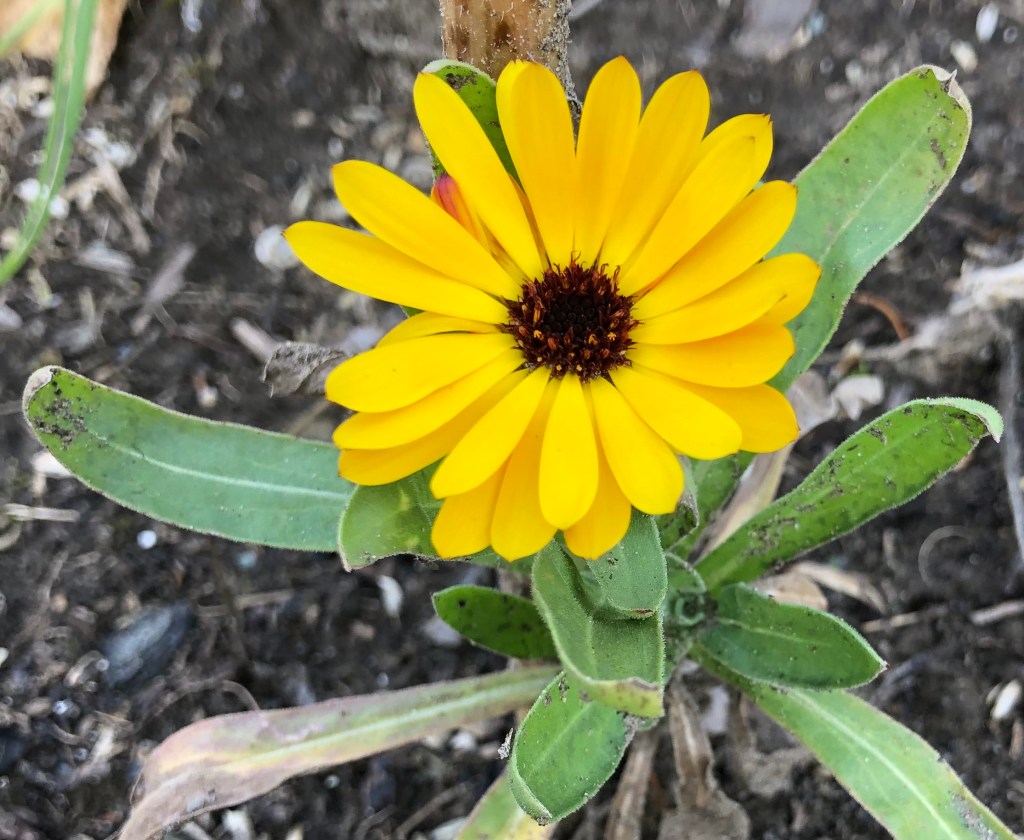
Calendula, such a pretty word, such a marvelous little flower, still blossoming beneath the frost-killed sunflowers in my garden.

Late Sunday afternoon finds me piling fallen maple leaves around these beauties in my garden, tucking in the soil for a winter’s hibernation. There’s celery, yet, too, among the Brussels sprouts. As I work, I snip off celery leaves, dusting off sandy soil on the hem of my shorts. The leaves are slightly grainy in my teeth, but when push comes to shove (as life inevitably goes), I’d rather have tried my teeth on a little grit than none at all.

Here’s what happens in New England’s October: the shadows creep in before the day has finished. We all know these shadows are edged with cold, with the intimation of winter and wind, of snow and more snow, and the always surprising dazzlement of winter’s glistening beauty. I bake an apple crisp, listen to election debates on public radio, comb my cat. October.

At no other time (than autumn) does the earth let itself be inhaled in one smell, the ripe earth…

— Rilke