Wood.

The wood man delivers cord wood not long after dawn. I’m in the kitchen with a manuscript spread over the table when I hear his truck beeping as he backs around the car my daughter left in the driveway’s middle late last night, returning from work. I lay clean spoons over my pages to keep them steady from my cat, who cares nothing about words or order.

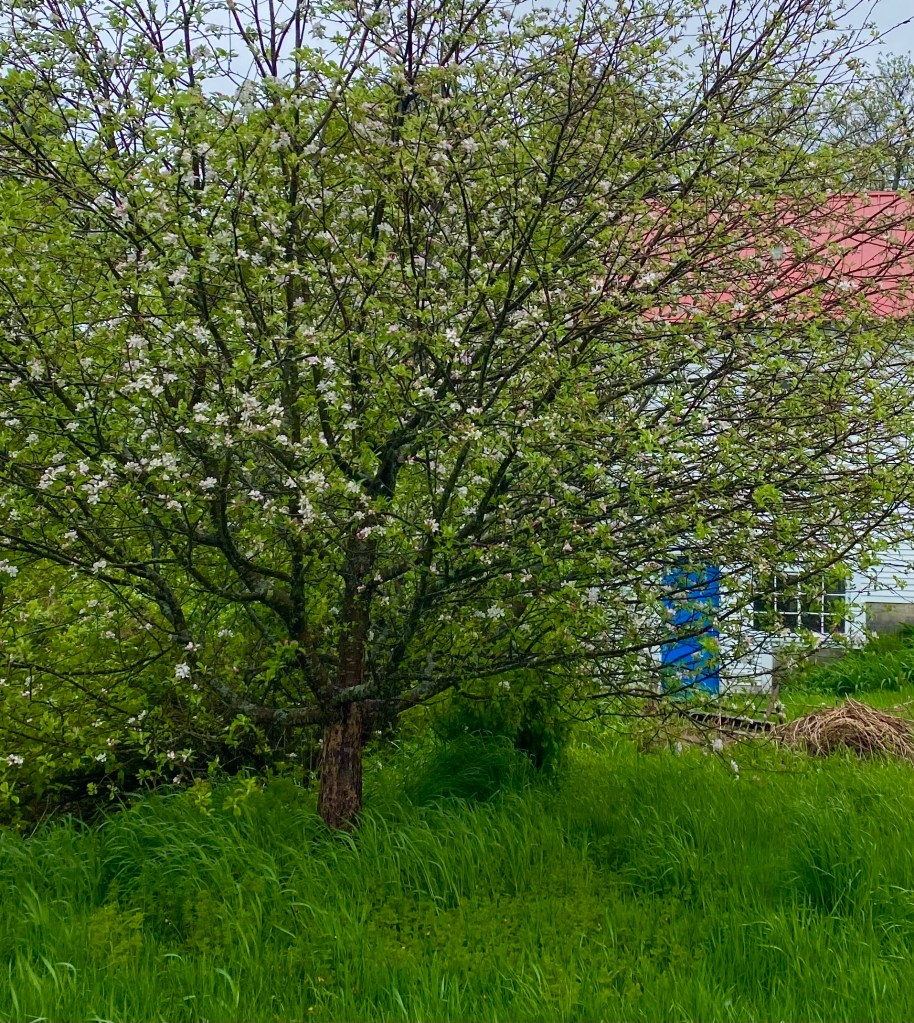
The morning’s chilly, sunlight snagged in the crabapple blossoms, downy white.

I hand him a check, and we talk for a bit about maple sugaring and sap sugar content, about his mighty 17,000 taps, and burning wood. Can’t people remember to order their own firewood every year, anyway? He dumps the load and drives off into the rising day. Freshly split, the wood’s redolent with sweet sap, that forest scent.

Two weeks and one day out from surgery, each day I’m pulling along further. After a winter of chemo, I now have a gnash in my middle, a non-bikini scar, that renders all the more real this cancer. Nonetheless, I ordered a small $16 tree, a witch hazel. One daughter digs a hole, the other plants the tree. Healing, I’m required to restrain myself from stacking that wood, digging holes, tugging out last year’s Brussels sprout stalks that lingered all winter, blackening and rotting. My daughter rips up a stalk and shakes the soil loose. The plant’s tendril-like roots spread skyward.

Amazing, I say, what comes from a tiny seed, isn’t it?

She shakes it again, then tosses the stalk in the garden cart and moves on to the next plant.

“Tree”

It is foolish
to let a young redwood
grow next to a house.

Even in this 
one lifetime,
you will have to choose.

That great calm being,
this clutter of soup pots and books–

Already the first branch-tips brush at the window.
Softly, calmly, immensity taps at your life.
― Jane Hirshfield

Mending…

After nearly two weeks away, I return home to the trees in full leaf, the lawn gone wild with violets and strawberry blossoms. Drizzly, cold, my brother starts the wood stove. The cats uncurl themselves before the blaze, satiated. A cold May, but verdant, lushly and satisfyingly so.

In these post-surgery days, I limp from room to room, venture outside to tug down a lilac branch and breathe in. The weeds run rampart, but whatever… the garden, too, will be sorted and tidied.

I’ve written repeatedly about the lilacs around my house, but again, I reiterate my joy in the soaring bushes. When I was five, we lived in a small green rented house, its yard surrounded by chainlink fence. A lilac bush leaned over the fence from the backyard neighbors. My second-grade sister was in school afternoons, my toddler brother sleeping, and so, after kindergarten and lunch, I lay on the long grass, staring up through the quaking leaves. These bushes, so New Englandy quaint with lavender, violet, and white blossoms, remind me of those unbounded childhood hours. One o’clock, two o’clock? Who knew? Who cared? I had just learned how to tie my shoes.

Like the walking wounded, I hobble from couch to chair, through the long grass, out of the workaday world and, yet, far from being a child. In glorious remission, in recovery from surgery, I keep thinking of this poem below, as I begin, day by day, to mend my body and life.

“Da Capo”

Take the used-up heart like a pebble
and throw it far out.

Soon there is nothing left.
Soon the last ripple exhausts itself
in the weeds.

Returning home, slice carrots, onions, celery.
Glaze them in oil before adding
the lentils, water, and herbs.

Then the roasted chestnuts, a little pepper, the salt.
Finish with goat cheese and parsley. Eat.

You may do this, I tell you, it is permitted.
Begin again the story of your life.

— Jane Hirshfield

Spring, in all her variations.

In the dark, the robins chirp, their language weaving night to dawn to daylight. Imagine, a whole season of birdsongs ahead. Or, I remind myself, quit stretching into the future. Simply listen.

Word around northern Vermont is that the spring is stuck. Days with thin ribbons of chilly sunlight. Drizzle and damp. In my wool hat and sweater, leather boots, I pull out the broken branches beneath the mock orange. Last winter’s heavy snow slid from the roof and snapped the brittle branches that should have been trimmed, anyway, last year. Against the house’s southern foundation, a cluster of white violets blooms. Every morning, the green pushes forth. The Japanese lilac I planted last April brushes out. Red stalks of peonies emerge. The tulips hold their plump buds closed, teasing, tomorrow, tomorrow.

But in the realm of today, today, each day I feel the chemo less in my body. Yesterday afternoon, in my fifteen-minute house tidying, I suddenly realized that my body has been cycling through chemo for six months. Before that, I’d been (ignorantly) filled with rapidly growing cancer. Now, walking barefoot around the house, the cats lazily watching me from their perches on couch backs, I realized what was different was that my body felt like mine again, me, the way I’d forgotten as familiar.

In alignment with that strand of my good news (apparently in opposition to what’s happening with arts funding on the national level), here’s a line from Dostoyevsky’s Prince Myshkin I read this morning: “Do you know I don’t know how one can walk by a tree and not be happy at the sight of it?”

Backaches and all.

Snow returns to Vermont; I remember an April 1st years ago when the snow fell so mightily our sugarhouse was hidden. I worried our toddler might get lost in the drifts.

These (early spring) afternoons, I walk around my garden where last autumn’s sunflower stalks still stand. The robins, those cheery birds, cluster. Redwing blackbirds sing joyously.

I’m nearly at my last chemo session – yes, counting down day by day, my simple math calculations and not-so-simple life. Mornings, I pull myself together to work; afternoons, I lie on the couch with my cat and read. The town library orders me interlibrary books. Recently, Blue, an illustrated memoir of St. Bart’s that I read in a few hours, a sojourn into a Caribbean vacation with a sweet family. I will be traveling nowhere outside the country, anytime soon, although I dream…

Where I am now is different terrain. My house has sheltered me (and my family) so warmly and kindly during this winter of disease. Now, I see where our house needs tending – paint on the barn, boards hammered back on the porch where the ice crashed. Every spring and summer, too, I plant more in the gardens, cultivating good living for birds and pollinators, not necessarily the woodchucks who come, unbidden. There will be no wars on my patch of hillside.

The bigger work for me now is healing; how happily I’ll shed medical appointments, the world of sickness, and savor my long walks again. My oncologist told me last fall that someday I’d forget I ever had lymphoma, and I’d forget him, too. Maybe someday if dementia drills into me (many many years from now). I would need to live a long long life if I were to forget this year.

In these winter months of cancer suffering, I’ve longed for many things, but prominent among these desires is to imbue this cancer with meaning. So now, as I’m beginning to contemplate my next steps, the spring and recovery phase, I’m determined to not slip into old habits or careless living. I mean nothing sentimental about this, as if plastering a gratitude sticker on my life will fix up my world.

Which way this will go is yet to be determined. Certainly, planting more perennials.

Stacking wood today

I thought how much I loved this life,

Backaches and all.

~ John Straley

Evening gathering….

In the spring, I moved my remaining hollyhocks into the fenced vegetable garden to save these flowers from feasting groundhogs. Spring, summer churned along. Now autumn, my garden still blooms its rainbow. Gathering tomatoes and basil for dinner, scraps of birch bark and kindling to start a fire, I pause for a moment in the drizzle, soaking in the delicate petals, the mist brushing in for the night, the trees already doing each their own foliage thing — some gold and orange, some already shaken down to bare twigs, others green, green, as if in defiance of winter.

Across the valley, the coyotes call, once, twice, as if testing their voices.

I snip bunchy orange marigolds for my table, their centers spicy. Overhead, the geese are always winging away these days, gathering their Vs, heading for their winter quarters, elsewhere. The clustered sunflowers, in their different heights and states of disarray from gold petal to curled brown leaf, rustle with the fat little chickadees dipping in and out, scavenging. Oh, sunflowers, so easily grown: scattered seeds, my palms pressing soil, water and sunlight. For me and the birds I imagine I sow these beauties, but of course that’s not true at all. The sunflowers are the waving prayer flags of my garden, this small territory.

The neighbor boys pile their sweatshirts and run in their t-shirts, the smallest hustling in and out of the lilac bushes, hide-and-seek. Rain pitters on leaves. A T.S. Eliot line runs through my memory, that graceful dismal poet, “…music heard so deeply/That it is not heard at all…”

A few snippets of autumn.

The natural course of things.

Dawn, I’m barefoot in the dewy garden, gathering peas, the world ignited. By the time my daughter and I meet in the kitchen, a little after five as she drinks coffee and heads to work, gray has skimmed over the sky, rain rain rain pushing in. (Side note: Red Sky at Morning, Richard Bradford’s novel, is a terrific classic novel, the former husband of my very long ago nursery school teacher, somewhere in Santa Fe….)

A year ago, heavy rains flooded much of my state. As I left Greensboro yesterday afternoon, I passed a village resident digging a trench with a shovel, some preventative channeling. About this time last year, I realized I knew a number of people who were driving around with shovels in their cars or pickups.

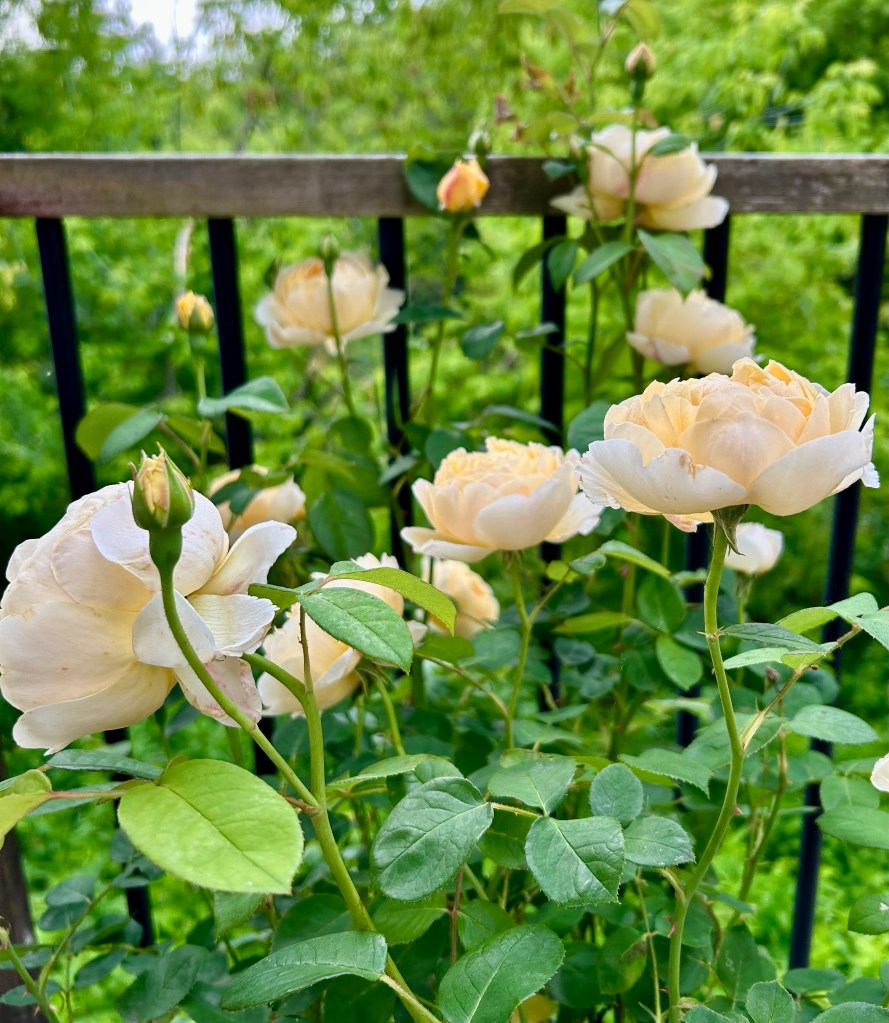
We are now in midsummer. Around two sides of our house, my garden grows — cottage roses and cup plant and phlox — and the wild rallies on the other two sides — jewel weed and box elder and goldenrod twine around porch railings, brush against the clapboard. Snip snip must be done, and yet somehow hasn’t yet. The groundhogs multiply, run beneath our chairs on the deck. I wonder about those foxes, about the natural course of things, wonder again, Well, what do I know? What will happen will happen….