Being a Child

Later in the summer, when the gardens are overrun with weeds, and cucumbers and string beans need to be picked from sagging vines, and the days are long with children swimming, and smoke hangs in the air from cooking outside, there’s often a point in the late afternoon when the world seems just a little much: that so-called witching hour mothers of babies know. We’ll move through that hour, through dinner and dishes, and washing up, and the cool leisure of evening comes in.

But now, in the spring, the world is yet at that new place. The weeds are nowhere near knee-high, and the warmth is as welcome as a novel in my hands I want to read.

I imagine this is how childhood should feel.

…And as I was green and carefree, famous among the barns
About the happy yard and singing as the farm was home,
In the sun that is young once only,
Time let me play and be
Golden in the mercy of his means,
And green and golden I was huntsman and herdsman, the calves
Sang to my horn, the foxes on the hills barked clear and
cold,
And the sabbath rang slowly
In the pebbles of the holy streams…

– Dylan Thomas, “Fern Hill”
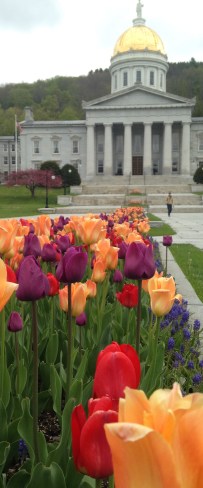
FullSizeRender.jpg

Montpelier, Vermont

New Growth

The maple tree before my house was seeded in this ragged lawn before I lived here, and it has grown steadily over these years. This beauty is likely much older than I’ve ever given her credit for. And yet here again, this May, her gnarled, lichen-covered branches are sprouting green again, with the tenderest of leaves.

I love that mystery; I love that rebirth; I love that change. One of my most favorite endings in a novel is Akhil Sharma’s Family Life, at once simple and exquisite, while throwing the reader back into the depths of the novel, the infinitely deep, living sea.

That was when I knew I had a problem.

– Akhil Sharma

FullSizeRender.jpg


Commune Scene

Green, green, green! Last night, reading about Vermont’s commune scene in the 1970s, I had to laugh about hippies coming to Vermont in the glory of summer, and then finding winter a different reality altogether. In a Vermont spring, every day, the black earth yields violet, buttery gold, emerald green.

Working in the garden in the late afternoon, I can fully imagine the hippie joy at this green paradise. Come the snowy season, though, and the idealism must have quickly faded. Having written a book about Vermont and youthful idealism, having given my own blood to this black and sometimes cold earth, on a day like today, Vermont is well worth enduring the stay. Today, I can pass on the Huck Finn advice.

(The back-to-the-landers of the 1970s) were acting, in part, on a characteristically American assumption that if things get bad where we are – too hectic, too dangerous, too messy – we can simply decamp to a new frontier and start again, that all we need to begin a new venture or even create a new society is a new piece of land.

– Kate Daloz, We Are As Gods: Back to the Land in the 1970s on the Quest for a New America

FullSizeRender.jpg

Woodbury, Vermont


Weeding

Before I’ve barely begun planting the garden, wilderness has taken hold of this ground. This afternoon, with my weeding tool and hands, I dug in hard. The younger daughter came to see if asparagus tips had emerged, then wandered away. On this Saturday afternoon, I listened to the frogs rocking  out in the hidden woodland pond.

Maybe this reclamation via weeding should be a battle. But it’s not. Surrounded by woods, the wilderness spreads into my garden through an infinity of ways, in a weed I can’t name, a wildflower I’ve never seen. Every year, my obscure patch of this earth surges with life – the geese winging overhead, the peepers’ chorus, ten thousand variations of green that shift and mutate daily. Not so long ago, I planted a garden with my baby cooing sweetly, laid on her back on a blanket spread beneath an apple tree, her bare toes stretching out toward the sun. This earth is so much larger then me and mine, and that knowledge is as steady as the tool in my hand, a knowledge to take comfort in.

When we marvel at that blue marble in all its delicacy and frailty, and resolve to save the planet, we cast ourselves in a very specific role. That role is of a parent, the parent of the earth. But the opposite is the case. It is we humans who are fragile and vulnerable and the earth that is hearty and powerful, and holds us in its hands. In pragmatic terms, our challenge is less to save the earth from ourselves and more to save ourselves from an earth that, if pushed too far, has ample power to rock, burn, and shake us off completely.

– Naomi Klein, This Changes Everything

FullSizeRender.jpg

my garden/Woodbury, Vermont


This Old House

For years, I’ve been buying my daughters creemees in the summer and admiring a small, terribly neglected house across the road. With an exterior of stained glass windows and ornate eaves, I imagine the inside has extraordinary woodwork. Surrounded by too many power lines, lived in by a series of renters, the house appears unkempt and ill-loved, the modern world grown up around it.

As a writer, I’ve looked at innumerable houses, and this little house seems hard-pressed for a good future, too near the road as it is, too near a river that floods, too not wanted… and yet, I’d love to walk through these rooms. I’d love to know who once lived here. With that riverbed soil, I imagine someone tended a burgeoning garden.

The grammar of shape is innately understood. Unlike speech, it is visible in plants and animals everywhere. The intuitive design process gives access to that knowledge. You do not work at design, you play at it.

– Jonathan Hale, The Old Way of Seeing

FullSizeRender.jpg

Hardwick, Vermont

The Middle Ages, Vermont 2016

One way I’ve (unintentionally) annoyed my daughters is my insistence that, every now and  then, I’m inhabiting the Middle Ages. This afternoon, in a stretch of breezy sun, at that optimum seventy degrees, I dug my fingers into the warming garden beds and unearthed worms, threadlike strings of root, lifting handfuls of johnny-ups for a friend.

Somehow, in my fictive Middle Age world, there’s only sunlight and soil, the constellations overhead undiluted by manmade light. This world lacks the drone and pollution of the internal combustion engine, contrails, the unending pressure to earn a living, get the kids one place or another, be accountable to the world out there. I have this vision of a world in perpetual growth, the earth still solidly at the center of the universe, the sun orbiting my serf’s homey patch of soil.

Conveniently, the Pope remains distant, the Children’s Crusade hasn’t happened yet, the Black Plague and smallpox are on hiatus. The thatch over my head is rat-free, famine hasn’t reared its head, and – of course – family life is just fine.

It’s a nice reverie, though, when I remain for these hours in my hands-on-the-land dreamlike stance, gathering tangy greens for dinner, my cheeks sun-kissed.

 But you may be surprised to hear that the Middle Ages were like a starry night. Let me explain. Have you ever heard people talking about the Dark Ages? This is the name given to the period which followed the collapse of the Roman empire when very few people could read or write and hardly anyone knew what was going on in the world.

– E.H. Gombrich, A Little History of the World

FullSizeRender.jpg

Woodbury, Vermont