Pre-Thanksgiving

When my daughter was four, she went through a period when she wanted the same handful of books read aloud each night. One of these books was Peter Spier’s ornately drawn picture book without words about Noah’s ark. The book was a hand-me-down from her cousins, and it was the only Bible story I think we ever read to her. The Old Testament’s grief and struggle doesn’t seem the cheeriest childhood bedtime reading.

But she loved the two-by-two of the animals, the dove with the olive branch, and Noah patting the soil around his vineyard at the end.

Yesterday, I picked up a gardening book at the library and read parts of it aloud to my daughters. The yard at our new-to-us house is fairly flat, blank slate. Envisioning growth, the three of us all agree on this common point: grapes.

Dreaming of a small vineyard, years in the tending: November. Thanksgiving.

images

Flowers of All Sizes

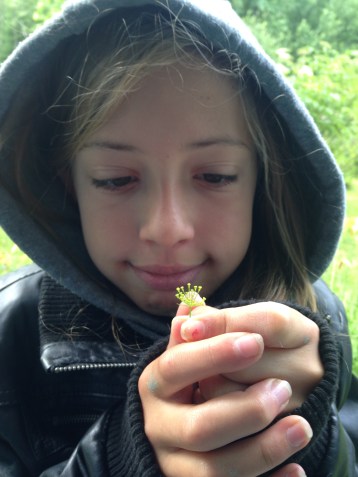
My daughter picked a piece of a dill flower in the garden today, then noticed her sprig was a miniature version of the whole. Curiously inspecting, she saw the symmetry reflected again in a smaller blossom-within-a-blossom.

For the longest time, my child examined that flower, wondering how tiny flowers could be. Down to molecules? she asked.

Forget those high school chemistry drawings and imagine this: molecules in the shape of flowers.

Maybe a little summer boredom isn’t such a bad thing….

Before the white chrysanthemum
the scissors hesitate
a moment.

– Yosa Buson

IMG_1829

West Woodbury, Vermont

Ah…. Water

Now deep in the muggy green of summer, the woods are splendid with fern, but the garden is parched, thirsty for rain. Fearful of my well, I’m reluctant to water, and what’s the point of watering if it’s not done well and thoroughly? What’s the point of anything, if not done deeply and truly?

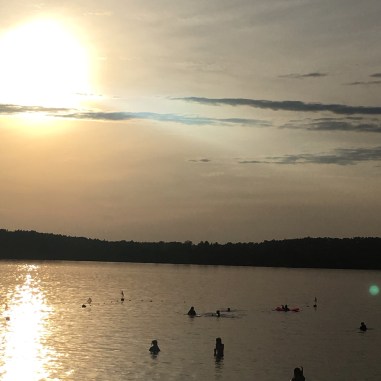
Now is the time for lakes, preferably spring-sourced, cool and clear, all the way to the sandy bottom. The children’s irritability washes away with swimming. As the evening cools, I step out on the bedroom balcony to admire the night sky. The constellations appear like tiny minnows in a lake, poised just for a moment, suspended in the firmament.

So what’s special about rain? Ever since we crawled up on the land, the water, it seems to us, has been trying to reclaim us. Periodically floods come and try to drag us back into the water, pulling down our improvements wile they’re at it… You know the story of Noah: lots of rain, major flood, ark, cubits, dove, olive branch, rainbow. I think that biblical tale must have been the most comforting of all to ancient humans.

– Thomas C. Foster, How To Read Literature Like A Professor

IMG_1759.JPG

Greensboro, Vermont

The Making of Things

If you write about Vermont, you’ll write about rain. There’s a myriad ways to know rain: lying in bed on a summer evening with the windows open, relishing the needed watering of thirsty garden greens, or the unwelcome tear of November ice in your eyes.

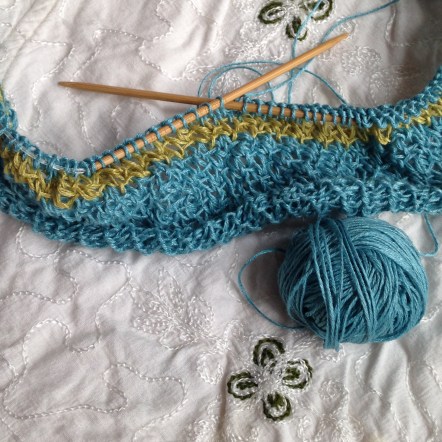
In knitting, my hands know how to create using wool (or linen or hemp) and needles. I can read a pattern, measure and gauge, but the bulk of that knowledge is through the experience of my hands and eyes. My fingers know if the tension is right, or whether to rip apart and begin again.

My daughter draws beautifully; something I cannot do at all. When I ask her, how do you do that? she says she doesn’t know. But yet, clearly, on some level, she does know. She just hasn’t yet articulated it. Writing, too, is that fascinating mixture of craft and raw, direct experience. Rain is a handful of soil so sodden it runs between your fingers, or lies heavily over fields and lakes, so dense and unending it might as well be a territory unto itself. Like Janisse Ray’s lovely line: Sometimes all day, days, rain falls.

But once I held
a kingfisher
in my hands,
I touched its blue power.
That may be the only time
I ever do.

From Janisse Ray’s “Kingfisher”

IMG_1544

The Garden’s Geometry

As a new mother, I was surprised by the weight of children; even babies, carried all day long, are heavy, and nursing in the nighttime, my arms often drooped with exhaustion. While my daughters are long since beyond the babes-in-arms stage, all afternoon yesterday I carried buckets of mulch and compost, bent with my hoe and scythe, and tugged my garden back from wilderness into domesticity: for a brief bit of time.

Step away, and the raspberry canes will run their way back. Creeping buttercup – or creeping crowfoot – proliferates knottily.

May is the season of optimism. I’ve planted melons for my watermelon-loving daughter, and promised to water well. The vertical territory of my beds lies low yet; visit in a few months and – like growing children – the vines will be lushly magnificent, the peppers spread out and holding hands, the bachelor buttons in bloom. May, like mothering, is the season of patience, too.

I’ve always preferred the woods in America to the woods where I grew up in Hampshire, which I can never help knowing are the hemmed-in exception to towns and villages and farms. New England is the other way around: a series of clearings in a forest. Keep walking north, and the clearings will shrink, until there are none.

Adam Haslett, Imagine Me Gone

FullSizeRender.jpg


Tree Collecting

I stepped outside the Montpelier Library today and stood for a moment with my face turned up to a shower of cherry tree blossom petals steadily raining down.

As a writer, I collect words I particularly love: myriad and succor, litany and exquisite, constellation and pinwheeling. For years now in my travels around Vermont, I’ve noted particular trees of exceptional grace, like Hardwick’s beauty mark of three silver maples on route 15.

Last weekend, stepping out the back door of my brother’s brewery, I nearly walked into an enormous apple tree covered in pearly blossoms and humming bees. What’s this?  I asked.

Amazing tree, he answered.

What a strange thing!
to be alive
beneath cherry blossoms.

– Issa

FullSizeRender.jpg

Photo by Molly S.