Squill

We’re into the third calendar month of the Stay Home order — I know this only by the date and time in the upper corner of my laptop — pretty much my compass to the exterior world these days. That — and an ongoing scrawl in a notebook that lists chores I cross off one by one to keep my paycheck coming. The paycheck I’m immensely grateful for.

These days, the old demons arise  — what am doing with my life? How have I failed my children? Is it normal my youngest wants to go anywhere else (yes, resoundingly, I know that is).

At the end of a rainy afternoon, as the weather parts, my daughters insist I trek through the raspberry and blackberry brambles behind our house. On the other side of the brambles, they show me an apple tree surrounded by emerald grass, and tiny blue squill sprinkled everywhere. They caution me not to step on the flowers.

This is Vermont spring — wet and muddy, largely brown, studded with small radiant flowers. Everyday, the green insistently pushes forward, brighter and stronger. That’s where we are.

IMG_6454

Photo by Gabriela Stanciu

Little Cabbages

While spectating my daughter’s soccer game, I surreptitiously watch a little boy dig a small hole in the frost-killed grass. He’s met a new friend, I surmise, another younger sibling, and the two of them make homes for a handful of plastic dinosaurs — nests the boys call them.

On their knees, they’re completely entranced. When the game’s over, they wander away, each to their own family.

In our garden, it’s Brussels sprout season now. Beneath the black edges, the tiny vegetables are perfectly green, tender as spring.

My favourite vegetable, without a doubt,
Is the humble, but holy, Brussels sprout.

— Angela Wybrow

IMG_6991

End of September

To counteract this seasonal shift from summer to autumn’s short days, I take the cleaver to gardenstuff — a carrot, a leek, an onion, garlic, parsley — and stew them with lentils and salt. Lentils, once the bane of our household (not lentils, again?). The younger daughter, still in her sweaty soccer practice shirt, eats hungrily.

Her older sister takes a knife to apples, listens to Stephen Colbert, rolls out dough. Pie, at least: it’s autumn.

IMG_6586.jpg

Miniature Mandibles

I’m reading outside with my bare feet on the firepit stones when I feel something like my cat’s tongue on my toe. I’m reading intently, in the few remaining minutes before my daughter returns from soccer practice and my attention will abruptly shift into chat about school and peers and the righteous outrage I suddenly see emerging in this teen. How had I forgotten that one of the most interesting aspects of adolescence is an emerging moral sense of the world? What’s wrong? Who’s right? (And, please, as a parent, could I just remain low and out of the light?)

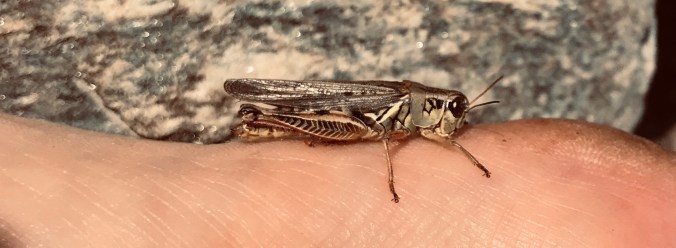
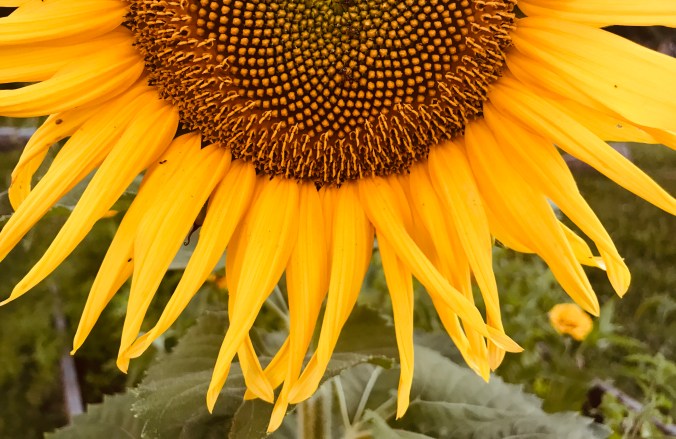
I’m reading, of all things, Wendell Berry, when I realize a grasshopper is nibbling my toe. It’s the very end of August, the sunflowers are opening, the basil is prolific, the beans have spread into a sculpture in the middle of my garden. I close the book and let the grasshopper gnaw.

We are dealing, then, with an absurdity that is not a quirk or an accident, but is fundamental to our character as people. The split between what we think and what we do is profound.

— Wendell Berry, The Unsettling of America: Culture & Agriculture

IMG_6407

Nearly 9th Grade

While the girls swim and jump off the bridge, I read a chapter in a history of Vermont — same old, same old.

We’re in the long, slow, cricket-singing days, just before school starts. The garden is jammed full, the leeks a failure, the nasturtiums a mighty army colonizing beyond their territory.

The days are jammed, too, with all the pieces of work, crammed in with When will we paint the barn? Fix the car’s exhaust. Mark when property taxes are due on the calendar. — All things I consider so important but will have forgotten in weeks, perhaps months.

The girls lean over the bridge in the sunlight, talking quietly, glancing at me and wondering if I’m listening. I am. I’m watching and listening, until I dive in and swim away, with only the lapping water against my ears.

On a branch
floating downriver
a cricket, singing.
— Issa

IMG_6306.jpg

Wandering, Mid-August

Three boys loop in circles on their bikes, eating popsicles and talking. Walking by, I note one boy rides an old banana-seat bike, not unlike my brother’s when he was a kid.

Monday evening, the neighborhood I walk through is unusually busy with people — a woman yanking yellowing pea vines from her garden, a young man powerwashing his deck, two women deep in conversation walking tiny dogs.

I pause at a woodshed where friends have built a tiny house to raffle for the local library addition project. The raffle’s this weekend, and we speculate about who might win. Kids, we hope. Not simply a cute toolshed.

We’ve hit mid-August when the cricket songs have shifted to a longer, slower sizzle, that gradual unwinding of their energy until the singing simply dwindles away in the fall. August is the season of gardens gone rogue — this year my enthusiastic nasturtiums have nearly eclipsed my peppers. The mornings are dim now; the mist moves back into the valley for the cool night hours.

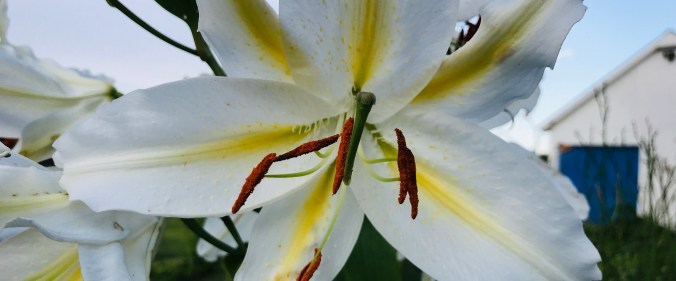
In the rose bed, whose flowers have long fallen, a single trumpet lily blossoms, and I wonder whose hands planted this beauty? Walking by, its fragrance pulls not only the pollinators but myself.

Here’s a line from a fascinating book I found in Maine — Don Kulick’s A Death in the Rainforest: How a Language and a Way of Life Came to an End in Papua New Guinea.

A language dies by contracting, by having its layers of complexity peeled off like an onion skin, getting smaller and smaller until there is finally nothing left.

IMG_6286