How We Spend Our Time…

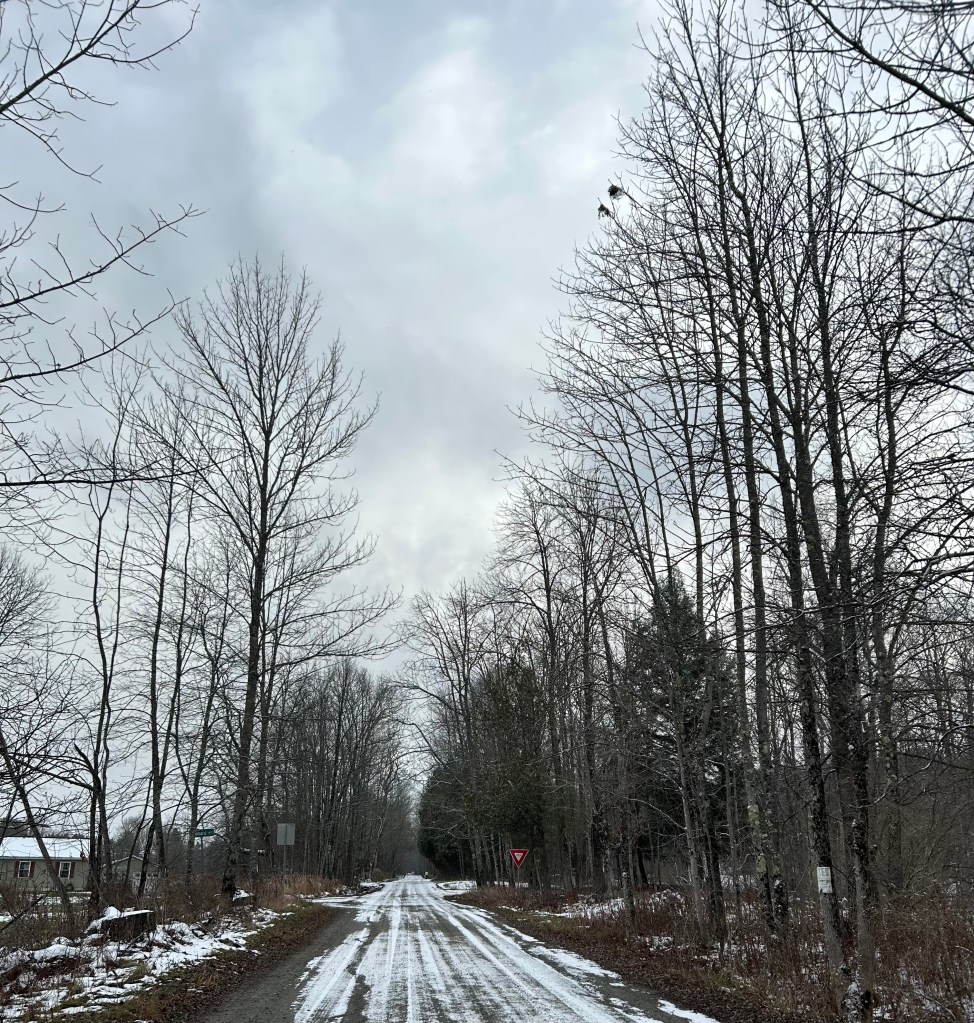
Sunday, I ask a friend to take a walk. It’s been a morning of housekeeping and writing chores, vacuuming and laundry, and the easiest thing would be to lie on my couch all afternoon and read. A light snow falls — pretty flakes and scant accumulation. As we walk, I pull off my hat and take off my mittens. It’s not the swimming season, not an afternoon where we meet at #10 Pond and talk about kids and work, about old parents and gardening, the loons calling and the sunlight thick with pollen. November is the honed-down season, stick and bone season, where your eye admires the landscape’s starkness. On these back roads, we pass farms, fields scattered with equipment, the shorn-down remains of last summer’s crops.

For so much of my life, I seemingly always had somewhere to be — and, raising kids, I probably did. I hurried to work and home to make dinner, or to pick up a daughter at school or a soccer game. Now, my girls are grown, with their own places to be; how hungrily I’m anticipating the abundance of our small family and apple pie this holiday. But this Sunday, I leave my post-it list on the kitchen table, check the woodstove dampers, and lace up my boots.

A year ago, I was for the first time in the Dartmouth-Hitchcock ER, in the trauma room with my daughters and the first oncologist I met. I was so new to the cancer patient world that I did not yet understand IVs and fluids and pain meds. That night, a surgeon told me I had to have surgery right now, immediately or I may not live, and I might not live through the surgery, either. It was the first time I had gone under in an operating room and woke in a dim recovery room and wondered, what now?

What now is the privilege of the living, and my god, I embrace that.

A year later, a few hours in the afternoon on a slippery dirt road. Later, I arrive home as twilight falls, the darkness so impenetrable in late autumn, back to my clean house and the cats who insist upon their dinner immediately, my solitary and sometimes un-solitary life, and what I’m making of my mortal time: fiercely writing, keeping the cats and myself fed, the hearth glowing, a holiday meal imminent. These earthly joys.

“… how we seek to spend our time may depend on how much time we perceive ourselves to have.” — Atul Gawande
Tiny flames, ice.

Bootstep by bootstep, my strength begins to return. It’s cold, darn darn cold, slicing at my eyes and cheeks. The cold and I are no strangers. I made maple syrup for years in an unheated outbuilding, raised my daughters in a house with scant heat, have spent decades of my life tromping beneath snowy trees in search of…. what? The usual things I suppose, by which I mean the unexpected. Or maybe just the sheer loveliness of a fresh snowfall.

Here’s my barometer for how I know I am improving, the cancer lessening. A long ago college friend appears at my house with the flu, explaining away his symptoms. At first, I don’t understand; what is he asking me? My old moxie rears up, fueled perhaps by the Red Devil chemo drugs. I’m taking in a poison to save my life, after all. As if it’s not enough to have cancer, I had to send him away, banish him from our hearth, point that what, whatever he thought he might be doing had nothing to do with me at all. It was all him. At this precise moment, there’s no space here for that, or for the flu.

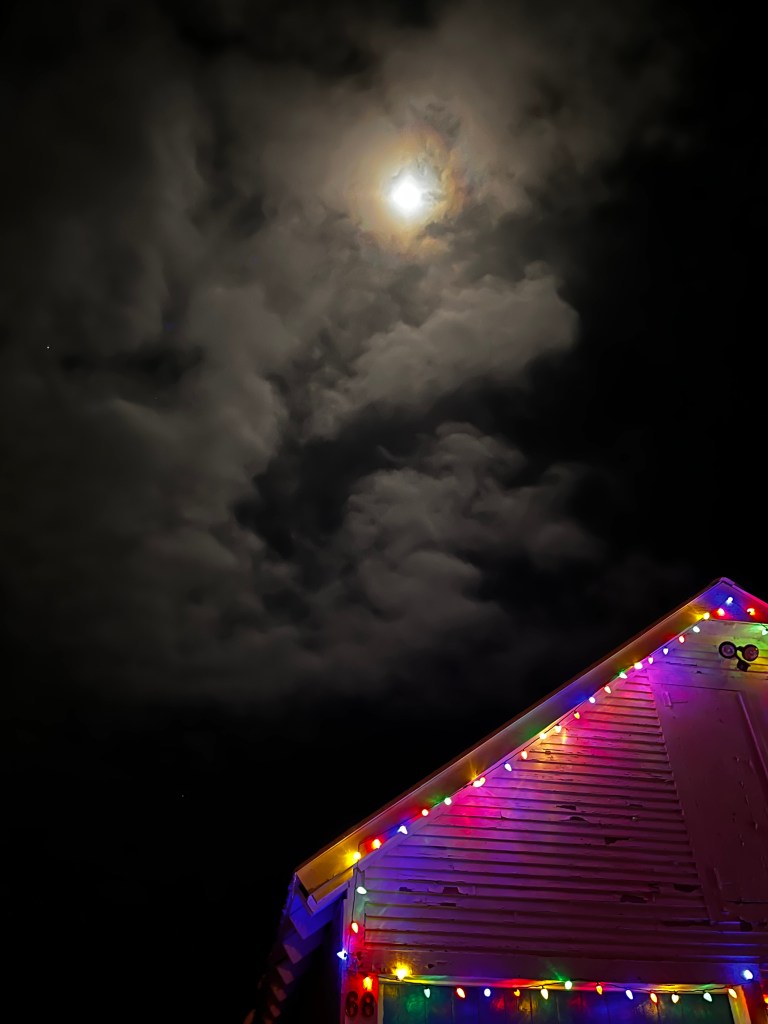
Later that night, neighbors appeared with ice lanterns made from five-gallon buckets. I grabbed my coat and stood outside, talking, while they lit beeswax candles and shared news of town. When they left, the tiny flames glowed brightly in the starless night, sure evidence that fire can burn even surrounded by fat ice.

Pig farm, glass buildings, moss.

Photo by Molly S.

The man who swept and cleaned my room at Dartmouth-Hitchcock lives in a nearby farmhouse where he grew up. All this complex here, all these buildings, he says, unrolling trash bags, was once a pig farm. Marooned in bed, IV-ed with multiple lines, I ask questions. His family raised beef, milked, had sheep, their own pigs, a chicken-and-egg empire run by the family women.

We talk food – garden canning, slaughtering and freezing, how his mother’s cookstove had a can of grease they used for eggs, steaks, day-old biscuits. That stuff in a box we eat now, with too many ingredients, that’s not food.

We get to gravy recipes, boiling water and how much flour to paste in. Then we wish each other well. Done for the day, he trundles his cart down the hall.

Home, I’m less cloudy for a few morning hours. By afternoon, the cats and I retreat to lying down, reading, slipping in and out of sleep, where I dream of an enormous pig farm where those tall glass buildings now tower over the surrounding woods. I dream myself back to early girlhood, sick, sick, playing paper dolls in bed. I weld my paring knife, skinning a Chioggia beet. For one long piercing moment, I ache to pull on my jacket and boots, slip wordlessly out the door and along the brambly path – a solitary walk to clear my mind. How I’d relish stepping from frosty twilight into my warm house. Patience, patience: my lesson now.

Friends text photos of sunsets, lakes, moss, running streams. Cell phone photos once so common to me, I study these, proof of a winter day. Mail arrives. Half insurance bills, half gorgeous cards – flowers, a paper wreath, snowy mountains – and so many welcome words. Late afternoon, I cook a pot of rice, my first contribution to a meal in weeks, save setting out forks and spoons like a toddler.

I like the juicy stem of grass that grows

within the coarser leaf folded round,

and the butteryellow glow

in the narrow flute from which the morning-glory   

opens blue and cool on a hot morning.

– Denise Levertov

Hard, Sweet Pears.

The couple who owned this house before me planted two pear trees in the front yard. The runt leans into the lilac hedge, as if hiding its crown. The taller has expanded into a pear tree version of pirouetting ballerina. Late afternoon, after pulling out withered lily leaves from the flowerbeds, I pluck two hard sweet pears and head over to the neighbor.

She’s created an unusual little garden with little pools of running water, so the delight is for your ears, too. I hadn’t realized it was the anniversary of her husband’s passing. We sit in her garden while the sun sinks down, talking about random things — work and the school board and gardens. The little boys across the street bike into her driveway. She’s parked as far back as possible to give the children a little more space on our tiny street.

When chilly shadows cover the garden, I stand, throw my pear core into her weeds, say goodnight. The boys have been called in for the night. As the cold edges in, mist thickens in the valley below. I watch how those cloud layers drift, cushioning the village, layered work just for the night. Then I pick another pear for breakfast.

Some days I find myself wondering how I’ve landed in this town, what random circumstances drove me here. There’s that trite old phase that the only constant is change, but of course that’s not true, either. All around us flow the steadiness of children, of loss, of those ripening pears.

September: such a pretty, sweet month.

Blackberry Eating

By Galway Kinnell

I love to go out in late September
among the fat, overripe, icy, black blackberries
to eat blackberries for breakfast,
the stalks very prickly, a penalty
they earn for knowing the black art
of blackberry-making; and as I stand among them
lifting the stalks to my mouth, the ripest berries
fall almost unbidden to my tongue,
as words sometimes do, certain peculiar words
like strengths or squinched,
many-lettered, one-syllabled lumps,
which I squeeze, squinch open, and splurge well
in the silent, startled, icy, black language
of blackberry-eating in late September.

Pay it forward: a debt.

In the local coffeeshop, a stranger kicks up a conversation, and we bat around our mutual appreciation for this early summer – the blossoms profuse. He buys his order and adds my coffee, too. Pay it forward, he says, and vanishes into the morning.

I take my coffee to the courtyard down the street, empty at this time of day. Ahead of me, after this bench work stint, the day sprawls. I move from eddy to eddy.

In the late morning, a friend I haven’t seen in a few years calls. I’m now in a dim basement room. As we talk, our conversation dips into the past. I feel as if I’m lifting silty strands of stories, stringing them through my hands, searching for clues to tie pieces together.

All day long, I ponder our conversation, how the actions of one person ripple through friends and acquaintances, shift through strangers’ lives, how I’ve always been interested in this since I was a teenager, holed up in my parents’ hammock, reading John Steinbeck’s East of Eden. Later in the day, still stuck on this, I stack firewood, listening to news about the Trump trial. In the hot June sunlight, the freshly cut wood is redolent with sap. An earthworm wriggles. The neighbor boys bike into my driveway, circle around through the grass, ever curious about whatever mundane thing I’m doing. Overhead, those turkey vultures circle their late afternoon sweep, ever hungry. Little snapshot of my terrain.

I believe that there is one story in the world, and only one. . . . Humans are caught—in their lives, in their thoughts, in their hungers and ambitions, in their avarice and cruelty, and in their kindness and generosity too—in a net of good and evil. . . . There is no other story.

— John Steinbeck

Mending Myself.

Mid-morning, abruptly the weight of my mother’s recent death lies on me, a physical presence, as if she’s leaning on my shoulders. It’s 21 days since she passed, days and nights crammed full. Like most mother and daughters, my mother and I had a relationship filled with 10,000 things and more. Again, today, on the eve of a short journey, I pack my laptop and books. I vacuum and mop and talk and talk and talk with my daughter.

Rain falls all day, so chilly I light a fire to the intense pleasure of my two cats. A year ago, my youngest and I flew home from Europe, my heart filled with our trip’s happiness. So, too, again, my life unfurls forward with an offer of good writing news. Spring in all her exuberance sings — such sweet joy for us in a northern sphere.

I wander outside. My shoes fill with rain. I stop in at a friend’s house. In her well-lit living room, with her purring cats, we talk about travels and love. Later, as I leave, she leans out the door, and we keep talking about honeybees and blossoms. The rain falls steadily, streaming down the collar of my coat. I have that walk home and more work, but I linger in the billowing fog, the gleaming green, our conversation gently pulling me back into this world, stitching me.