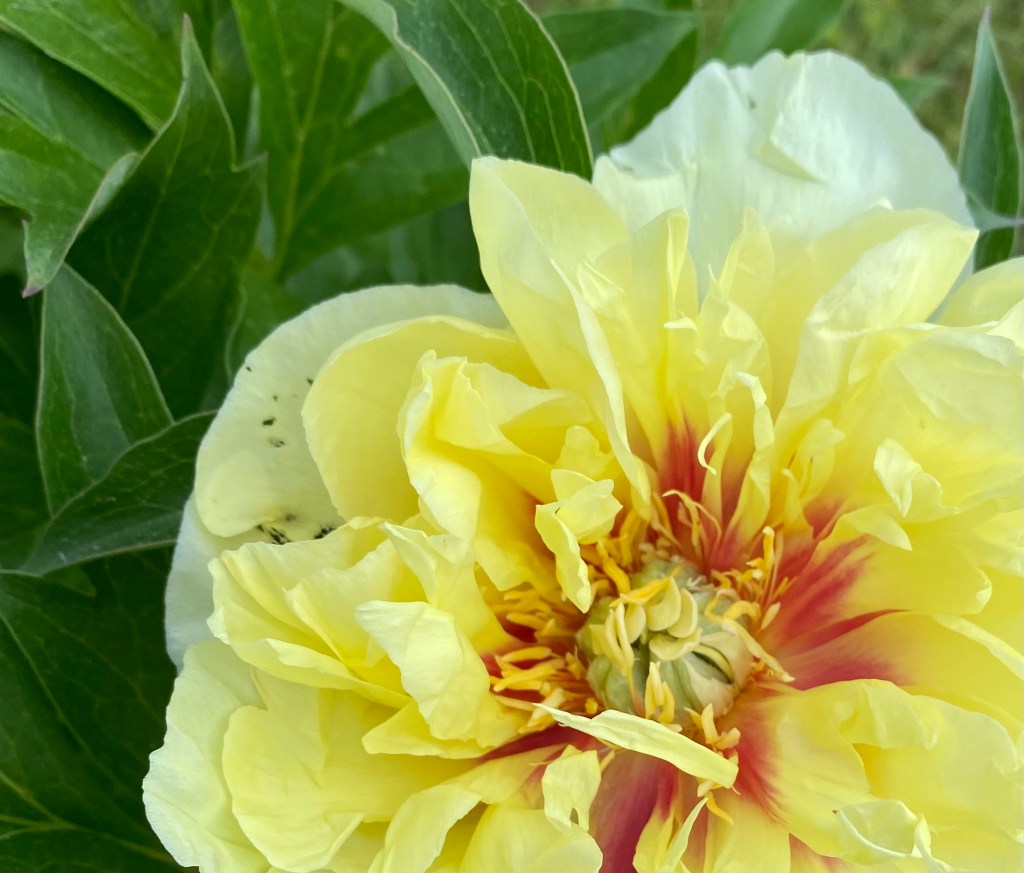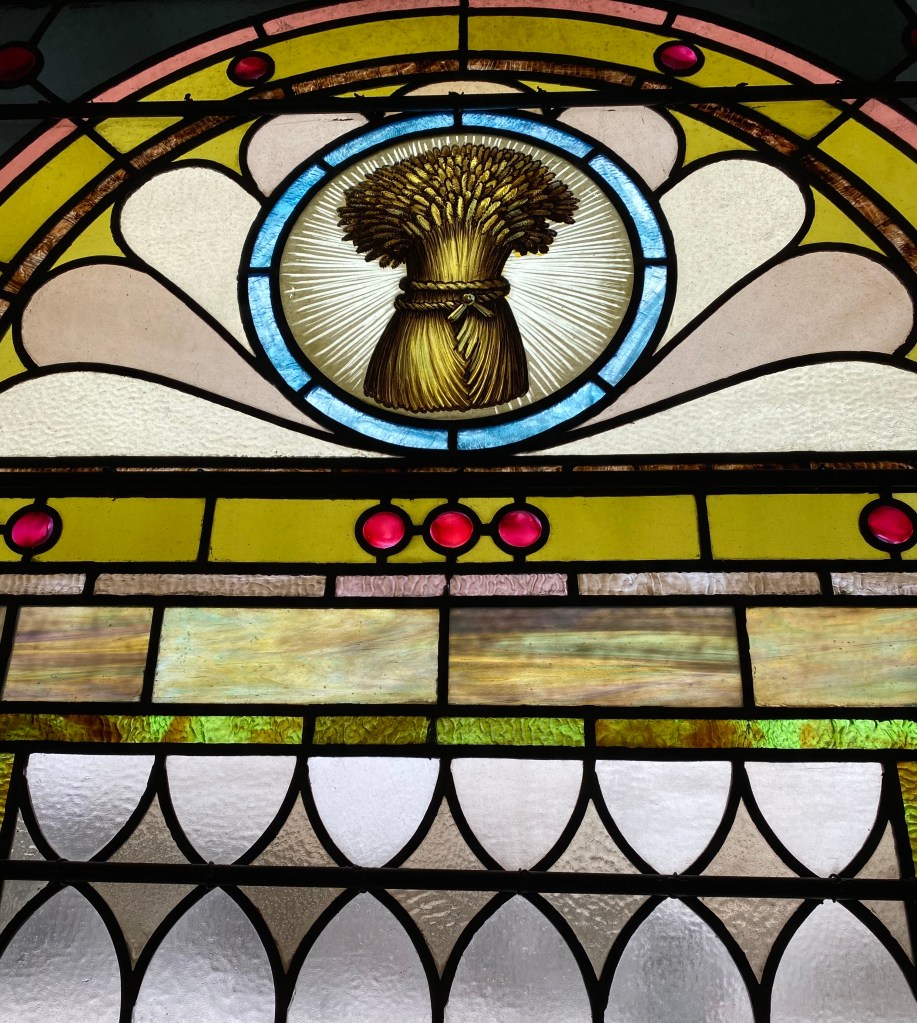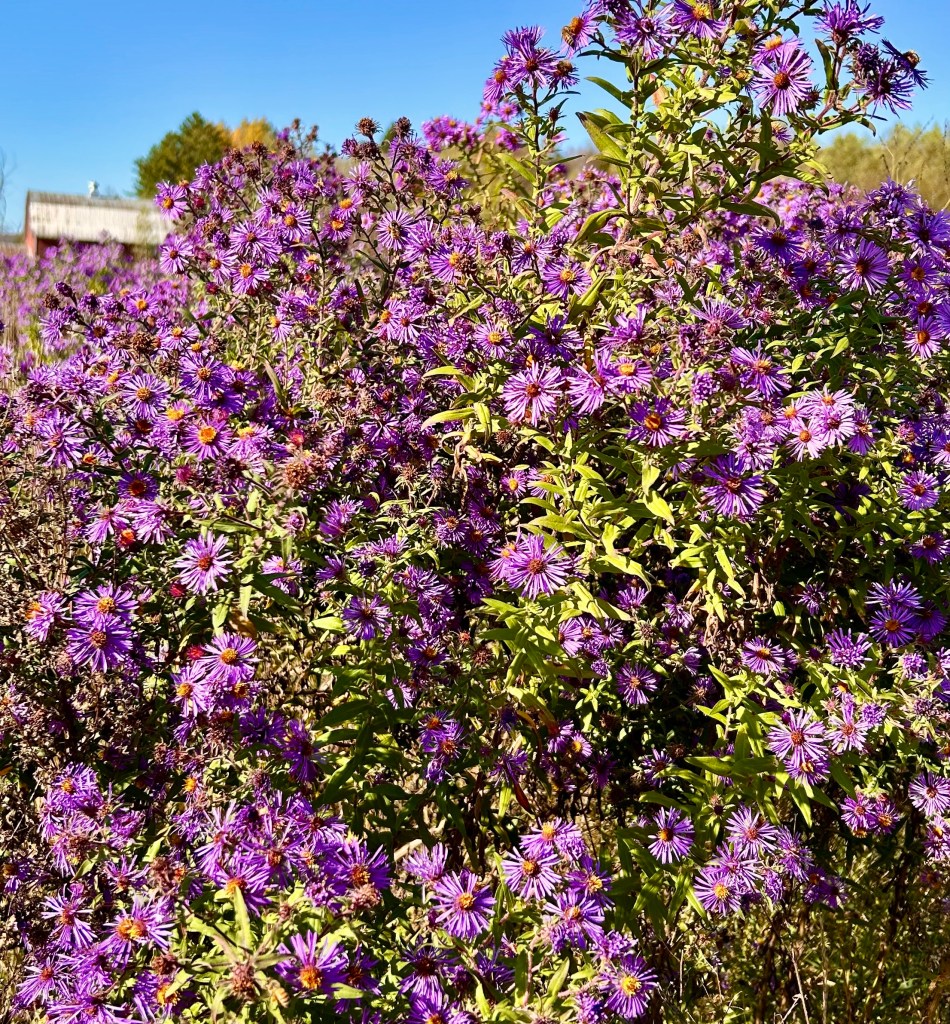
Put on a dress of flowers…

I spy a young fox on my front yard sniffing the trunk of the pear tree. Someone planted these two fruit trees long before I lived here. The smaller bends into the lilac hedge as if it’d prefer to be a lilac. This one, the taller, shoots high, its branches like an enormous hand raised in greeting.

The fox checks out the cohosh I planted this fall. Dawn is coloring up towards whatever day might emerge. I’m walking around my downstairs rooms, a dress in my hand, headed into work today, to sort out questions I both can and cannot answer, to talk with my office partner about town roads and FEMA, the drying up streams and lakes, about the merits of apple cider vinegar, and grownup kids. We’ll open the screen-less windows wide open in this 100-year-old former school, letting in the sunlight over the dusty sills. Hungry wasps fly in and out. An ordinary day of the things of this world, some humdrum, some irritating, some lovely as this balmy October weather. As for me, broken by cancer, limping back to whatever rude red health I can summon, I think, Put on a dress with flowers.

The fox crosses my neighbor’s pine-cone-strewn grass and disappears down our thin road. A fortuitous sign, I think, for this day.

Ode” by Zoe Higgins

Here’s to everything undone today:
laundry left damp in the machine,
the relatives unrung, the kitchen
drawer not sorted; here’s to jeans
unpatched and buttons missing,
the dirty dishes, the novel
not yet started. To Christmas
cards unsent in March, to emails
marked unread. To friends unmet
and deadlines unaddressed;
to every item not crossed off the list;
to everything still left, ignored, put off:
it is enough.
The first green of spring…

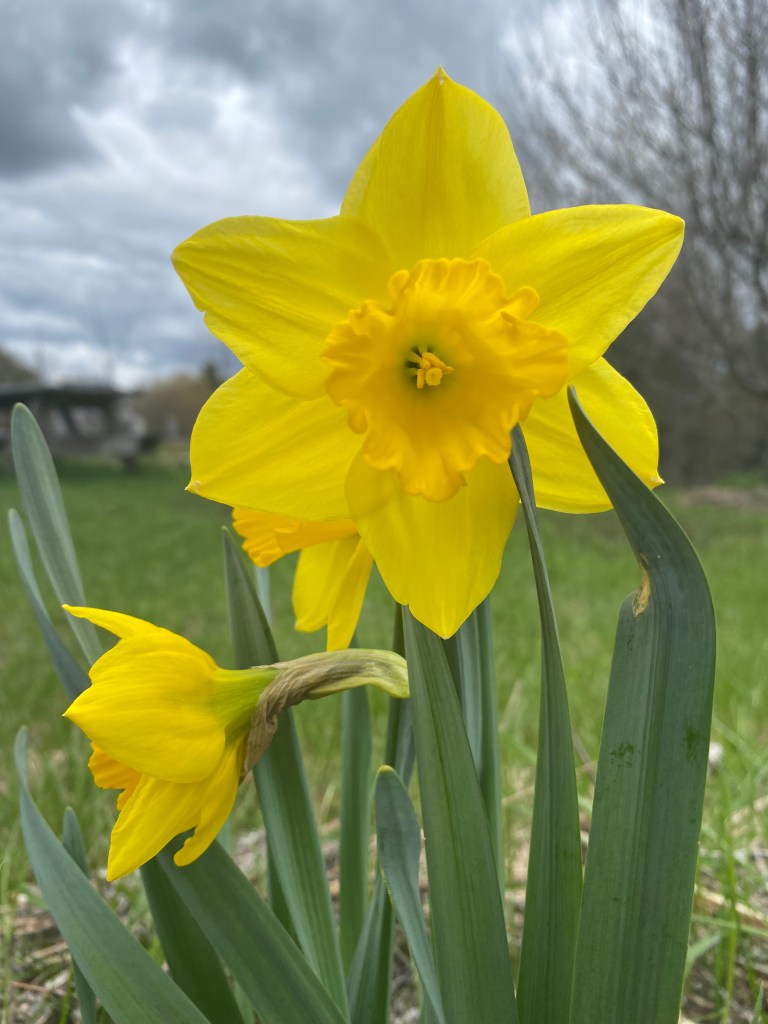
Spring fever – and the green is barely beginning in my patch of Vermont. Southernly, along the Connecticut River, we find greening grass in Lebanon, the hillsides washed with fattening buds. Perhaps especially because I am (finally! finally!) beginning to heal, my body aches to rake and tend, to bend down and finger budding flowers. The photo above is a tease. We’re close, but my daffies aren’t yet unfolded.

Too, we are a ways from marsh marigold, that swamp flower with profuse greenery and gold blossoms, but here’s one of my favorite David Budbill poems, so good it’s worth reading over and over…

The First Green of Spring

Our walking in the swamp picking cowslip, marsh marigold,
this sweet first green of spring. Now sautéed in a pan melting
to a deeper green than ever they were alive, this green, this life,

harbinger of things to come. Now we sit at the table munching
on this message from the dawn which says we and the world
are alive again today, and this is the world’s birthday. And

even though we know we are growing old, we are dying, we
will never be young again, we also know we’re still right here
now, today, and, my oh my! don’t these greens taste good.

Cat justice, homestyle.

A friend stops by with a gift of a stunning orchid. My naughty cat, Acer, immediately jumps on the kitchen table, and I swat him away. He lies on the couch, glaring unhappily as we talk. Gorgeous flower bouquets have come my way, been lavishly admired, then sent home with others to enjoy without cat destruction.

But the orchid is so stunningly beautiful I want to keep her. Later, I set this flower on the bathroom counter and shut the door. Acer is still sulking on the couch, paws stretched out before him, the epitome of cat depression, really hamming it up for my youngest daughter who mollifies him with kitty treats.

The cat and I: we are at odds. This morning, I let him into the bathroom. He sits on the counter, hungry to the core of his being to shred these velvety petals. In this new cancer world, my constant checking of time — my furious need to get stuff done — has instantly vanished. The mock orange outside the window sways in the breeze. Mid-November, this gloom is as much brightness as we’re going to get today.

Acer has no need to explain his position to me; his furriness is tense with desire. I pet his head and explain my infatuation with the orchid, which doubtlessly Acer dismisses as a weak case. And the orchid herself? Surely she wants to keep her own amazing life, both svelte and voluptuous.

The outcome is nearly certain. I’ll have to let her go. But for now, the house is warming with the wood stove, daughter sleeping upstairs, and — accusations of cat injustice be damned — just the right amount of ethical challenge and beauty, for ten minutes or so.

Old cheese, new peonies.

The girls come find me where I’m swimming, the water brackish, strewn with pollen. A blackbird keeps me company. The girls have snagged out-of-date cheese that’s perfectly fine and a tomato that’s sweetly ripe. At home, I dice last year’s garlic. I insist the girls admire the Bartzilla peony that’s blooming now, two blossoms and more fat buds of blossoms. The Bartzilla was a gift a number of autumns ago. My youngest planted the hairy root with me, skeptical. Now, for these few days, this peony’s a marvel.

All day, I’ve been thinking of this Mary Oliver poem. Well worth a share.

Peonies by Mary Oliver

This morning the green fists of the peonies are getting ready
to break my heart
as the sun rises, 
as the sun strokes them with his old, buttery fingers

and they open —
pools of lace, 
white and pink —
and all day the black ants climb over them, 

boring their deep and mysterious holes
into the curls, 
craving the sweet sap, 
taking it away

to their dark, underground cities —
and all day
under the shifty wind, 
as in a dance to the great wedding, 

the flowers bend their bright bodies, 
and tip their fragrance to the air, 
and rise, 
their red stems holding

all that dampness and recklessness 
gladly and lightly, 
and there it is again — 
beauty the brave, the exemplary, 

blazing open. 
Do you love this world? 
Do you cherish your humble and silky life? 
Do you adore the green grass, with its terror beneath? 

Do you also hurry, half-dressed and barefoot, into the garden, 
and softly, 
and exclaiming of their dearness, 
fill your arms with the white and pink flowers, 

with their honeyed heaviness, their lush trembling, 
their eagerness
to be wild and perfect for a moment, before they are
nothing, forever?

Bone Marrow.

The co-op cashier confides to me as she rings up my tomato and a loaf of bread that she loves this weather — brilliant sun interspersed with downpours. “Must be the Irish in me.”

The past few weeks have been a kind of July bonus: great growth in early June. My apple trees brushed out. I’ve placed an old desk and weathered chair on my covered porch. Recently, carrying out my laptop, I saw the desk sprinkled with gold pollen as if magic had swept through in the night. What luck, I thought, sat down and sneezed, worked.

I am of the wary bent, not to crow, don’t reveal a royal flush, a full house, for god’s sake don’t invite in bad fortune. At the little farmstand around Woodbury Lake, I park and walk behind the dilapidated barn towards the greenhouses, in search of a few more flowers for my garden, to fatten out the echinacea the groundhogs ate last year. In the tiny house, a dog barks. The farmer steps out and calls to me, my former library patron. He sings, “I’m saying it! I’m loving this.”

His words, not mine. Mine are this: in this northern realm, take in the sun and the green, store these gems in your marrow.

Music = flowers = courage.

Nearly a decade ago, my then-husband and I attended an improv poetry reading and concert in a church in Cabot, Vermont — an afternoon I later remembered as the last good thing we did together as a couple. Later that afternoon, news arrived of illness in our family. Although there was no way I could have predicted it at the time, the stress of disease further fractured our fragile marriage.

This weekend, I returned to that church with its high-ceilinged rough beams and unadorned crucifix for a performance with native flutes and storytelling as part of the town’s Twelfth Night celebration. Before the performance, the storyteller remarked about a flute, tens of thousands of years old, made from the rib of a cave bear. Flute music, like the drum which mirrors our mothers’ heartbeats, is bound into our DNA. With a rattle of shells, he began with the Chippewa’s creation story of the flute and expanded into a meditation about music as auditory flowers. Not Hallmark’s pastels: flowers are the rugged beauty that propagate our world. The music poured my heart full with courage.

Outside, a light snow sprinkled. Somewhere in the pandemic, my youngest played spring soccer in this town. In that time, no one was carpooling, and so I always drove. While she played, I walked along the river, early enough in spring that the peepers were singing but the black flies hadn’t hatched.

I had left my hat on the pew. When I walked back in, I met the poet’s wife. The poet, who was once so kind to me, has passed on now. His wife and I spoke for a few minutes, and then I went out, hat in my hand, snowflakes falling into my hair.

“… the need is now for a gentler, a more tolerant people than those who won for us against the ice, the tiger and the bear. The hand that hefted the ax, out of some old blind allegiance to the past fondles the machine gun as lovingly. It is a habit man will have to break to survive, but the roots go very deep.”

— Loren Eiseley