Stories

Driving the kids home from basketball practice tonight, I listened to their discussion about the beginning of humankind. Did people come from monkeys or from God? My daughter eventually brought up the Big Bang. That must have been the beginning, but how did the Big Bang fit into God and the monkeys?

Eventually, I suggested maybe all these ideas might be true. The kids’ answer was to ask for more snacks.

I kept thinking about that idea of how we tell stories of ourselves. And where does one story begin and another end? I’d just been with a group of teachers asking, Tell me the story of what is it you do. I listened for the hard bones, the unseen, that jointed their stories together.

Long ago, I believed stories remained in books, interesting but tepid things. Now I know story is the absolute heart of who we are, at times suffused with finesse and grace, at others – as in Baltimore – swollen with the tangles of history and present outrage.

There’s a phrase we use in our house: an ax can be both tool and weapon. Story, too, can be utilized as either, but further, I’d say, as tool, weapon, and journey.

We tell ourselves stories in order to live, or to justify taking lives, even our own, by violence or by numbness and the failure to live; tell ourselves stories that save us and stories that are the quicksand in which we thrash and the well in which we drown, stories of justification, of accursedness, of luck and star-crossed love, or versions clad in the cynicism that is at times a very elegant garment.

— Rebecca Solnit, The Faraway Nearby

FullSizeRender-2

Photo by Molly S.


Unraveling and Knitting

This cold, dank and inimitably dark season is also the yarn season. Unlike living, any knitting project can be unraveled and reknit. Late last night, knitting while reading my bell hooks library book propped open with my bare toes, I realized the needles and yarn I had mated didn’t fit. Still reading, I  unwound the hat and rolled up the yarn. This evening, I chose a smaller needle size, and this hat I’m knitting for a friend’s Christmas present is aptly on its way.

Not so, our lives.

I’m sometimes asked, But is your fiction real? Of course it’s real, but it’s also fiction. Isn’t the craft of writing rewriting ad infinitum? Take out a character, emphasize a plot point, weave through an image of a great blue heron? Our lives are bulkier and baggier things.

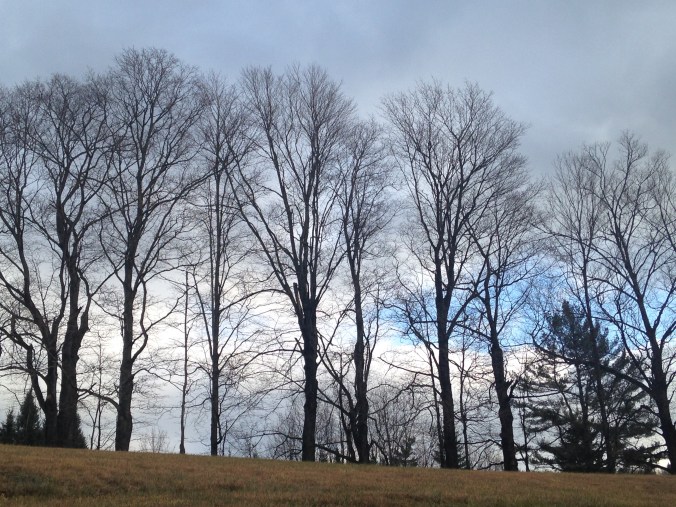
I was reminded of this, stopping along a roadside today, admiring how the trees knit into the sky. One of my childhood’s keenest memories is standing at the edge of a giant cornfield in Illinois, where our family was camping on one of our numerous cross country treks. I was likely ten, the age of my younger daughter now, and I stood with my father, excited as I have ever been about anything in my life. Good lord, all that corn and the sky! The world was limitless.

The true artist is never so lost in his imaginary world that he forgets the real world, where teenagers have a chemical propensity toward anguish, people between their thirties and forties have a tendency to get divorced, and people in their seventies have a tendency toward loneliness, poverty, self-pity, and sometimes anger. The true artist choses never to be a bad physician. He gets his sense of worth and honor from the conviction that art is powerful – even bad art.

John Gardner, The Art of Fiction

IMG_0405


Singing and Writing: a Small Blue Book

The other morning, between errands, I stopped in at Bear Pond Books in Montpelier, and found a small novel by Tomas Gonzalez, a Columbian, In the Beginning was the Sea. The book is beautifully crafted and fit just about in the palm of my hand, yet with a real heft and weight. And – it was my favorite color: blue.

These past few days I’ve swum down into the sea of this book. I’m not at all likely to head south to Columbia, and the book itself is not gleaming feel-good read. But it’s writing with a depth that goes down and down, and is as true and real to me as drinking a glass of my own well water.

As a Vermont writer, I’m often asked about sense of place and its importance in my writing. Yes, of course, place-centered geography centers in my writing. But equally, I know, the beauty of  a tropical paradise can also drive an inhabitant over the edge, and to write with a sentiment that place is only holy seems false to me. Surely, the yingyang flip of holy is unholiness. While this short novel holds the beauty of human life and the moonlit sea, the writing also contains the deeper elements of all the vagaries of human existence.

“So WHY does our writing matter again?” (my students) ask.

Because of the spirit, I say. Because of the heart. Writing and reading decrease our sense of isolation. They deepen and widen and expand our sense of life: they feed the soul… We are given a shot at dancing with, or at least clapping along with, the absurdity of life, instead of being squashed by it over and over again. It’s like singing on a boat during a terrible storm at sea. You can’t stop the raging storm, but singing can change the hearts and spirits of the people who are together on that ship.

— Anne Lamott, Bird By Bird

IMG_0124

Storm Windows, Fiction

While I was at work yesterday, my daughters washed and latched storm windows on the kitchen windows. They also biked in the season’s first snow, baked a chocolate cream pie from Pie which the younger daughter is reading, argued, played memory games, and spread out a rug in front of the wood stove as an official opening to the wood stove/snow season. Already, the piles of games and books and knitting are growing in uneven piles on that rug.

As my own book nears its publication date, I’m pushed to speak more about how I came to write this book, and why. In my own busy household that mixes children and rural Vermont, what’s increasingly clear to me is that writing is a human activity as essential to our lives as stocking your root cellar or bank account or however you do it for the long, colder season ahead. Our culture emphasizes material gain above pretty much everything else, but, really, at the day’s end, there’s little else of relevance besides stretching your bare toes toward a hot fire, with the children nearby, and the windows buttoned up against the growing dark and cold.

The society to which we belong seems to be dying or is already dead. I don’t mean to sound dramatic, but clearly the dark side is rising. Things could not have been more odd and frightening in the Middle Ages. But the tradition of artists will continue no matter what form the society takes. And this is another reason to write: people need us, to mirror for them and for each other without distortion – not to look around and say, “Look at yourselves, you idiots!,” but to say, “This is who we are.”

Anne Lamott, Bird by Bird

IMG_0119

October/West Woodbury, Vermont