Ah, Monet

When my older sister was a student at Williams College, I often rode the Greyhound and visited her. While she was in German or physics class, I walked to the Clark Art Museum. Entrance was free for students, so I could visit over and over. As I read a lot, too, I learned about Monet and his garden, and Renoir and his women.

Although I didn’t realize it at the time, I was learning art is a physical craft. None of the guards cared if I leaned into the paintings and admired brush strokes, bending in to see the raised curved of paint Sisley’s brush had left. I studied how a particular shade of yellow lent a certain light. I became a writer and not a painter, but those hours in the Clark were invaluable to me. I learned to step into light, to realize darkness as moving force, and to see what is there, rather than what I expected to be there.

Yesterday, I visited with my daughters. In a room suffused with natural light, filled with Impressionist beauties, my younger daughter walked to my most beloved painting in the whole museum – Monet’s ‘Geese in the Brook’ – a golden, sunlit beauty. This child, who had been more interested in the possibility of ice cream rather than Pissarros, said that was her favorite.

When I asked her why, she said, Because it’s beautiful. Look at it, mom.

Bingo, I thought to myself. That was worth the trip alone.

I was learning something from the painting of Cézanne that made writing simple true sentences far from enough to make the stories have the dimensions that I was trying to put in them. I was learning very much from him but I was not articulate enough to explain it to anyone. Besides it was a secret.

Ernest Hemingway, A Moveable Feast

FullSizeRender

Williamstown, MA


Daughters

In my usual, take-your-kids-to-work-with-you way, the girls came, too, when I read at Vermont’s Norwich Bookstore, in the first real sunny day of spring.

Afterward, my daughters and I walked around Dartmouth College, where the enormous green was filled with students and flying frisbees. The young women wore strappy dresses; the daffodils spread their buttery petals; we ate homemade cherry gelato. All was budding and new in the world. Driving back along Vermont’s sparsely travelled interstate, we passed fields turning toward emerald from the dull brown they’ve held for weeks. The rivers and lakes had thawed, and flocks of birds darted in quick waves.

All the way home, needing no map, we laughed and told stories.

…You are born a woman
for the sheer glory of it,
little redhead, beautiful screamer.
You are no second sex,
but the first of the first;
& when the moon’s phases
fill out the cycle
of your life,
you will crow
for the joy
of being a woman,
telling the pallid moon
to go drown herself
in the blue ocean,
& glorying, glorying, glorying
in the rosy wonder
of your sunshining wondrous
self.

– Erica Jong

FullSizeRender.jpg

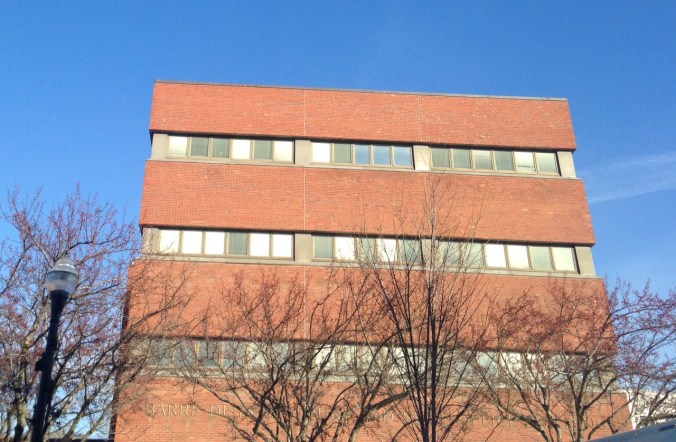
Hanover, New Hampshire

Creative Mountains

Driving to Stowe this morning, my ten-year-old daughter pointed at Mt. Mansfield and said with utter joy, I’m going up in those mountains today.

She did. With her companion and the child’s mother, they skied higher than she ever had, returning at the day’s end with cheeks sweaty red, her braids tumbled. On the way home, as she told me about her day, I realized she had made a mental map of her journey, laying winter skiing over her summer hiking.

While she skied, I sat in a sun-filled room with strangers and climbed my own mystical creative mountain, traversing the terrain of novel writing through rock and streams, dusty back roads and the variated sky bent over a village. My villagers (like the people I know) sleep and dream, wake and eat, their hearts filled with desire and lust, with unhappiness and the unrequited past, with daily pleasures, like eating salad and enchiladas with a child and listening to her story.

How I admire this child and her fearless joy, her unalloyed pleasure in sun and snow, in steep mountains, and the wind over her face. As creative adults, shouldn’t we aim for that confidence in hard places, that dusting away of doubt that so frequently plagues us?

More to the heart, perhaps, like a child, we should savor unfettered happiness in our hours.

And then, of course, the novel-writing itself affects the novelist, because novel-writing is a transformative act.

Jane Smiley, 13 Ways of Looking at the Novel

IMG_4372

Photo by Molly S./Woodbury, Vermont

Imagination

Yesterday at dusk, while my daughter in her snowsuit gathered icicles and arranged them in an order known only to her, I walked in the cold along our road, the fresh snow recently plowed and sprinkled with brown dirt. How is it the sky can hold that lightest and palest of blues, complementing the frosty earth? Across the valley, Mt. Mansfield’s ridge gleamed with snow and sunlight.

Walking along the road, I imagined myself a wild creature, a woman around a wolf’s rangy body, my pelt matted with balls of ice, my lungs pulling greedily at the air, eyes keen and cunning, utterly watchful, without fear. Imagination is a word used too mundanely, like a child’s activity we toy with and too often cast away. I used the force of imagination today, descending into the bowels of bureaucracy, through windowless rooms with numbered forms and lengthy procedures and strangers weeping; I carried with me the hoary scent of wet fur, the wildness of snow and open skies, the singleminded hunger for survival.

Around our kitchen door, my child’s icicles glowed in the light through the windows tonight, widening the circle of the world she created.

Reading fiction not only develops our imagination and creativity, it gives us the skills to be alone. It gives us the ability to feel empathy for people we’ve never met, living lives we couldn’t possibly experience for ourselves, because the book puts us inside the character’s skin.

– Ann Patchett

FullSizeRender

Barre, Vermont

Stories

Driving the kids home from basketball practice tonight, I listened to their discussion about the beginning of humankind. Did people come from monkeys or from God? My daughter eventually brought up the Big Bang. That must have been the beginning, but how did the Big Bang fit into God and the monkeys?

Eventually, I suggested maybe all these ideas might be true. The kids’ answer was to ask for more snacks.

I kept thinking about that idea of how we tell stories of ourselves. And where does one story begin and another end? I’d just been with a group of teachers asking, Tell me the story of what is it you do. I listened for the hard bones, the unseen, that jointed their stories together.

Long ago, I believed stories remained in books, interesting but tepid things. Now I know story is the absolute heart of who we are, at times suffused with finesse and grace, at others – as in Baltimore – swollen with the tangles of history and present outrage.

There’s a phrase we use in our house: an ax can be both tool and weapon. Story, too, can be utilized as either, but further, I’d say, as tool, weapon, and journey.

We tell ourselves stories in order to live, or to justify taking lives, even our own, by violence or by numbness and the failure to live; tell ourselves stories that save us and stories that are the quicksand in which we thrash and the well in which we drown, stories of justification, of accursedness, of luck and star-crossed love, or versions clad in the cynicism that is at times a very elegant garment.

— Rebecca Solnit, The Faraway Nearby

FullSizeRender-2

Photo by Molly S.


Unraveling and Knitting

This cold, dank and inimitably dark season is also the yarn season. Unlike living, any knitting project can be unraveled and reknit. Late last night, knitting while reading my bell hooks library book propped open with my bare toes, I realized the needles and yarn I had mated didn’t fit. Still reading, I  unwound the hat and rolled up the yarn. This evening, I chose a smaller needle size, and this hat I’m knitting for a friend’s Christmas present is aptly on its way.

Not so, our lives.

I’m sometimes asked, But is your fiction real? Of course it’s real, but it’s also fiction. Isn’t the craft of writing rewriting ad infinitum? Take out a character, emphasize a plot point, weave through an image of a great blue heron? Our lives are bulkier and baggier things.

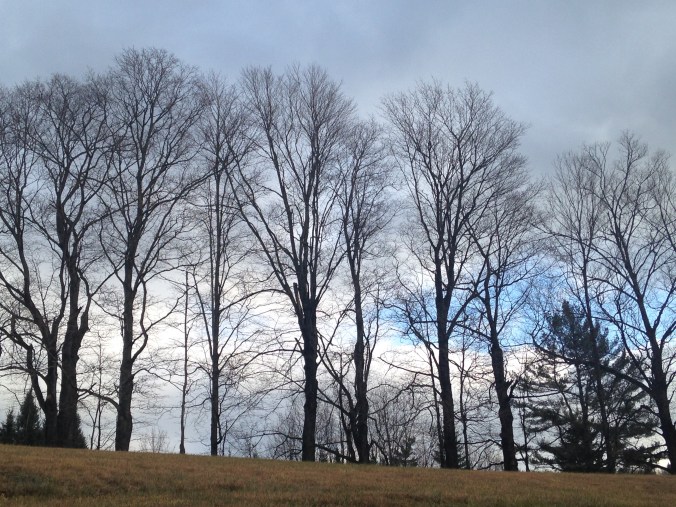
I was reminded of this, stopping along a roadside today, admiring how the trees knit into the sky. One of my childhood’s keenest memories is standing at the edge of a giant cornfield in Illinois, where our family was camping on one of our numerous cross country treks. I was likely ten, the age of my younger daughter now, and I stood with my father, excited as I have ever been about anything in my life. Good lord, all that corn and the sky! The world was limitless.

The true artist is never so lost in his imaginary world that he forgets the real world, where teenagers have a chemical propensity toward anguish, people between their thirties and forties have a tendency to get divorced, and people in their seventies have a tendency toward loneliness, poverty, self-pity, and sometimes anger. The true artist choses never to be a bad physician. He gets his sense of worth and honor from the conviction that art is powerful – even bad art.

John Gardner, The Art of Fiction

IMG_0405