Calendar (and actual) spring…

In my rinse-and-repeat pattern of this long winter, driving back from Dartmouth in the late morning, sunlight sprawling over the brown fields, the tree limbers along the interstate beginning the season’s cutting, I notice the Connecticut River has thawed. Unmutable sign the back of this mighty winter has cracked.

Home, my yard half-buried yet in twig-strewn snow, the ash buckets mark their winter resting place, a chaos of cinders that touch the edge of the quartz-pebbled rose garden my youngest and I made, years ago.

Later, a friend stops by with good cheer and belated and welcome Christmas presents. The sun is yet bright. We walk, slowly, slowly, on the short stretch of dead-end road before my house. I point to a robin perched in a pin cherry. She spies last summer’s hornet nest spun into the lilacs, a nest on the neighbor’s windowsill.

We were once neighbors ourselves. In mud season, we walked with our little kids up and down our back road, taking our time as the kids searched for frog eggs in the roadside ditches and tender green folds pushing up through matted brown leaves in the forest: the first spring beauties and trout lilies, bloodroot. Now, during my last hospitalization, her son repaired my daughter’s car, stayed for dinner and conversation.

Too snowy and wet to sit down, I lean against my car’s bumper. A robin chirps in the neighbors’ sugar maple, an expanse of curved trunk and branch and twig. Such a meager peep peep this rust-bellied hand-sized creature makes, prying winter away, thrusting our world towards nest building, egg laying, song.

“Against Panic” by Molly Fisk

You recall those times, I know you do, when the sun  

lifted its weight over a small rise to warm your face,   

when a parched day finally broke open, real rain   

sluicing down the sidewalk, rattling city maples   

and you so sure the end was here, life a house of cards   

tipped over, falling, hope’s last breath extinguished   

in a bitter wind. Oh, friend, search your memory again —   

beauty and relief are still there, only sleeping. 

Finding Jesus with the star sunglasses…

Home again and somewhat shocked to see an ice floe leering off my back roof, not exactly the size of A23a Iceberg, but approximating it….

I’m under strict orders to drink broth, eat saltines, lie on the couch and read — the last two I’ve been perfecting for months now. As for the rest of the order (this is the only thing you should be doing, Brett), I’ve been quietly breaking rules for years. Now, intimate with cancer and my mortality, I push myself to obey the orders, stick with the plan, follow the course precisely.

The winter thaws. The iceberg chips, shifts. I step outside and lean against my house in my down jacket that is now limp and beaten down, a sad thing that, this quarantined winter, I’ve used so little. How will my thousand words a day fit into these orders? A grant deadline looms. When will I put on my clean shoes and that linen sweater I knitted and return to work? A cardinal perches on the railing.

In those 48 hours I spent in the Dartmouth ER, in a beige isolation room, an upbeat nurse with amazing eyelashes occasionally stopped in to cheer me and whoever of my daughters was there. On the TV, which we never turned on, she pointed out a tiny orange plastic duck, and told us someone had placed small figurines all over the hospital. “I found Jesus,” she said. “I know that’s weird, to go around a hospital saying I’ve found the Man, but really…” She reached in her pocket and pulled out an inch-high plastic Jesus in a long robe, black curls, gold star sunglasses. He smiled so widely his teeth gleamed.

In that same room, I spied a second duck, brought the ducks home with me and lined them up on the bathroom mirror beside the wooden blue elephant from the Metropolitan Museum my daughter gave me. Two tiny things that arrived in my pocket, after a week of manifold things, after months of many manifold more. All day, it will rain, the warmth softening that iceberg on my roof, falling on the deck and breaking the wood, or not. If it’s broken, we’ll repair it this summer. If not, we’ll move on to the next thing.

And utterly seasonally inappropriate, here’s a Galway Kinnell poem I’ve been loving:

Blackberry Eating

I love to go out in late September
among the fat, overripe, icy, black blackberries
to eat blackberries for breakfast,
the stalks very prickly, a penalty
they earn for knowing the black art
of blackberry-making; and as I stand among them
lifting the stalks to my mouth, the ripest berries
fall almost unbidden to my tongue,
as words sometimes do, certain peculiar words
like strengths or squinched,
many-lettered, one-syllabled lumps,
which I squeeze, squinch open, and splurge well
in the silent, startled, icy, black language
of blackberry-eating in late September.

Mirth in the mirthless. A great mercy.

Mirth in messiness… another night drive to the ER, so cold, what were we leaning into? Five degrees, maybe six? The stars above the river ice a mockery of light. Kindness and Dilaudid, another scan, a hurry-up-and-wait, the three of us talking about nothing in particular save for a hike we once took in a thunderstorm and an orange water bottle confiscated (gone, forever) at the Albuquerque airport.

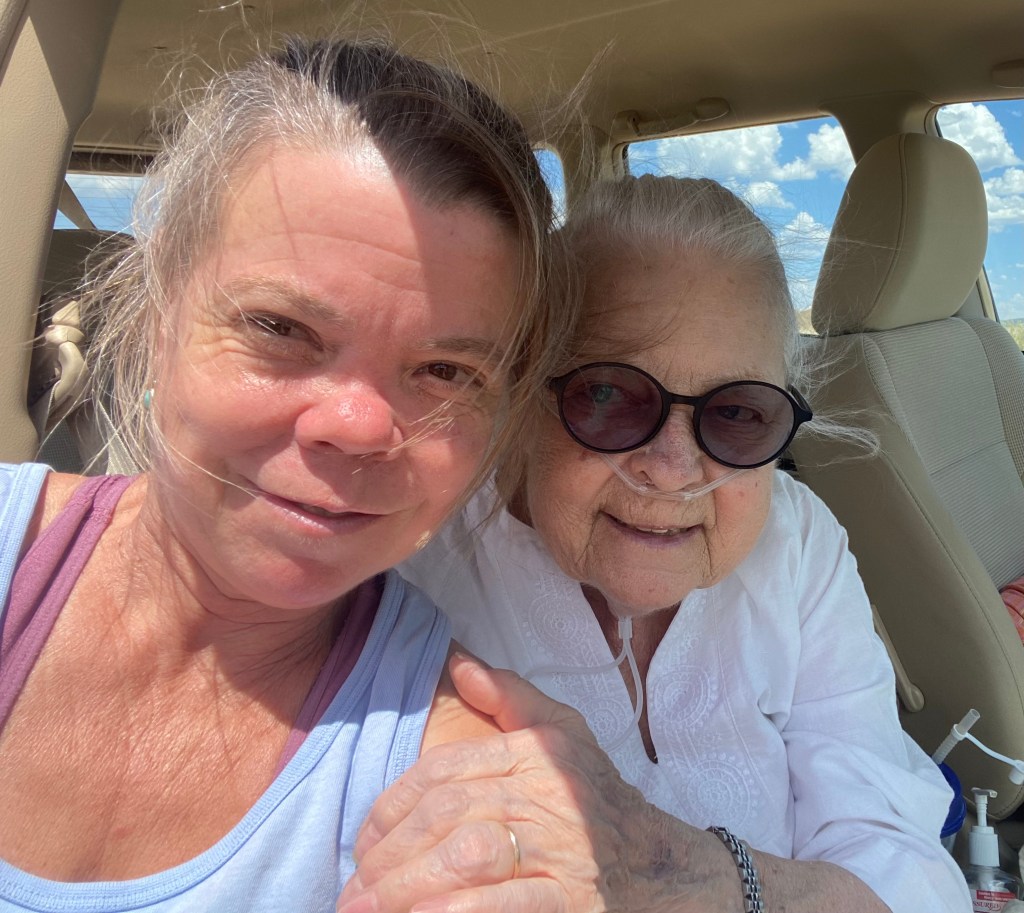
It’s the small hospital not far from our house, not the cancer complex with its soaring blue-green glass. On this zero-degree night, my daughter presses her feet against the room’s wall heater. There’s hardly any patients, save for a man we never see who insists that he must be heard. In the night of dim small lamps, I sleep and wake, talk with a woman from the high plateau country of the upper midwest. She remarks wistfully that Vermont is too tiny and cramped for the sweep of the midwestern sky. Maybe it’s just the Dilaudid, but when sleep folds over me, I dream of those childhood summers my siblings and cousins and I chased fireflies while the grownups drank bourbon and ate our leftover birthday cake and kept at their two-week conversation. The dew washed our bare feet.

The hospital morning flicks on before the sun has dulled the night’s darkness. Mirthless, indeed, I become, crabby with human lack and inhuman fate. Words, words, mine and others’, in a repeating loop. I text my nurse friend. On her lunch break, she appears, and then there’s laughter from nurses in my room. People come and go. I sign for more billing. (How much is this going to cost me, anyway?) The chaplain appears who’s read my book and wants to talk Flannery O’Connor and death. I’m not about to be funeral planning for myself anytime soon, but I plunge right into that death question. Indeed, this wretched cancer, my uninvited guest, perhaps the truest teacher of my life.

He asks, To know to savor every day?

Oh sure. But the disease has whittled me down to a glittering core, to ignore the petty fluff that not so long ago stung my eyes, and certainly my heart, too. What remains is real, both beautiful as those fireflies winking in the sultry midwest night, and ineffably, unbearably sorrowful.

I intend to live a long life; I’ll at least go on for some while, which is all any of us can say. In the meantime, this rarefied illness journey? Not lacking for writing material.

From Flannery O’Connor, The Habit of Being (1988):

In a sense sickness is a place, more instructive than a long trip to Europe, and it’s always a place where there’s no company, where nobody can follow. Sickness before death is a very appropriate thing and I think those who don’t have it miss one of God’s mercies.

Chemo ride…

… took a bitch turn. Dreaded day 5 passed (thank goodness for the amazing anti-nausea meds), but with the last bag of this poison/healing fluid, a fist immediately grabbed my chest and squeezed my breath. My cheeks coursed with blood.Terror, say the word, terror. So much back and forth, oxygen and treatments and more liquids through this purple spaghetti plastic that drip, drip, drips near my heart. I shook fiercely – rigors – the nurses said. I was stuck on the word as my molars hammered, rigors!, where is this hard ride taking me? The fluid was stopped with a promise not to start again until I knew.

In and out of a fog, a dream of a herringbone jacket with a pleated flair my youngest wore as a two-year-old. In the evening, a nurse sits with me. As the drip-drops begin again, she talks, right beside me, watching me, close eye, about this disease, about infection and rest, about what I will need to do and avoid – do not knick your fingers with a knife, no dirt, no cat litter, no flowers, no illness. I ease from tension and realize, yes, yes, I am still breathing, I am still taking in this toxin that quite possibly will save my life. I glance up at the round analog clock on the wall that reminds me and my brother of school days. These are the moments Burlington’s Phoenix Books is hosting the Almanac intro in an online event. In my haze, I imagine the Almanac editors and reading and answering questions, this book filled with farm dirt and blooming flowers, hay chaff and sneezing, insects and sheep, and stories – so many stories – of people working on this northern place on the globe. In my half-dream, exchanging novels to read with this steady stranger, I feel my place in the world opening up, both descending into the long trek of illness and healing and, miraculously, an upward course, too, as this illness strips me down. Your bone marrow, the stranger says, marrow, a word I love and have been content to let lie, bone marrow doing its bone marrow thing. All this is changing, too, from nature, from medicine, from my fierce intent to reclaim my body.

All of you who have traveled or will travel this journey, bone marrow and rigors and fear, how simultaneously far and yet close this feels, all of us.

….. Everyday, a dear friend texts me a poem read in her clear strong voice. Here’s Rilke’s “Let Darkness Be a Bell Tower”

Quiet friend who has come so far,

feel how your breathing makes more space around you.
Let this darkness be a bell tower
and you the bell. As you ring,

what batters you becomes your strength.
Move back and forth into the change.
What is it like, such intensity of pain?
If the drink is bitter, turn yourself to wine.

In this uncontainable night,
be the mystery at the crossroads of your senses,
the meaning discovered there.

And if the world has ceased to hear you,
say to the silent earth: I flow.
To the rushing water, speak: I am.

Sonnets to Orpheus II, 29

Human chaos, the desert.

Galisteo, New Mexico

My daughter sends word of rain and more rain in our Vermont world. Meanwhile, on the other side of the continent, visiting my father in New Mexico, we’re amazed by the hues of green. The desert’s rainy this year, too. In the afternoon, I work outside while a storm blows in. In New Mexico’s wide skies, sooty clouds may lower and threaten and yield not a drop of water, blowing elsewhere, breaking or not.

In this quiet, edge-of-the-greenbelt place, news comes to us, the President now ill, an election teetering any which way. We do the everyday familiar things — drink coffee and eat dinner, play cards, talk about my mother’s recent death, about each one of us. After dark, the two girls and I stand outside in the dark in the cool rain, breathing in that ineffably sweet fragrance of the rain-damp desert. Wind shakes the junipers. Here, at fifty, I seem to be carrying a goblet of my life, the wind in the junipers one of the very first sounds I remember as a little girl, so many trips crisscross between Vermont and the desert, the enthusiasm of these young women with me who have seen so much of this world already, so eager they are for more, more of life. Later, when the girls are whispering and laughing in bed, the rain falling, the breeze blowing through the window, I feel that endless ancient desert around me, the calling coyotes, dwarfing for this moment even our human chaos.

Growth.

In these days of long light, my daughter and I are drinking tea and talking on our glassed-in porch when she spies a fox walking along the lilacs that fence us from the road. The red fox, a real beauty, turns and looks at us.

June has been a season of the wild pushing in — the prolific groundhogs (and my thoughts will come to naught about this, but I’m wishing for a more even ratio of groundhog to fox, for my garden’s sake), the multiplicity of birds, raccoon and possum, the circling turkey vultures. This year, too, my garden grows half-wild, the amaranth reseeding around the Brussels sprouts, coreopsis sailing over the fence. One morning, I straighten and pause, brushing dirt from my fingers, when I spy a fox staring at me through the layers of hydrangea and pin cherry trees. For a time without borders, we hold each other’s gaze. What passes between us is a wordless language, with no clear question or agreement. Maybe simply curiosity.

There’s plenty of the human chatter around me these days, much of it rippling up in chaotic waves. But then, this, too. Last night, poetry at a rural arts center, with all the best things of Vermont June: wildflowers and the pleasure of company, the beauty of words stitched finely together.

…. Last, never least, here’s some words about the unsurpassable Vermont novelist Jeffrey Lent, in need of a little lift…

Child

How you’ve grown, child

of mine—pearl from my oyster,

you sparkle like snow. 

Mary Elder Jacobsen