Harrowed Up Heart.

As part of the 2050 project, I’m asked to read at Newbury’s Tenney Library, surely one of the prettiest Vermont libraries, and Vermont has plenty of these. The crowd is full and cheery, the snacks are sweet, the librarian gives me a tour of this enchanted place, built inside as a series of arches. The original gas lamps have been converted to electricity, and I ponder what it was like in 1910 or so, coming in from a slushy afternoon to a warm and glowing library.

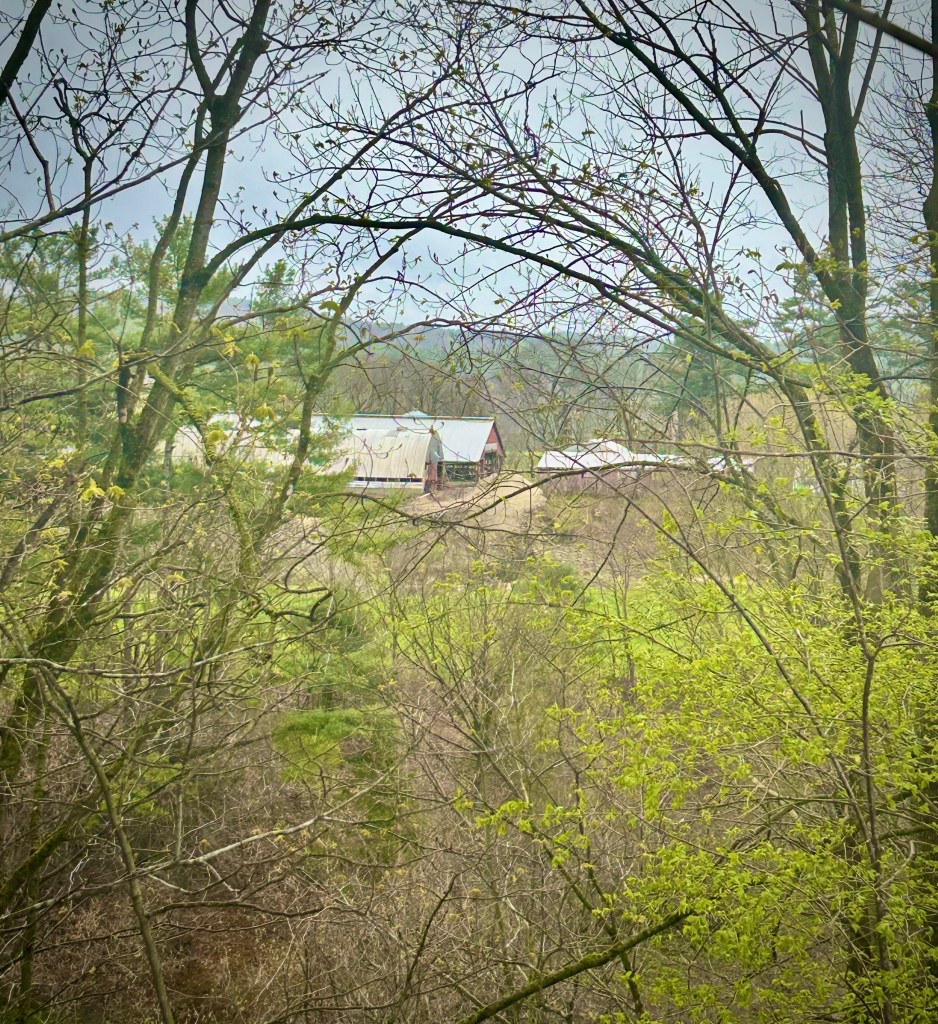
Newbury is a town on the Connecticut River, the village high on a bluff. Before I head out, I walk across the street and behind a church. Through the trees and brambles that are just tufting with green, enormous fields stretch along the river, long rectangles of emerald, others black earth harrowed up for planting.

I linger, shivering a little in my wool sweater, hands jammed in my jeans pockets. Early May, spring season of promise. That plowed-up land, the blue swoop of the river, the invincible thrust of spring pushing mightily through the chill — such happiness here. I head not back to the interstate, but up a mountain’s dirt road, to a house surrounded by green and blooming daffodils and a tangle of apple trees. A lovely couple invited the readers to dinner. The couple is both humorous and gracious, the conversation full of the idiosyncrasies of local talk and global concerns. The pleasant evening drifts into night, from eggplant to lemon tart. Exhaustion, my now familiar, weighs my bones. After thankyous, I stand outstanding in the cold wet, breathing what might be the spicy scent of daffodils growing, threading through in my mind the unfamiliar roads I’ll follow home. Then I let that worry go and simply breathe, damp spring holding me, as if I’m a daffodil, too.


“Like daffodils in the early days of spring, my neurons were resprouting receptors as the winter of the illness ebbed.”
― Susannah Cahalan, Brain on Fire

Bone Marrow.

The co-op cashier confides to me as she rings up my tomato and a loaf of bread that she loves this weather — brilliant sun interspersed with downpours. “Must be the Irish in me.”

The past few weeks have been a kind of July bonus: great growth in early June. My apple trees brushed out. I’ve placed an old desk and weathered chair on my covered porch. Recently, carrying out my laptop, I saw the desk sprinkled with gold pollen as if magic had swept through in the night. What luck, I thought, sat down and sneezed, worked.

I am of the wary bent, not to crow, don’t reveal a royal flush, a full house, for god’s sake don’t invite in bad fortune. At the little farmstand around Woodbury Lake, I park and walk behind the dilapidated barn towards the greenhouses, in search of a few more flowers for my garden, to fatten out the echinacea the groundhogs ate last year. In the tiny house, a dog barks. The farmer steps out and calls to me, my former library patron. He sings, “I’m saying it! I’m loving this.”

His words, not mine. Mine are this: in this northern realm, take in the sun and the green, store these gems in your marrow.

What Nourishes Us.

On my way home from Bookstock — a terrific book festival in Woodstock, Vermont — I stop at a farmstand for strawberries. I’m a little dizzy with heat, with talking, with the sheer writingness of the day. No one’s around, and I admire the lake across the road.

The farm owner backs up his truck. End of the day, he’s pulling in what remains in the wooden stand. We talk for a little about the pontoon boats and how the lake is surprisingly deep at his shoreline across the road, a perfect temperature for swimming.

He tells me about the alarm that sounded in his greenhouse recently when the overnight temperature dipped near to forty. We’re standing in near-90 degree heat but Vermont weather is fickle. The farm owner was a patron in the library where I worked. I bought political books for him that maybe no one else but he and I read. Cold winter days, he’d sometimes appear and read silently for an afternoon and then leave with a stack of books.

This day I’ve driven on blue highways down the heart of Vermont, along rivers and through narrow valleys, past homesteads with fat gardens, through classic white clapboard villages and a town center dominated by a post office and a rusting flag pole. On one farm, TRUMP is painted on a metal storage box beside the farmhouse where the roof is bitten out in pieces. Lilac bushes cover the first floor windows. An RV in the side yard appears to be the occupied space.

I buy two pints of strawberries. The farmer loads up his truck. I stand at dusty roadside in the hot breeze. Bring it on, I think. Summer. The strawberries are the sweetest I’ve tasted in years. Nourishment from the goddesses.

Somewhere in Snowy Spring….

Through a few inches of snow, I follow stone steps down to nearby Lake Caspian, winding around a cedar-shingled house, holding a railing someone has taken the care to build, baluster by baluster.

The homeowner wants to build a tiny boathouse by the shoreline. While I listen to his plans, I eye the lake visible beneath the bent that hang over the lake. Although I’m wearing my winter coat, I imagine wading in, sweeping my fingers in the cold water.

The few of us stand among white birches, sharing names and stories. Because this is Vermont, we talk about the weather, the need for precipitation, and how everyone’s wood pile is faring. We make our way back up the hill, still talking.

A robin, in a crazed songbird rush, swoops by, nearing clipping one woman’s ear. She laughs.

It’s Saturday. Later that afternoon, I’ll stand in my driveway, talking with my friend about the fat list of things that worry and stress us. But for this half hour or so, I visit with acquaintances and strangers, talking about the area’s barns, how these great structures were built with care. Some remain; some are simply memories.

For listening recommendations, my father passed along this link to This American Life‘s Three Miles.

Chance Encounter

Rain? Snow? Sleet? A mixture of all falls this morning.

Rounding a bend on a snow-covered dirt road in East Hardwick yesterday morning, I suddenly brake when hundreds of little black birds cover the road. There’s no one behind me, no one ahead of me, and I get out. A few birds flutter upward and perch on the electric wires, strewn already with these little creatures.

I’m at at farm, near a manure pit. Through the barn’s open sides, I see cows twisting their heads.

The birds don’t move. I don’t move. Then, eventually, because I’m a human and the birds are wild, I get back in my car and nudge forward slowly. Grudgingly — or maybe patiently — the birds part to the fields and the wires, and I move on.

Still February here.

On snowy afternoons there is a special blessedness in saying, oh it is too snowy to chop wood this afternoon. And the gray snow sifts down, and one takes off one’s boots and sits by the fire and is glad of the way wool socks smell; and a pie is baking in the oven, and the gray snow is sifting down.

— Elliott Merrick, Green Mountain Farm

Happy April is Poetry Month

The other night I heard Leland Kinsey read from his new book of poems, Galvanized, at the Galaxy Bookshop in Hardwick. Leaving home on a weeknight is always a pain, with homework rearing up, dinner dishes, and – although it’s only ten minutes – the ten minutes in the car to drive. I’m always glad when I get to the bookstore, though. The company is familiar and jovial; the books are terrific.

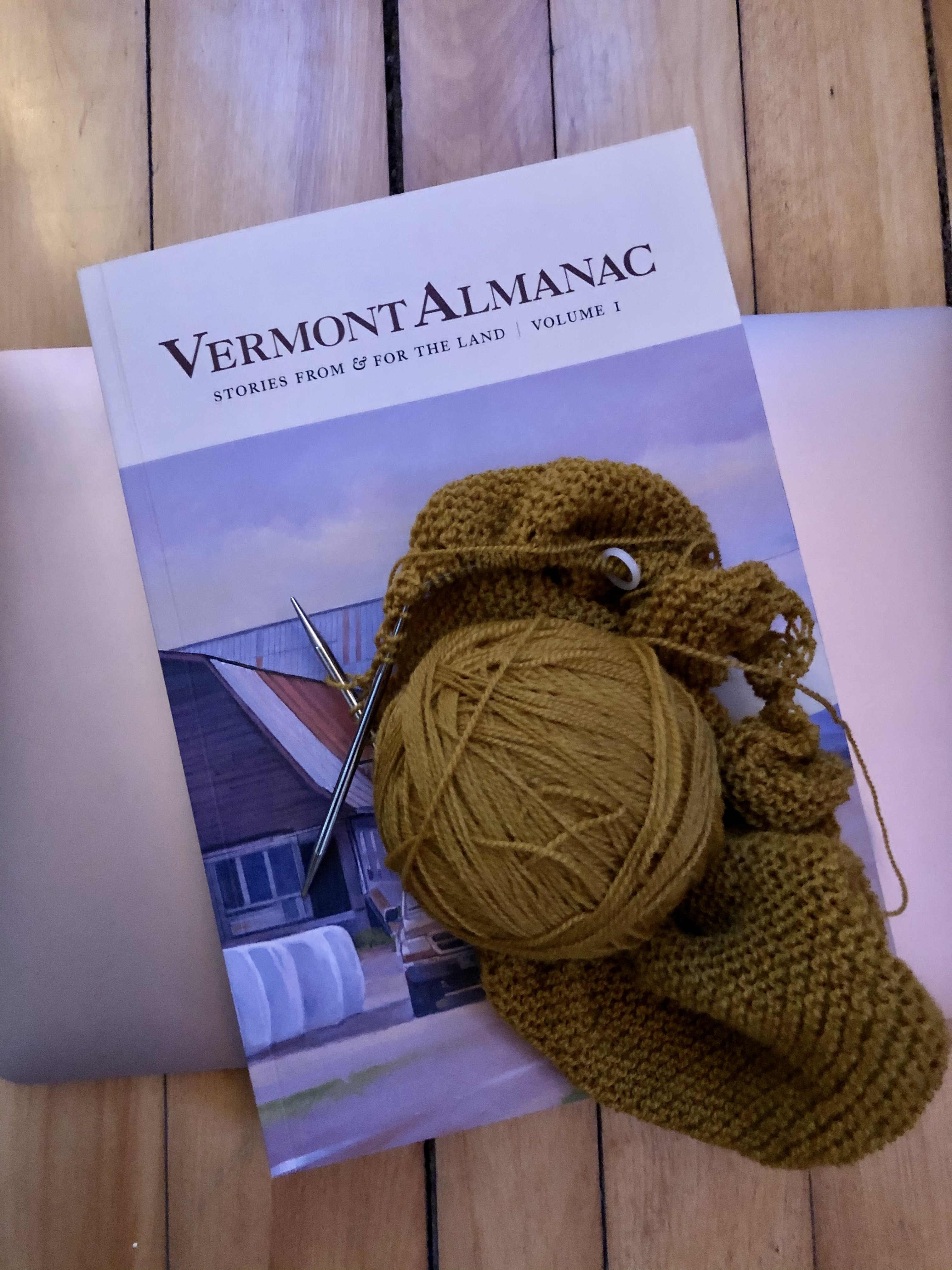
I’ve been to many, many readings at this Hardwick bookstore, but this reading was particularly fine. I’d brought my knitting, but I left it in my lap, untouched. A couple in the back had come with their baby, and the little one’s babbles wove beneath Leland’s voice. Leland hails from a lengthy line of Vermont farmers, and his poetry is strewn with glacial erratics, swallows, ponds  – with a keen awareness of mortality, of hard physical work, of human frailty, and love. Perhaps what I admire most about his poetry is that constant thread of beauty, winding all through his words like that baby’s murmur.

Galvanized is a collection of poems suffused with life, penetrating into the deepest recesses of our lives, a book of laughter and tears and beauty, the matter of our everyday lives. Isn’t that what poetry is all about?

…. The same uncle said recently about a blue suit,
“I bought it to be laid out in;
now I’m wearing it to the wakes of others.
Life takes so long.”

Wear.

From “Deer Camp,” Leland Kinsey, in Galvanized

FullSizeRender.jpg

Barre, Vermont/Photo by Molly S.