Romance into the Grave?

Just on the other side of my garden lies a town cemetery, wisely placed far above Hardwick’s flood plain, with a rooftop view of the village, built on a sandy hillside and along a river. Interestingly, the villagers frequently use the cemetery as a public green space, and older women with little dogs or couples holding hands frequently pass by my elderberries.

New to this house, my daughters and I leap the fence and are beginning to know these stones – names and dates and what little local lore we’ve garnered.

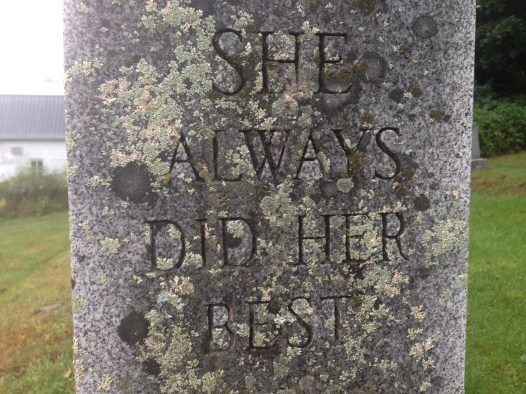
Our favorite is the couple with a pithy phrase on one side – She always did her best – and on the other end – He did not. Our visitors usually pause, blinking, and then laugh out loud.

By the dates, I notice he died twenty years before his wife.

Revenge or love? It must be love. My daughters and I – we’re sticking with that theory.

We could have some arrangement
By which I’d bind myself to keep hands off
Anything special you’re a-mind to name.
Though I don’t like such things ’twixt those that love.
Two that don’t love can’t live together without them.
But two that do can’t live together with them.
From Robert Frost’s “Home Burial”
IMG_1875

Hardwick, Vermont

Depths of Domesticity

In a cold rain, my teenager heads out to the barn in search of a saw and a just-right piece of wood, then disappears upstairs with her wood-burning tool. The younger girl spreads between the kitchen table and oven, baking mini-eclairs.

Not so long ago, the girls were toddlers, with me trailing behind, frazzled and tired.  While I believed they were so needy as little girls, I was likely wrong, caught up in our society’s crazy ideas of overparenting. Even then, my girls were writing their own stories, learning the ways of the world – beginning with nursing (and more nursing and yet more nursing), with skinned knees and bruised shins, with making friends, once sharing stories about a beloved stuffed Piglet and now trading their own girl secrets.

While I’m in the dining room, in my own writing world, my daughters are writing and rewriting their own lives. Toddlerhood is darling, but this is cool, too.

How do you begin to tell your own story?

Jacqueline Woodson, Another Brooklyn

FullSizeRender


A Single, Superlative Sentence

Like this cold September (what? covering gardens already?), reading Knausgaard is both exasperating and mesmerizing. Does he really live in a house with small children and can write about minutiae?

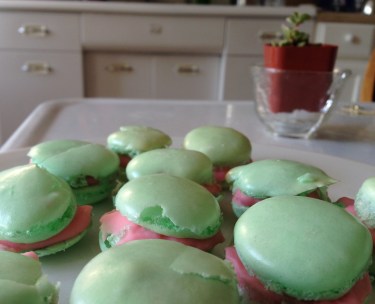
Reading at the kitchen table, my bare toes rub over the sugary effluvia of lime-green macaroon making on the floor. I keep reading.

The children wander in for more macaroons, my daughter’s afternoon vision yielding these quarter-sized airy sandwiches with a pink sweet filling.  While I was in the other room, trying not to listen while tediously working on a paid project, the girls, left to themselves, experimented with baking whipped egg whites (Wow, that’s weird), periodically carrying in a baking sheet of baked samples, the hot sugar still bubbling from the oven, asking my unskilled opinion. In the end, they assembled two dozen uneven tiny cakes, dripping filling. Extremely satisfied, they stand back. Look.

Writing this, I realize (again) our life is all minutiae. Maybe that’s the gem of having children – tiny things mixed in with cosmologically-sized love – Blake’s world in a grain of sand.

Check out this sentence about ancient triceratops and reading to children at bedtime.

That petrol (in a puddle) was extracted from crude oil, which was brought up from reservoirs deep under the ground and consisted of transformed organic matter from a time when human beings didn’t exist, only dinosaurs, those gigantic but simple creatures, and when trees and plants too were larger and simpler, and that it was the prehistoric force of that zoological and biological matter which now unfolded around us, all this made sense – the kinship between the bulldozer and the dinosaur was obvious to any child – but not the connection between the power of petrol and the mysterious beauty of the small trembling rainbow swirls in the many puddles of the 1970s.

Karl Ove Knausgaard, Autumn

FullSizeRender


Library Book Find

These early August morning, mist nestles around the house. Laundry left overnight on the line wets again. I’m reminded of the first three days I lived in Vermont – 18-years-old, in unbroken mist, concealing this new landscape. I had no idea where I had arrived.

Reading Knausgaard is akin to entering fog – uncharted, mesmerizing. Years ago, on a long expedition with my girls, I insisted we would take only what we could carry. At one repacking stage, my older daughter lifted a heavy hardcover book from my backpack and demanded, What’s this?

Knausgaard. Here’s a few lines from his latest:

What makes life worth living?

No child asks itself that question. To children life is self-evident. Life goes without saying: whether it is good or bad makes no difference. This is because children don’t see the world, don’t observe the world, don’t contemplate the world, but are so deeply immersed in the world that they don’t distinguish between it and their own selves. Not until that happens, until a distance appears between what they are and what the world is, does the question arise: what makes life worth living?

Karl Ove Knausgaard, Autumn

image2

Photo by Molly S.


Art? Why?

Yesterday, while the 12-year-old girls swam in Greensboro’s perfectly clear Lake Caspian, I read on the beach, just me and a few gulls, a pair of kayakers pushing off. An older woman wandered down and waded into the water and said only kids could swim in that water, and then left, too. The girls had swam out and were experimenting with laughing underwater.

Later, we went to Bread and Puppet’s outdoor theater, sprawled in the hot sun. Coming home, the girls swam again, while I eavesdropped on a pleasant conversation between our former pediatrician, his wife, and friends.

I kept thinking, What does art matter, anyway?, all this barefoot and Blundstone-shod performance in the field? What does poetry, fiction, song, mean, anyway? The more I thought, I wondered if my question was wrong, if the answer lay in who was listening, like myself listening to those 12-year-old girls. Maybe art is like that a cappella hymn, voices raised in harmony and confidence, to the variated audience, the shape of the earth, the enormous pine trees, and all that sky, blue and shifting with clouds, over field and forest, highways and water, on and on, and on.

Maybe my question, like a koan, holds the answer.

A painter should begin every canvas with a wash of black, because all things in nature are dark except where exposed by the light.

– Leonardo da Vinci

IMG_1758

Postcards from Charlottesville

My daughter and her friend dug into boxes of records and gleaned out The Beatles, set up the stereo and record player in our barn, and cranked up The White Album. They hung up the hammock, strung lights around the walls, and then – needing a disco ball – smashed a mirror and hot-glued shards on a soccer ball.

While I wander around the edges, moving from chore to chore – nothing egregiously awful, but edgy and dissatisfied, preoccupied with I’m thinking – the girls are in the barn, creatively busy, smiling, wanting only a break to go swimming and eat ice cream sundaes.

Later, in the dark, I go for a walk in the adjoining cemetery, familiar enough with these paths that I can walk both by the scant light and my memory. The crescent moon rises in the black sky, over the mountain ridge and our house, where I see the girls’ string of Christmas lights shining. I pause, noting the moon’s hue. Tinged amber? Faintly orange?

Then I wise up and just stand there, shivering a little in my sweater, admiring this slice of moon, autumn creeping near.

… I have been there all along and this, I suddenly and certainly know, is motherhood; this mere sufficiency, this presence. With every cry she has tutored me, in what is plain and hard: that my affection, my silly entertainments, my doting hours, the particular self I tried to bring to my care of her, have been as superfluous as my fury and despair. All that is required is for me to be there….

– Rachel Cusk, A Life’s Work: On Becoming a Mother

My sister, Tanya Stanciu, who lives in Charlottesville sent these photos.

IMG_3048IMG_3049IMG_3051IMG_3052