Autumn, Now

Talking to my brother while frying sausages with garden greens for dinner, I mention the girls and I have just gone swimming, with the temperature high in the 80s. He says, The climate isn’t changing; the days are just getting warmer. I immediately take the phase and turn it around to reflect something inane in my own life. We’re going to use that joke for years to come.

At a soccer game, another parent mentions he’s been watching Ken Burns’ Vietnam series, and he offers that his dad served a tour in Vietnam. I share my memories of my father watching Walter Cronkite every night and drinking bourbon, fiercely opposed to that war.

Collectively, as a parent group, we wonder what our kids will remember about these years; as adults now, we sense tension rising in our own rural Vermont. But these September days are balmy and beautiful. We cease talking and admire dragonflies nipping by, fat shafts of sunlight between us filled with dust. Even when the girls have hit the locker room, and then scamper around us, hungry, we keep on admiring, filled with the great good luck of being alive on such a day, mothers and fathers of healthy strong girls, at a leisurely, end-of-the-day soccer game.

The summer moon.
There are a lot of paper lanterns
On the street.

– Buson

IMG_2005

Neighbors

While my 12-year-old was turning cartwheels on the grass, I leaped over the fence last night into the cemetery and stepped between two enormous, fragrant hydrangeas, their blooms just beginning to brown and fade. My daughter followed me over the fence and turned a few cartwheels down the slope.

Spread over one of the highest points in the village, the cemetery’s view gazes down at the few streets of houses, the brook and river concealed in the foliage, and the rise of Buffalo Mountain across the way. From here, the village is small, cradled in the green-turning-to-gold-and-red forest which far outsizes the town.

All summer, we’ve begun to know the village’s patterns – how the traffic rises in the morning, ebbs off in the day, then rises again. How on warm evenings, certain porches fill with talking people or other folks simply sitting, watching the evening go down, phones glowing in their hands. Across the cemetery is a house often lit with the white twinkling lights like ours, and whoever lives there burns a campfire behind a fence of lilacs.

Late nights and early mornings, the darkness lies thickly through the slumbering town.

My daughter leaped back over the fence and stretched out her hand to hold the bouquet of blossoms I’d snatched, so I could jump over, too.

The home is the center of life. It is a refuge from the grind of work, the pressure of school, and the menace of the streets. We say that at home, we can “be ourselves.” Everywhere else, we are someone else. At home, we remove our masks.

– Matthew Desmond, Evicted: Poverty and Profit in the American City

FullSizeRender.jpg

front door

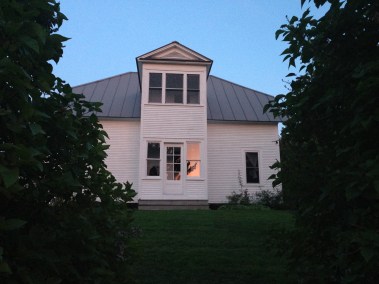
Home/Place

My our tiny place on the planet is reveling in summeresque weather; I write this, knowing days are not far off when our collective Vermont shoulders will brace against the polar vortex. Meanwhile, the sweet warm air brims with dragonflies and fluttering insect life galore.

If there’s one theme – for what that word may be worth – that might struggle up to the surface of my writing life, it’s likely interconnectedness. So many of the bad decisions I’ve made have stemmed from my own blind ignorance – not understanding how this led to that and why this other thing was a factor, too. Years ago, when I first started college, a professor very simply pointed out that some things we can see with our eyes, and some things we can’t, but that doesn’t make those unseen things any less real.

When my daughters and I talk about the hurricane season roaring in, far from us, or Trump’s public words about Charlottesville, I find myself saying I don’t know, surrounded by the vastness of these things. Begin with questions, I keep reminding my girls and myself. Questions are a real place, too.

Here’s one of the ending paragraphs from this fine book:

I wanted to try to write a book about poverty that didn’t focus exclusively on poor people or poor places. Poverty was a relationship, I thought, involving poor and rich people alike. To understand poverty, I needed to understand that relationship. This sent me searching for a process that bound poor and rich people together in mutual dependence and struggle. Eviction was such a process.

– Matthew Desmond, Evicted: Poverty and Profit in the American City

FullSizeRender.jpg

Where We Live, Hardwick, VT


Myriad Memories – and Now

Hiking down the Zealand trail with my brother in New Hampshire’s White Mountains, he suggests taking a spur to “somewhere with a really good view.” My 12-year-old is more game than I expect, and we hike along an easy wooded path, in a valley where he and I surmise a railroad must have been laid for logging, many many decades ago. It takes longer than we imagined, because, well, hiking always takes longer.

Suddenly, the woods drop away, and the view is way more than terrific. It’s unbelievable. High above, sheer granite cliffs end in autumn-yellow woods. We step out on enormous granite boulders and gaze up and down the valley, flanked on either side by steep mountains. In the distance at one end, we see the Zealand Falls hut; to the other side, the valley funnels down to silhouettes of blue mountain ranges.

We spread out on the rock. It’s just the three of us and a dog and the sunlight and the leftover blue cheese and chips from lunch. My daughter’s brought beer for my brother, and she’s proud that it’s still cold. In the mountain valley, with foliage turning scarlet in flashes against a muted sea of gold, the place reminds me of Frijoles Canyon in New Mexico, of Washington’s Mt. Baker territory where I lived as a grad student, of so many hikes I’ve taken with my daughters. All the best memories of my hiking life are folded into this one wide valley.

My daughter wanders off with the dog. My brother and I talk about hikes we took together as kids, laughing about how we never packed enough water. A raven calls, and then another answers. We stay there for a good long while, in no great rush about anything, talking, surrounded by all that landscape, all those layers of mysterious life in the forest and the river below, those lines of receding mountain ridges leading to the sea.

The autumn evening.
The buses are in line,
One goes out.

– Nakamura Teijo

FullSizeRender.jpg

In a Darkened Theater

This week, I interviewed an author who had written what seemed to me the odd choice of a childhood memoir-in-verse, but she explained she chose that form because memory comes and goes in bits, not separated into blocky and linear chapters and paragraphs.

I kept thinking of her words yesterday, separated from a sunlight-sparkling autumn day in a second-floor opera house theater, as I listened to trains whistling through town. The warning calls punctuated a very adult conference about children’s literature, and my attention kept straying to those mournful sounds as the trains chugged their slowed way through town. Like a fishing hook, the notes pulled up my memories, reminding me that the last time I had been in White River Junction was three years ago, myself and my family riding through on Amtrak, looking through the windows at this brick-building Main Street and wondering who lived here.

At the conference’s end, impatient to leave and return to my own life, to hurry home along the interstate flanked by maples turning red, a woman read aloud a children’s book I had heard as very young child. I put down the sweater I was knitting and just listened to the words, familiar from long ago. The train whistles kept calling: a collage of memory.

You think your pain and your heartbreak are unprecedented in the history of the world, but then you read. It was books that taught me that the things that tormented me most were the very things that connected me with all the people who were alive, who had ever been alive.

– James Baldwin

Tiny Treasure

A little boy, maybe six, came into the library yesterday with his hand cupped around some precious thing. I had propped the door open to let in the warm September sunlight and a few stray flies. His short hair sweat-soaked, he wore a t-shirt so large it nearly covered his knees.

He laid a crumpled bird shell near my laptop and asked me to keep it safe. I found it, he said by explanation.

The boy was supposed to be somewhere else, and we heard an adult outside calling his name. On his way out, his hand hovered over an apple on my desk, a yellow-skinned fruit with a few dark blemishes I had picked from a wild tree that afternoon, walking to the post office.

I told him it wasn’t sweet, as I lifted the apple and handed it to him.

September’s such a quiet month, with the cricket songs slowly spinning quieter. Wordlessly, he considered, and then he took the apple and disappeared into the sunlight again.

I wondered if the boy would return for his treasure. He did.

Soon the child’s clear eye is clouded over by ideas and opinions, preconceptions, and abstractions…. Not until years later does an instinct come that a vital sense of mystery has been withdrawn. The sun glints through the pines and the heart is pierced in a moment of beauty and strange pain, like a memory of paradise. After that day, we become seekers.

– Peter Matthiessen

IMG_1900.JPG

Nichols Ledge, Woodbury, Vermont