October, Vermont

This has been a terrible week in Vermont news, involving brutal violence against young women, their mothers, and their children. I don’t usually write about violence and domesticity, for a very raw reason: I am one of those women who called the state police into her home, not once, not twice, but seven times in a period of days. But my life – and my daughters’ lives – did not end in bloodshed. Last night, I said goodnight to my daughters as they spoke to each other while lying in their beds, with their doors open across the hall. We live in a house where a Christmas cactus blooms profusely.

While I struggle with the usual junk – a too sparse income, a book I’m trying to sell – I consider myself unbelievably lucky. At certain junctures, our lives could literally diverge either one way or another, and sometimes those places may span out lengthily, over days or weeks, or sometimes nothing more than seconds: the driver that swerved and did not hit the child, the plane missed by moments that later fell from the sky.

Those intangibles, in so many ways, drive our lives: I remind myself, over and over, that it matters whether I see the world with bitterness or with gratitude. As my brother once impressed on me, there are things that cannot be undone. Violence is one of those things. In my life, the sage kindness of strangers pushed my life away from an abyss. That’s a debt I owe to the world, and I debt I intend to repay in largesse, one way or another, to a world that is sometimes beneficent and sometimes unimaginably brutal.

Most people are afraid of the dark. Literally when it comes to children, while many adults fear, above all, the darkness that is the unknown, the unseeable, the obscure. And yet the night in which distinctions and definitions cannot be readily made is the same night in which love is made, in which things merge, change, become enchanted, aroused, impregnated, possessed, released, renewed.

– Rebecca Solnit, Men Explain Things To Me

Light

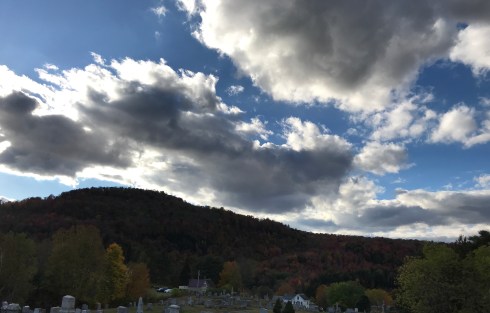
On a late afternoon, I walked out of the Montpelier Library and down the street. The trees along the street were shedding their pale yellow leaves in a balmy, golden light; the sidewalks were busy with children, the afternoon commute already inching its way home.

I walk this way frequently, and always, at one particular place, in front of the stately Montpelier Inn, I remember one evening I stood there, many years ago, with my baby daughter on my back. It was late October then, although I don’t remember any cold. Instead, I remember swaying from foot to foot, already habituated to holding a baby – in my arms or on my back – and watching the twilight creep in, the day’s pale light slowly passing to dusk.

I remember that afternoon-slash-evening as one of the longest pauses in my adult life, waiting for someone who never appeared. Later, I realized my message had gotten lost along the way.

It’s odd, how even in the sunniest and lightest moments of our lives, there’s the past we keep walking through – and I do keep walking, every time, heading back into the busyness of my life – this afternoon, at least, graced with that lovely autumn light.

The trees go on burning
Without ravage of loss or disorder.

From Donald Hall’s “Letter In Autumn”

IMG_0037.jpg


Round and Round

Autumn is my Proust’s cup of tea, recollecting for me all those childhood afternoons I walked home from elementary school, scuffing through knee-piles of fallen leaves, as they crumbled and broke, releasing their rich humusy scent.

Each morning, my 12-year-old hoists her backpack and walks across the dewy lawn, leaping over the chain link and heading down the cemetery hill. Sometimes she looks back over her shoulder to see if I’m watching; sometimes she disappears into her day without a look back, unconsciously and imaginatively creating her own teacup of memories.

While the landscape shines postcard-pretty, behind our back porch the  box elders shake loose their leaves, and up-close we’re beginning to see what was hidden under the summer’s greenery. My 12-year-old fantasizes about a zip line from the porch deep into the ravine. Her eyes sparkle as she imagines flying down that ravine, deep into the heart of a place not yet well-known.

this piercing cold—
in the bedroom, I have stepped
on my dead wife’s comb


– Ueda

IMG_0024

Wide Wingspan

As a kid, I believed bald eagles were in the same otherworldly category as unicorns: other than in a picture, I never imagined seeing these enormous birds.

Today, I walked towards my girls in the car, all of us in a little rush to get somewhere, when a bald eagle soared overhead. I called for the girls. They got out of the car, and we stood looking up and talking, watching the eagle glide over the rooftop and through the pines, before we continued on with what we were doing.

The eagles are always amazing, always stunningly intent on their prey. In times of enormous stress, I’ve imagined myself a coyote, feral-natured, a singular predator.

The world does change. We are neither one thing or another. Bald eagles may not be ubiquitous in my lifetime, but these beauties are edging into the landscape of my daughters’ childhood. I stood there, the golden autumn around us, taking note.

We are truly blessed because we
Were born, and die soon within a
True circle of motion,
Like eagle rounding out the morning
Inside us.
We pray that it will be done
In beauty.
In beauty.
Joy Harjo, “Eagle Poem”
IMG_0018

Small Find

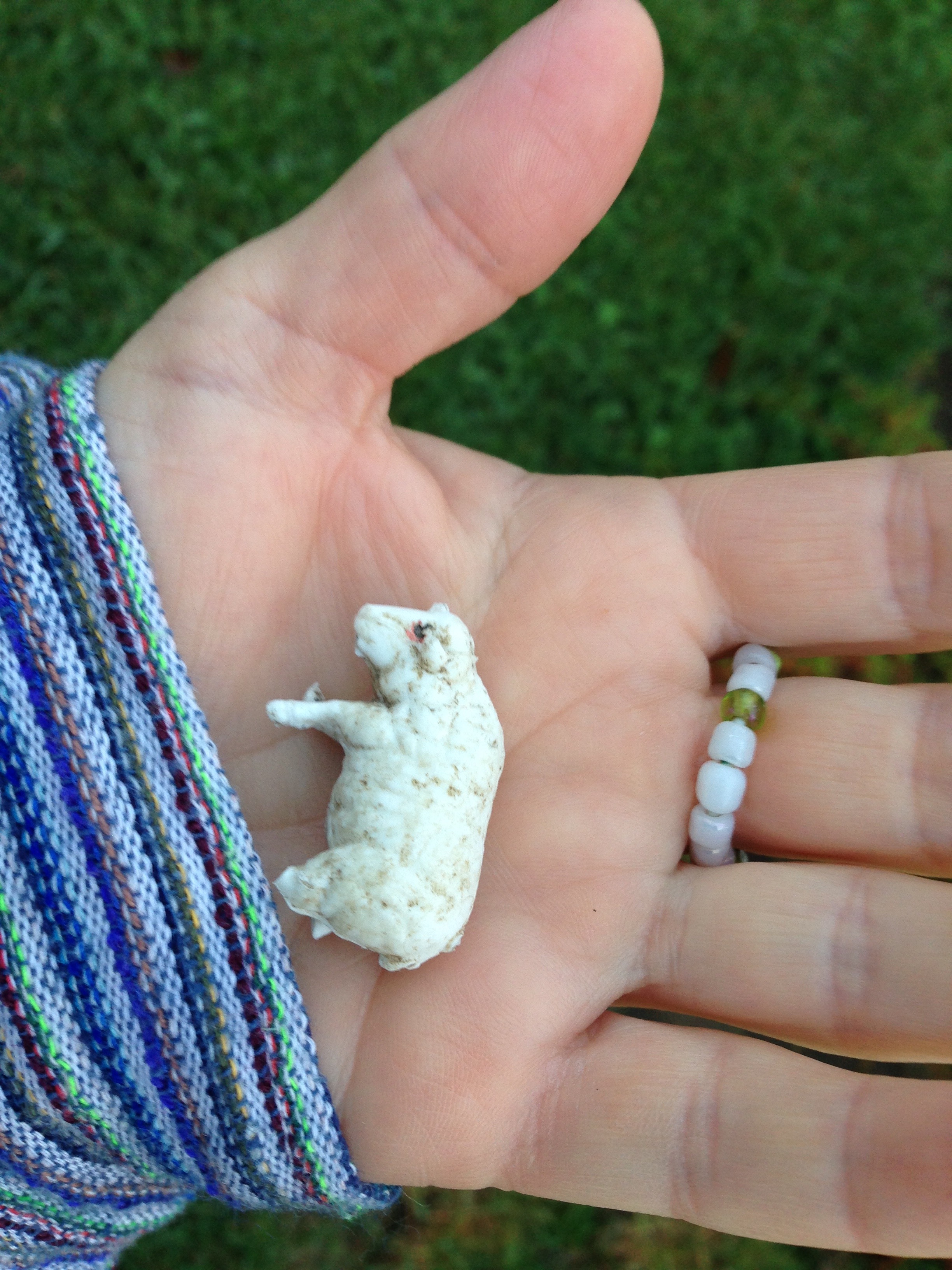
Rain unearthed a tiny toy from the cotoneaster’s soil I planted a few weeks ago – a plastic white ram smaller than the length of my thumb.

The soil’s sandy here, loamier on the house’s southern side where an immense mock orange stretches nearly to the second-floor bedroom windows.

My archeological find, near the barn’s ramp, is good child’s play area, near the house but not too near, cool in grass in the summer, with the cement a fine place to spread out small toys. Orange tiger lilies and silver-lavender allium spread tenaciously along the barn’s side, and I’d like to think some small child knelt in the grass there, happy to be home from school, entranced in the roaming world of her or his ram and animal companions. I’d prefer to think this creature, its back legs gnawed or worn at its hooves, wasn’t discarded carelessly.

I gave the animal to my daughter, youngest at the house now. Folded in her hand, she carried it on a walk all through town, then laid it on the windowsill beside a geranium, in the sun.

Somewhere, Heidegger says we are constantly tumbling towards death, and every once in a while we get a clear glimpse of this fact. We must then adjust our minds to accommodate the new knowledge. It makes us sadder, but also more urgent in our living, more aware that lives are fragile, ephemeral, not to be wished away. It make us, it should make us, humble.

From my recent interlibrary loan, Pitiful Criminals, by Greg Bottoms

Tiny Footsteps

Rain began in the night, the first we’ve had in a long time – unusual in Vermont where rain is often ubiquitous. I lay awake in the night, listening to the storm wash over the roof, listening to the wind and water blow in from the east. We’ve lived in this house such a short time that rain on the roof is still new to us. In our former house, the roof was so poorly insulated, weather pounded hard on the metal, and the girls and I find ourselves listening in this house: what’s happening?

I got up and went downstairs and outside in my bare feet, leaning against the house in the dark, sheltered from the rain beneath the porch’s overhang. In our old house, I often went outside in the night, and learned how to walk in darkness so pitch I couldn’t see my moving feet or, some nights, even my own hand held before my face. I drove away fear of darkness many years ago, and came to know the sparse starlight as a companion, the darkness rich with nocturnal forest life all around us.

Here, there’s plenty of wild, too. We’re just above a steep ravine with a stream, choked with trees, singing with verdant avian life. In the night, I leaned against the house, wondering who else in town was awake in this little hour, listening to the rain.

Western wind, when wilt thou blow,
The small rain down can rain?

– Anonymous