Hardwick Postcard #8: Talk, Talk

There’s not a bland way to write this: gossip is part of the human condition. Gossip in a small town? Can be funny. Or scorching.

Arriving at a library meeting, someone walks in and says, I’ve been to the post office. I’ve got gossip.

I come out from the stacks where I’ve been shelving books and say, Do tell….

I spend a lot of time at the post office, and I frequently have the odd sense the post office folks know me intimately. While my email inbox may have more details, a whole landscape of my life channels through that slender box. Like gossip, sometimes the mail’s good, sometimes bad, and sometimes rather dull.

From the post office gossip unravels laughter, but then much seriousness, too. The story is about one person, one family, but really about our community. In a multifaceted way, it’s a variation of the contemporary disfunction of our greater society, about emptiness and loneliness, and the natural lust to fill those caverns in our souls, and how badly awry human nature can go.

Then we stop talking for a moment. We just stop.

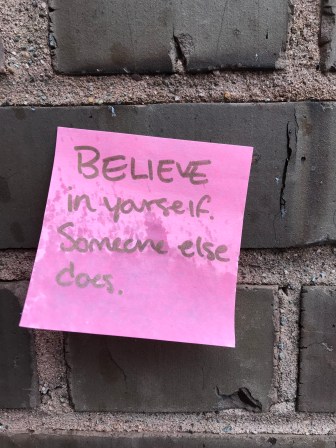
Later, my daughter sends me a photo of a post-it she found on a classroom building at Johnson State. She snapped the photo and left the note for another passerby to read.

Reading fiction not only develops our imagination and creativity, it gives us the skills to be alone. It gives us the ability to feel empathy for people we’ve never met, living lives we couldn’t possibly experience for ourselves, because the book puts us inside the character’s skin.

– Ann Patchett

IMG_1900.jpg


Hardwick Postcard #7: Middle School

At the middle school concert’s intermission, my merry-eyed daughter sat behind me with a girl I didn’t know, so I turned around and introduced myself. Being 12, the girls laughed at this weirdly formal introduction, and then the couple beside me began laughing, too. I had been sitting beside the girl’s parents.

It’s a little world we live in.

I chatted with the new friend’s parents. Quickly, the girl’s mother and I realized we had both served on an elementary school board. The lights dimmed just as we started a conversation that could have launched into a very long conversation about school consolidation.

For all its myriad faults, public education — at least in Vermont — is still all about the local community. Chances are, at a middle school concert, you’ll sit beside people you like, and, equally possibly, besides people you don’t.

But you’re all still there.

My father sent me this Wendell Berry essay. Read it.

In 1936, moreover, only a handful of people were thinking about sustainability. Now, reasonably, many of us are thinking about it. The problem of sustainability is simple enough to state. It requires that the fertility cycle of birth, growth, maturity, death, and decay—what Albert Howard called “the Wheel of Life”—should turn continuously in place, so that the law of return is kept and nothing is wasted. For this to happen in the stewardship of humans, there must be a cultural cycle, in harmony with the fertility cycle, also continuously turning in place. The cultural cycle is an unending conversation between old people and young people, assuring the survival of local memory, which has, as long as it remains local, the greatest practical urgency and value. This is what is meant, and is all that is meant, by “sustainability.” The fertility cycle turns by the law of nature. The cultural cycle turns on affection.

Wendell Berry

IMG_0622.jpg

Main Street, Hardwick, Vermont

Hardwick Postcard #6: Young Men

Without much discussion in the hardware store’s parking lot, the girls picked out a tree from the high school’s forestry program, then looked at my small car, the tree, and the car again.

The young man who had sold us the tree said, If you’re not going far, I’ll take your tree home for you. He had been selling trees all day in the cold, and his cheeks were red. Like most of the young men who work in the woods and know how to use tools and their hands, he was polite. He was a young man who would insist on taking off his boots rather than track mud on your kitchen floor.

He put the tree in the back of his truck, followed us home, and carried it to our back porch. I gave him a handful of chocolate chip cookies the girls had made that morning.

Barter economy? Perhaps an illustration. Or maybe just young man decency.

The two great aims of industrialism – replacement of people by technology and concentration of wealth into the hands of a small plutocracy – seem close to fulfillment.

– Wendell Berry

IMG_0592.JPG

Hardwick Postcard #5: Wear a Hat

Mexican hero Emiliano Zapata insisted, The land belongs to those who work it with their hands. With the snow here to stay, I’m already dreaming of star-shaped potato blossoms, the first tender snips of garlic shoots, rain-drenched rows of glossy greens.

Meanwhile, my daughter – far more interested in eating than agriculture or politics – claims her territorial lines. At 12, she walks. A few years from now, like all the other rural Vermont kids, she’ll finagle a vehicle or rides from friends – opening up an entirely different landscape for her – but for now, she learns her path to middle school footfall by footfall, first over the cemetery fence. She turns to wave goodbye to me and hurries off to meet her friend.

To reach the school, she and her friend walk down the hill into the valley where Hardwick village lies along the Lamoille River, then up the hillside where the standard brick middle/high school sprawls. The entire walk – past the dead, the elementary school with its crossing guard, two auto parts stores, a busy diner, a few storefronts, a laundromat and a library – takes less than 20 minutes.

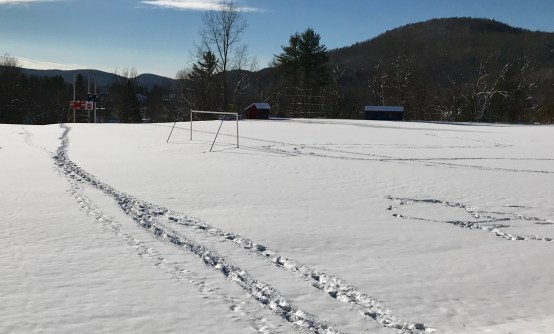
December’s lesson: wear a hat and mittens. The walk is cold.

At the risk of seeming ridiculous, let me say that the true revolutionary is guided by a great feeling of love. It is impossible to think of a genuine revolutionary lacking this quality.

– Ernesto Che Guevara


IMG_0576.jpg

Hazen Union, Hardwick, Vermont


Hardwick Postcard #4: Jumble of Stuff

December’s New England sings monochromatic variations of gray, white, and conifer dark green – except for us, who live here.

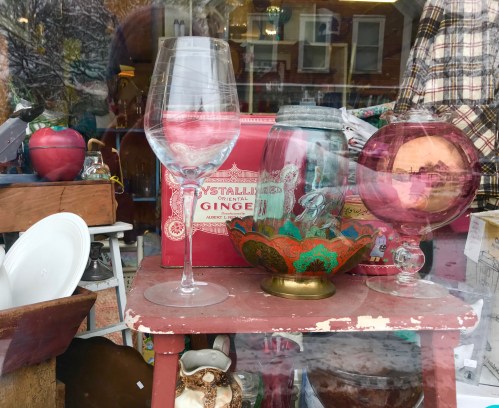
Like a jigsaw puzzle, this Hardwick storefront window of used things perpetually enchants my girls. Years ago, I raided a treasure trove on the back shelves, of used anthropology books.

Never depend upon institutions or government to solve any problem. All social movements are founded by, guided by, motivated and seen through by the passion of individuals.

– Margaret Mead

Here’s an essay of mine recently picked up that begins, When my daughter was 17, she smashed her fist through her dad’s car window in a fit of anger….

IMG_0563

Hardwick, Vermont

Hardwick Postcard #3: Snowy Day, Slower Day

In the dark, I open my daughter’s curtain to see snow falling in the streetlamp between our house and the neighbors’, and I wake my daughter as I usually do, talking quietly and setting a purring cat beside her. The cat burrows under the covers.

In the steady snow last night, we visited the library and the librarian, where my daughter opened a box of tinsel and spread a glittery rope over a bookcase and the mantel. Outside, damp flakes fell on our cheeks.

Everything’s slowed down a little, with slush on boots.

In variations of emotion, the conversation repeats, Winter’s here.

For the great doesn’t happen through impulse alone, and is a succession of little things that are brought together.

– Vincent van Gogh

IMG_0562.JPG