The Long Haul

After work, it’s too dark to go running, and I’m home in a foul mood while my daughters cook dinner. While cleaning out a closet that afternoon, they discovered a box of photographs and claimed the photos were evidence there was little adult supervision in their early childhood.

I insist there was plenty, but I had always seen wildness as more of a virtue than a vice.

The three of us are wise enough to let that lie, and dinner conversation winds into the details of the day. After, the girls wash the dishes and I carry in firewood. Then my oldest and I walk through town. There’s no one out these days. It’s dark; the cold is beginning to staple down around us.

Coming home, we stand on the knoll outside our house, watching the creamy, waning moon rise. As we stand there talking about hard deep things — how we carry the past around with us — I remember myself as a brand-new mother, believing that the wildness of imagination shapes our lives. I no longer believe that; I know that, but I also know what a long hard haul this life can be.

I call into the house for my youngest to come out and see the moon. She walks barefoot through the snow. We stand there, the moonlight on our faces, soaking up that ethereal light, before we head back in.
Once in a Blue Moon

Saturday, we were at a jack o’ lantern walk at the elementary school where my youngest graduated a few years ago.

Because it’s rural Vermont, it was dark, and everyone was spread out. I slipped away from the few kids and walked further along the woods path. I know this path well, and it veers down to the wetlands. There, I leaned against a white pine. The moon was nearly full, and the silvery light skipped over the rippled water.

For the longest time, I stood there, knowing my daughter was happily wandering around in the dark with her friends. In the darkness, I remembered the countless times I had admired this lovely lady moon — over fresh snow and icy backroads, in the muggy heat of summer.

At the beginning of this election week, I woke thinking of our beautiful moon, silently orbiting the globe.

The old man of the temple,
Splitting wood
In the winter moonlight.

— Buson

August flowers

Eagle and Loon

I’m at the edge of a pristine lake crouched under an enormous white pine at the place where the owners want to build a boathouse. On the way down, I waved to the carpentry crew working on the house; they’re the hired help as I, a town employee, am a version of hired help, too.

I’m writing a few notes when I hear a rush of wings. A bald eagle swoops out of the white pine so near to me I see its shockingly white tail feathers. The creature is so large its wings are almost oversized, flapping mightily as it turns and heads over the lake, apparently in no particular rush but moving rapidly as its wings bend through the air.

At the same time, as if on cue, a loon calls on the glassy lake. For that moment — in a day I’ve jammed with too much — I’m in no rush to go anywhere. Still crouching, I watch that eagle head across the lake, admiring its enormous wings, while I listen to the loon’s echoing calls.

My daughters and I have been swimming on this lake when loons didn’t nest here. All spring and summer we’ve seen eagles. The wild world — with its greater, wiser plan.

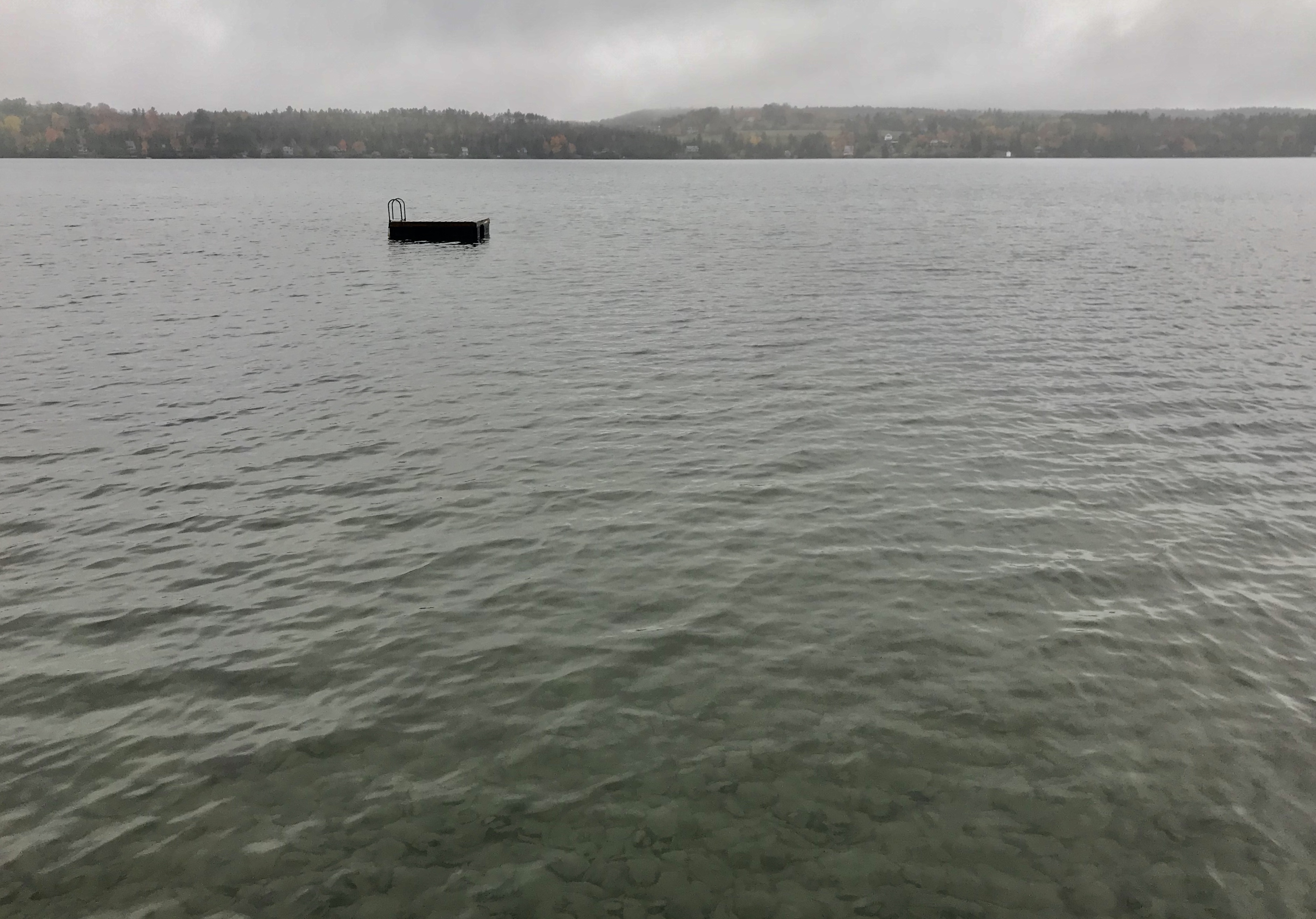
The loon dives and disappears. I wander to the lakeshore and dip my fingers into the cold, clear water. Gray sky, fallen leaves in the water, stones, my boots — and so much more.

Laughter

Standing in the rain watching my daughter, behind the socially distanced spaced out row of spectators, I hear a sound through the downpour steadily pummeling my borrowed umbrella. It takes me a moment, but then I realize two women cozied up together beneath their umbrella are laughing.

On the wet field, the girls are playing hard. Their ponytails and masks and uniforms are sodden. Many are covered with mud. Beyond the field, patches of pale gold leaves glow in the misty rain.

For a moment, I have the sense this sums up the pandemic — alone and isolated with my mask and raincoat and umbrella — and yet together. I stand there, happy the girls are playing, listening to the laughter of strangers through the downpour.

The apparition of these faces in the crowd:
Petals on a wet, black bough.

— Ezra Pound, ‘In a Station of the Metro’

Homework

How could I have forgotten that the light in October is exquisite?

Unlike hazy summer, Vermont autumn is clear. The woods are emptying of leaves. The wind sweeps through the towns and over the hills.

From my garden, I cut a cabbage, boil the leaves slightly, and roll up meat and rice, filling the pan with sauerkraut — a Romanian recipe from my grandmother, who died before I began cooking.

Bit by bit, our hours migrate from the garden and back porch in the house. We no longer eat dinners in the sunlight. When I return from work, I see crumbs on the kitchen table, remnants of my teen and her friends.

I imagine these girls figuring out their online chemistry class and plotting their future. When I ask what’s happening in those hours, I hear, We’re fine.

In the evening, the teen spreads out her graph paper and notebook. I knit on the floor with the cat beside the wood stove while her sister reads the day’s news aloud.

The teen shoves her graph paper to me and asks if her approach to problem-solving is correct.

I look at the paper and suggest, Call your uncle. That’s out of my skill set.

The cat flips over and purrs.

The teen bites the end of her pencil and goes back to work.

“The world begins at a kitchen table. No matter what, we must eat to live.”

Joy Harjo

Evening Out — Of Sorts

A friend and I stand in the high school parking lot, watching our daughters finish soccer practice on the field. At least, I say as the girls walk towards us, laughing and talking, they’ve had one practice.

That’s where we are — maybe our world will fold up again tomorrow, but at least the girls had an afternoon together, running on the field on this sunny August day.

At dinner, I quickly realize the soccer team is angry about a school board position, and my daughter glares at me. I have a seat on the board; I listen to her complaint, and think, Let her be mad at the board.

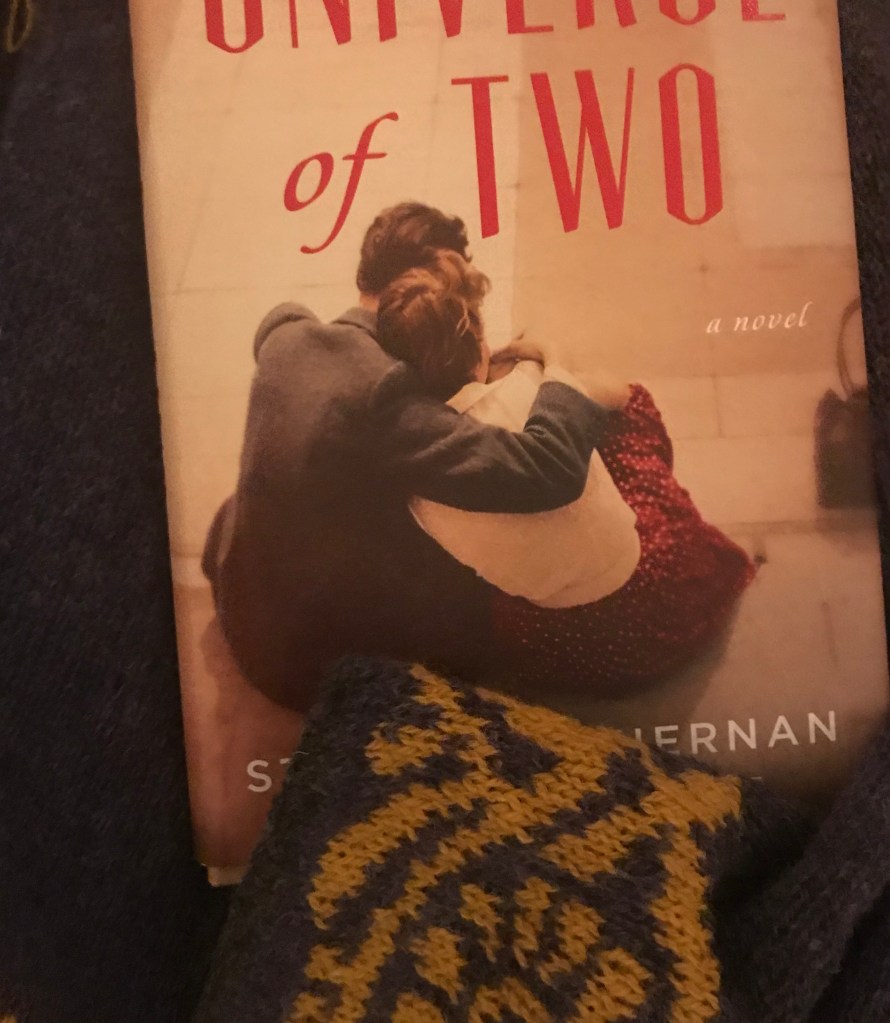
I almost don’t head down the hill to Atkins Field, for the first reading I’ve attended in months, in a beautiful post-and-beam gazebo. A strong breeze blows up, threatening rain. There’s just over a dozen of us, bundled in jackets and blankets folks have pulled from their cars, sitting in lawn chairs. I’m regretting coming, when the author begins speaking. I’ve heard this author before — Stephen Kiernan — and loved his stories. Before coming, I knew nothing about his book, but as he begins speaking, I realize the book is about Los Alamos — a place I know. I put away my knitting, huddle into my chair, and listen.

The dusk comes down. Across the way, I see a single turkey vulture flying across dark clouds, its rising wing glossy with sunset as it struggles to fly into the wind.

At the very end, Kiernan reads the opening page of his book. Kiernan reads particularly well. Listening, for just a moment, I sense all these things coming together — the craziness of attending a reading spread out with masks, unable to whisper and giggle, the ever-present pandemic, but also the setting of Kiernan’s book — WWII — and how ordinary people have endured through terrible times, and we will, too. The chilly wind reminds us of autumn’s imminence, but for these moments, the beauty and power of Kiernan’s writing pulls us together.

And when I arrive home, my daughter is waiting for me on the porch, happy again to see me.

“I met Charlie Fish in the Chicago in the fall of 1943. First, I dismissed him, then I liked him, then I ruined him, then I saved him.”

— Stephen Kiernan, Universe of Two