Postcard From Hardwick: September 1

After an intense week of work and family — of wondering where is this heading? — my daughter locks her keys in her car and texts me. Can I bring my keys? And there’s a sketchy stranger near her, too.

When I arrive, she’s leaning against her car, looking up at the sky, and the sketchy somebody is a dad in the high school parking lot, teaching his kid to drive, in that jerking, slow way my daughter and I both recognize.

I mention that my brother can teach my second daughter to drive.

From a soggy patch in the weeds, a bullfrog croaks.

September 1 today, the anniversary of the fateful day Hitler rolled his tanks into Poland, beginning the war that destroyed so many lives.

September 1, the anniversary of my former inlaws.

This morning, all’s quiet on this green patch of Vermont, overcast, with cricket songs and bird calls, a day that begs reflection.

All I have is a voice
To undo the folded lie...
There is no such thing as the State
And no one exists alone;
Hunger allows no choice
To the citizen or the police;
We must love one another or die.

— W. H. Auden, September 1, 1939


IMG_3115

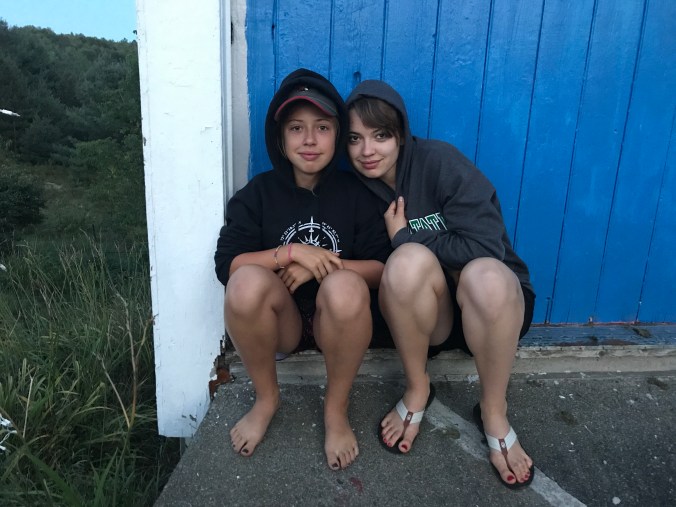
Being 13, Hardwick, Vermont

Ode to the Miraculous Melon

And then there’s this: at the very end of Vermont’s summer months — August 27th, a day of jumbled work and bruised adult egos, a day of existential pondering, after a moonlit night when I consider my very genuine failings as a parent to my oldest child, a day of humidity that ends with my daughters sitting on the bank of the pond while I swim with my friend, in all that cool water, its glassine surface broken in circular ripples with biting fish, and I long to keep swimming, swimming, we drive the 30 seconds home with a garden-grown cantaloupe cradled in my hands.

The melon had already split at its oblong end, vaguely skull- and exposed-brain-esque. As I carry the melon into the kitchen, the girls eye it skeptically. Already, that cracked end is clustered with fruit flies — where did they come from? — and I brush them away quickly with my hand and open the melon with a cleaver. The orange flesh bleeds juice.

With the cleaver, I slice off irregular squares, and then I’m eating it — famished not for the fruit, not for the sugar, not for the sticky liquid — but for the sheer miracle of a hard-shelled seed turned into such sweetness from soil and rain and sunlight, for all that this summer has been — both amazing beauty and clustering flies and ugliness of split rinds and quickly — hush, wait, yes — how just momentarily — we’ll all disintegrate back into that dust.

But not yet. Not this evening, with its creamy, rising nearly-full moon, two girls and two cats, a handful of chickens, and the crickets all night long, their songs still soldiering solidly.

IMG_3092


Family Lore

My father, visiting, tells the story of his parents driving from Michigan to California, in the fall of 1941. I imagine my father, 4-years-old in the backseat with his much older sister, his parents driving an American-made car on innumerable two-lane highways, in the time when cars were made with tank-quality metal.

Decades before blue jeans and seatbelts, his parents — both Romanian immigrants — must have been on the immigrant road again, traveling not for leisure but to size up the Golden State: could they make a living in this land of sunshine?

They returned with the intention to sell their business and property and move. That early winter, however, the Japanese bombed Pearl Harbor. With the country at war, moving was no longer an option.

In the blue predawn, I lie awake, thinking of the journey of these people, a grandfather I never met, my grandmother and aunt, now long dead. How this terrible war ended the California dream of my grandparents, but made their grocery business; how my dad enrolled in the University of Michigan in Ann Arbor, where he met my mother; and that his sister lived her adult life in southern California.

All a mystery, perhaps, that journey cloaked in the murky past — and yet not, the consequences of those years still unwinding in my life — and my daughters’ lives.

I saw in their eyes something I was to see over and over in every part of the nation — a burning desire to go, to move, to get under way, anyplace, away from any Here… Nearly every American hungers to move.

— John Steinbeck, Travels with Charley: In Search of America

IMG_3067

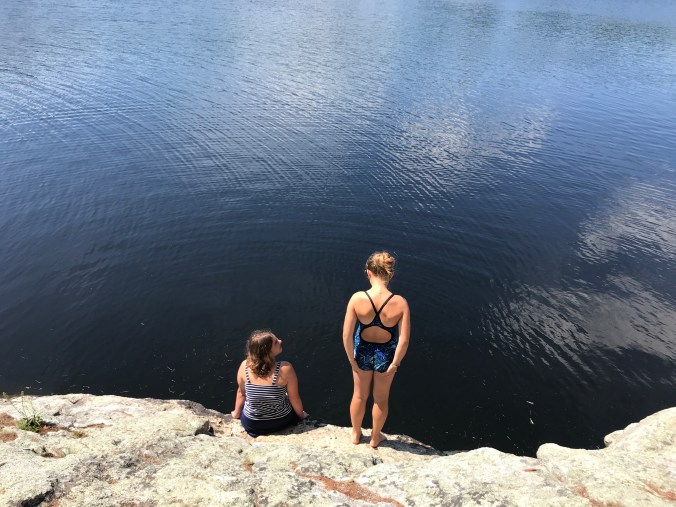
Postcard from Hardwick, swimming, 2018

Kidness

I’m at a restaurant in town with my parents, expecting to meet my daughters. My older daughter walks in alone, and I ask, What’s up? Where’s your sister?

She’s busy apparently, in a kid kind of way, hiding in the back of her friend’s car, so she and the friend can surprise the friend’s mother.

Well, I think, good luck to the mother.

In a few minutes my daughter appears, in soccer practice shorts, her face tanned and glowing. That, she says, was so fun. She assures me the mother wasn’t angry, preoccupied with a math homework assignment, instead.

In the early morning dark, I lie awake, listening to the crickets’ low sizzle. Like the lilacs, the mating songbirds have finished for this year. On the grass beside my garden lies a swimming floatie that needs to head back into the barn.

End of August, turn of seasons. Except, perhaps, if you’re in the season of being 13: keep on being 13 for a while yet.

Here’s an unrelated quote from what I’m reading: Lauren Markham’s The Faraway Brothers: Two Young Migrants and the Making of an American Life:

The United States cannot at once be isolationist — build a wall, kill the trade deals — and global, selectively reaping the benefits of an international economy, like lower-cost imports, cut-rate outsourced workforce, and cheap labor in our fields here at home. We have played a major part in creating the problem of what has become of Central America, and we must play a major part in solving it.

IMG_3055

Childhood

We drove to Maine and back on a Sunday, my older daughter sleeping in the passenger seat, stunned-looking from the night shift. We traveled with another driver and, true to my experience in Maine, pulled over a few times to consult whether we’d gotten lost or not.

At the end of our journey was an airy summer house on a blue puzzle-piece lake, and my 13-year-old, looking even taller, walking under the shady oaks to us.

A narrow wooden-slat bridge led from the shore to boulders in the water. The wind blowing over the rocky crest and the stunted pines growing from stone reminded me of climbing above tree line — one of our cherished summer activities — surrounded by terrific swimming. On the shore, the scent of sunlight on the sandy soil and the fallen pine needles reminded me of camping in the high desert mountains, so many long weeks of tent-living when I was a girl.

This usually quiet child chattered all the way home, about kayaking around the lake with her friend, the four pizzas they made for dinner one night, visiting a yarn store she knew I would love; about the snails her friend’s father gathered and she didn’t eat; about the fish he smoked that was delicious.

Then we were home again, to her cats and her chicken chores and her own bed.

I once described this child’s great strength as pragmatism. Like any parent, the jury’s still out on what she’ll cherish from her own childhood — in a terrible illustration of the best-laid plans heading south, her father has disappeared — yet she’s sunny and even-keeled, happy to be with these people, happy to have this summertime adventure.

Star Hole

I sit here
on the perfect end
of a star, watching light
pour itself toward
me.

— Richard Brautigan

IMG_3027

IMG_3033.JPG

Cat’s Heart

My daughter’s cat lies on the gray-painted floor at the top of the stairs, just outside her room, looking in. She’s away with friends in Maine. Over email, her sister and I see pictures of her swimming in a lake and the ocean — all that great blue and green wilderness around her 13-year-old self.

Her cat, of course, knows nothing of this, but simply lies at the threshold to her door, waiting for her return.

This morning, the rain’s returned, a great downpour. In the garden, yesterday, I pulled out handfuls of dead lily leaves, the broken and blackened remainders of lupine stems. Middle of August, and school and soccer start soon. The evenings come earlier, and the Black-eyed Susans burst brightly along the weedy roadsides.

Things do not change; we change.

— Thoreau

IMG_3025