Making Sense?

At dusk, after washing the dishes, my daughter agrees to go on a walk with me — she is clearly good-humoring me. It’s cold, and I sense she doesn’t care all that much about the gorgeous blue horizon.

Plus, she’s 13. Having once been 13 myself — albeit in the last century — I know 13-year-olds cannot wear hats.

Walking, she asks me why is this necessary? I offer my usual lines — that it’s pleasant to walk in the evening, that a little cold and adversity build character (my dad’s line). I remind her of my amazing wealth of character.

So, she says, you have character because you froze your ass off?

Put that way, I admit that perhaps not all the pieces of my thinking always hinge together perfectly. Or perhaps they do….

Real poetry, is to lead a beautiful life. To live poetry is better than to write it.

Basho

0

February Yields To March

The snow lies so deeply around our house I might be wrong about that slender path, first through the transplanted hydrangeas from Susan and then along the milkweed behind the garden. Down the hill, through the wild tangle of pine and boxelder, I see a single porch light every night. Come spring, I imagine, I’ll walk in my boots through the melting snow, stand at the edge of the forest, and see whose light that is.

The light stays longer in the sky, but it’s a cold light,
it brings no relief from winter….

(The earth) says begin again, you begin again.

— Louise Gluck, from “March”

IMG_4814

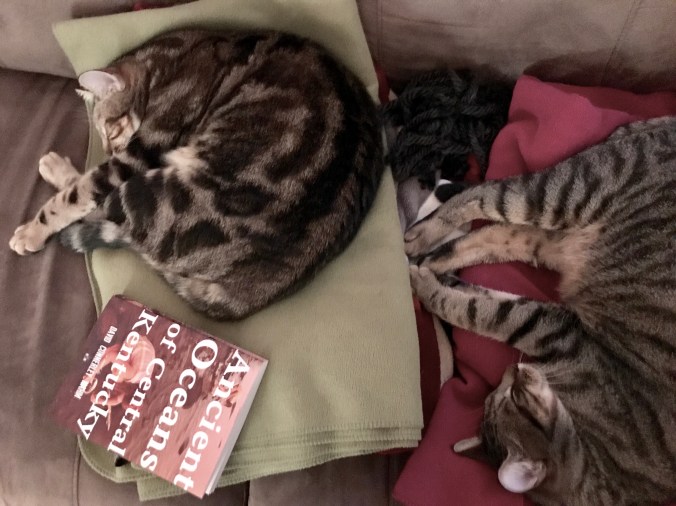
The cats — models of serenity.

Political Art? Or Just A Lot of Stuff Kicking Around?

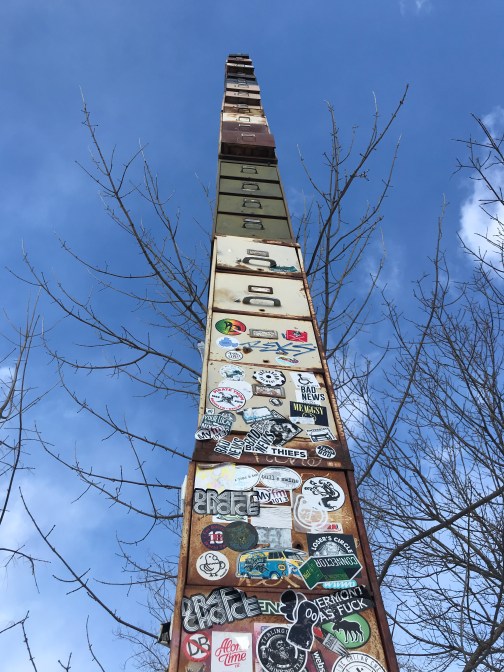
A tower of filing cabinets? My 13-year-old is simultaneously entranced and dumbfounded. I don’t get it.

Maybe, I suggest, we shouldn’t think about getting it but just take it in. She gives me that look perhaps unique to only young teenage girls — a combination of you’re not making any sense in my world coupled with I’ll try to humor you. 

In the single degree temperatures, with a frigid wind blowing over Lake Champlain, I offer a quick rundown about bureaucracy, thinking Kafka, Kafka, remembering driving by the tall Bank of New Hampshire building as a kid, wondering how many people worked all day, buried deep in that building. Even at night, the building glowed: cleaning crew shift.

Despite the cold, she’s happy — I can see it — this kid on the cusp of shedding her childhood — her face reflecting that combination of WTF and how cool is that?

IMG_4783

10,000 Years of Pollen: Storyline

An expert in New England’s ancient forests shares the story of taking a core sample from a pond not far from my library — easily within a few hours’ walk — and extracting 10,000-years-worth of planetary history. 10,000 years of pollen!

I’m standing in the dark in the back, while a few latecomers step in, carrying the cold on their coats, kicking snow from their boots. I’m also coincidentally near the hot tea, which I urge my guests to take.

10,000 years. His chart graphs the fluctuation of trees in this plot of Vermont — the persistence of beech, rise of rock maple. Exquisitely, I think of a larch not far from the library, how cool and welcoming that forest is in the summer, how brilliantly yellow its autumn needles. The extremely large view and the absolute specific.

Afterwards, finally home with my girls who are in an especially good humor, I think of the UVM museum my youngest and I just visited, chockfull of very ancient human artifacts, a variation of pollen — and in particular the arrowheads found along Lake Champlain. Whose hands made these?

Still socked in by winter… no pollen in the wild wind in the conceivable future…

IMG_4786

Specific child, specific 5 degree day, Burlington, February, 2019.

The Lion, and The Lion Again

These days, I’m always writing about the weather and here’s why — with a vengeance, winter hurls at us.

In a select board meeting last night, someone paused and said, The wind. Soon afterward, the lights snapped out. In the utter dark, I stood talking, bodiless, about agenda. The town clerk appeared with two battery lanterns, her face flickering with shadows.

The 13-year-olds pulled me into the town vault where the clerk had shown them a book of vital records, each certificate in a plastic sleeve. The girls had gone wild about the death certificates, reading aloud cause of death: thrombosis, carcinoma, asphyxiation from car exhaust in a closed garage.

I read about a woman who had shot herself in the chest, in the 1950s, down the road from where I once lived. In my mind, I repeated her name and age.

The town clerk showed me handwritten ledgers from when the schoolhouse was built in 1914. Nails, $6.50.

At home, the power was out, too, and I finished knitting a baby sweater by candlelight. Before we went to bed, we looked out the second floor bedroom windows at the dark valley, a snowplow carrying its own light along Route 15. I reminded the girls of reading about wartime, in so many other times and places, when families shut off their lights, in fear of bombing. Three degrees. The wind shrieked around our house.

I lay on my daughter’s bed, listening to her day of babysitting and kid stuff. She knitted by her little lantern while I watched the shadows of her moving hands on the ceiling. A cat curled between us and slept.
6rI36jhT

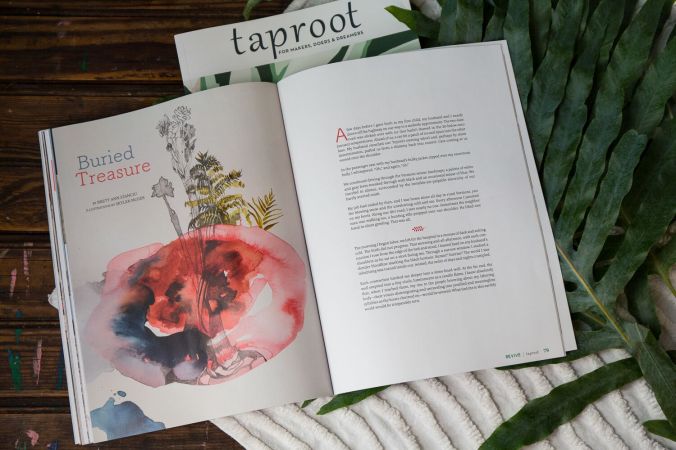
Artwork from the recent Taproot issue — appropriately titled Revive — where an essay of mine appears.
Wander with Laughing Teens

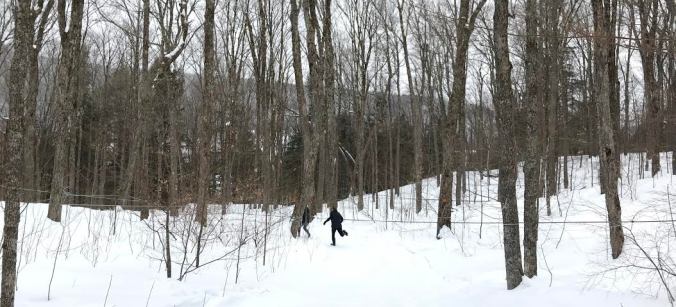
The girls put effort into dressing for a walk through the sugar woods — hair up and all in black, save for a borrowed pair of colorful leggings. In capitulation to winter (which remains), I exchange my holey and holy jeans for a better pair and pull on a raggedy sweater.

We’ve stretched into Sunday and into winter school break, with waffles in the shape of maple leaves and needlepoint projects the girls have pulled out of drawers. I’ve finished my taxes and offered what was apparently an incredibly dull overview of federal monies — who profits, who doesn’t. It’s no loss — the girls shake off the warmth of our kitchen and greet the wet woods and sprinkling rain with joy.

The woods are misty and ghostly, crisscrossed with animal tracks. The maples bend overhead, whispering their secret language. The 13-year-olds jump on each other’s backs like puppies, giggling, and empty snow from their boots.

After reading Donald Antrim’s harrowing essay in the recent New Yorker, I picked his memoir, too.

People are fond of saying that the truth will make you free. But what happens if the truth is not one simple, brutal thing?

— Donald Antrim, The Afterlife: a memoir

IMG_4779

Hardwick Town Forest, tapped in for sugaring