Cutting grass at night…

I’m finishing mowing the front lawn when my neighbor opens her door and hollers, “Hey, there!” across her driveway. Save for a series of apartments in my twenties, I’ve never lived so close to another house and moved here, in fact, from a house that was surrounded by wilderness.

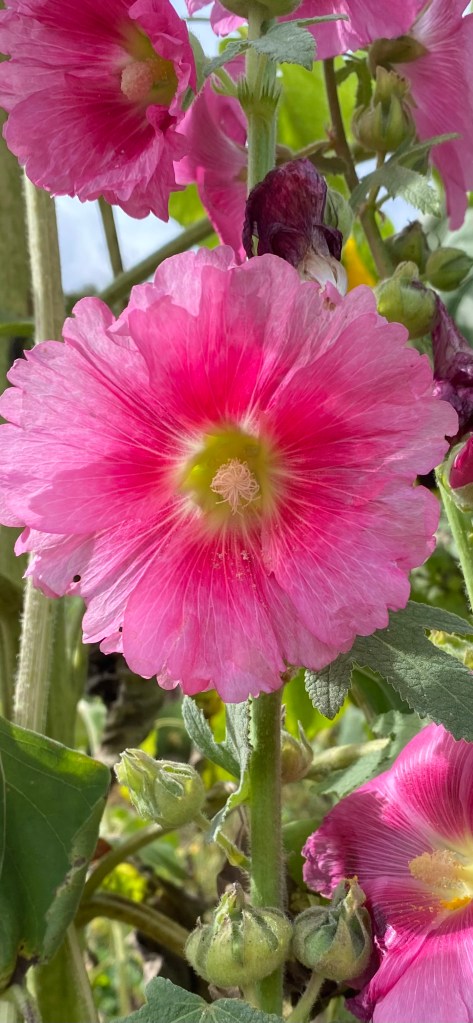
She’s a darn good neighbor. Twilight fattens to darkness as we talk about small things — a mutual friend who visited her, red roses blooming yet by her door. My pink cottage beauties have long since dried up.

I’ve lived long enough now in this town to have experienced the meanness of catty gossip and the kindness of strangers; nothing different from any other town or city, I suppose, simply the variety of human behavior, the tenor of thinking that makes me satisfied to be standing here in this dew-dampening grass, listening. A fallen pear that’s split by the mower blade bleeds its sweetness into the evening.

It’s a harvest full moon night, diminished by the eclipse and then returned. I sleep with the windows wide open, the moonlight on my curled cat who’s sleeping in his own cat way, more dream than rest, busy at his own cat magic. Here, too, I can hear the traffic on route 15, coming and going, going and coming. At 3:30 a.m., the traffic stills. The tree frogs sizzle on.

As a girl, we traveled summers in a green jeep and slept in tiny nylon tents. Waking in the night on those cross-country trips, I’d hear the interstate. So curious I was to know where everyone was headed. I repeated all that again in my hungry twenties. For a summer, we lived near the river in St. Johnsbury, Vermont. Every night, the train whistle bleated mournfully, passing through. Here I am now, in my fifties, lying awake, listening. The scent of the grass I cut that evening drifted into our house. In the moonlight, my cat lifts his head, questioning. “We’re here,” I counsel, “all’s well.” He tucks himself back into his curl. The moon and the frogs keep on. A milk truck rumbles by, pushing us towards day.

Two autumns…

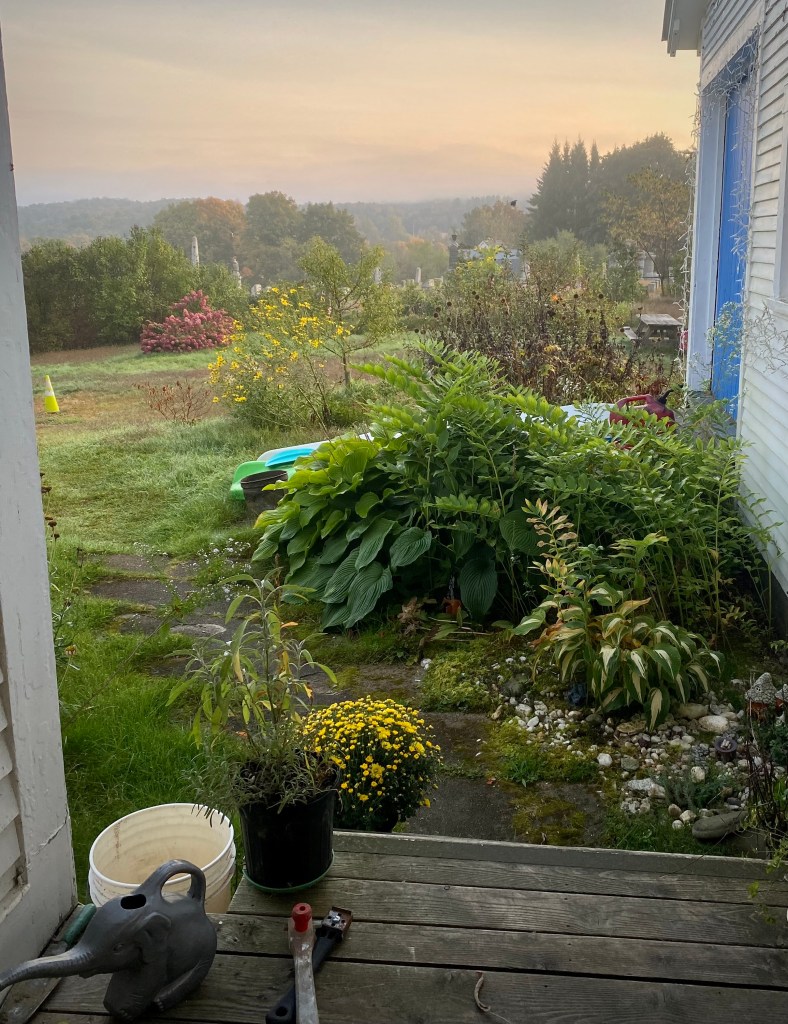
I leave the garden to do its final hallelujah of the season, the tithonia and sunflowers and cosmos fraying now, the basil still slipping into my cooking pot. September 11, the morning I stood in my sun-filled kitchen watching my toddler tricycle around the table, listening to public radio and wondering what was happening. My youngest was not yet born. Now, 23 years later, my daughters and I text during the debate. My cats are curled at my feet, in their usual, wise cat-disdain way, thinking their feline thoughts, savoring like any smart creature the warmth from the wood stove.

On my evening walk, I meandered the long way home. A half moon hung in the sky, sweet as maple pudding, so near I imagined I could reach out and lay my fingertips on its smooth sheen. Early autumn. So much more to come.

for me going

for you staying—

two autumns

– Buson

Crash, smash, end of summer….

Sure, it’s hot again, but it’s a day without swimming. I’m in the nether in-between place where the youngest is headed back to college, and my life inevitably tips towards the not-so-fun adult things I’ve kicked down the proverbial road. Borrow a spark plug wrench and fix the lawn mower, walk down the hill and ask the young carpenter what to do about that stucco that crumbled from the house foundation, just behind the rose bushes that we sliced away last weekend, tearing away the moss to keep the moisture, moisture from my house.

We are inside and outside all day long, hanging up laundry and sweeping the porch, loading a car… The cats are confused. The kitchen floor is sandy. I think of this day and the next and the few following until I might meet my friend for dinner, exchange our mothering stories, ask what’s happening? what now? what next? This year, I have officially crossed over into the population of the dead mothers club. In a strange kind of way, I find this like membership in the new parents club: once you’re a parent, you’re in, a lifer, whichever way you’re going to take that ride. As for me — and maybe it’s really my suspicion I’ve been poisoned by mold at work — but I turned with an anathema against cattiness and pretense, as if my own death perches on my back just like my daughter now heading back to college classes who hung on my back not that many years ago, her miniature fingers curious against my ears, reaching for wild blackberries. Evenings, the August she was one, I walked her sleep every night as the twilight sank and then laid her, sodden with dreams, on our bed.

So it goes, this rich wild life.

On a whim, I buy a copy of Pearl by Siân Hughes in Montpelier. Oh, novel of my heart:

Had I stopped to think for a minute that the fracture in my family, the rift opened in my own heart, would be passed down to the next generation, through my own damage if nothing else? No, I hadn’t. It never crossed my mind….

A real clusterfuck of thinking…

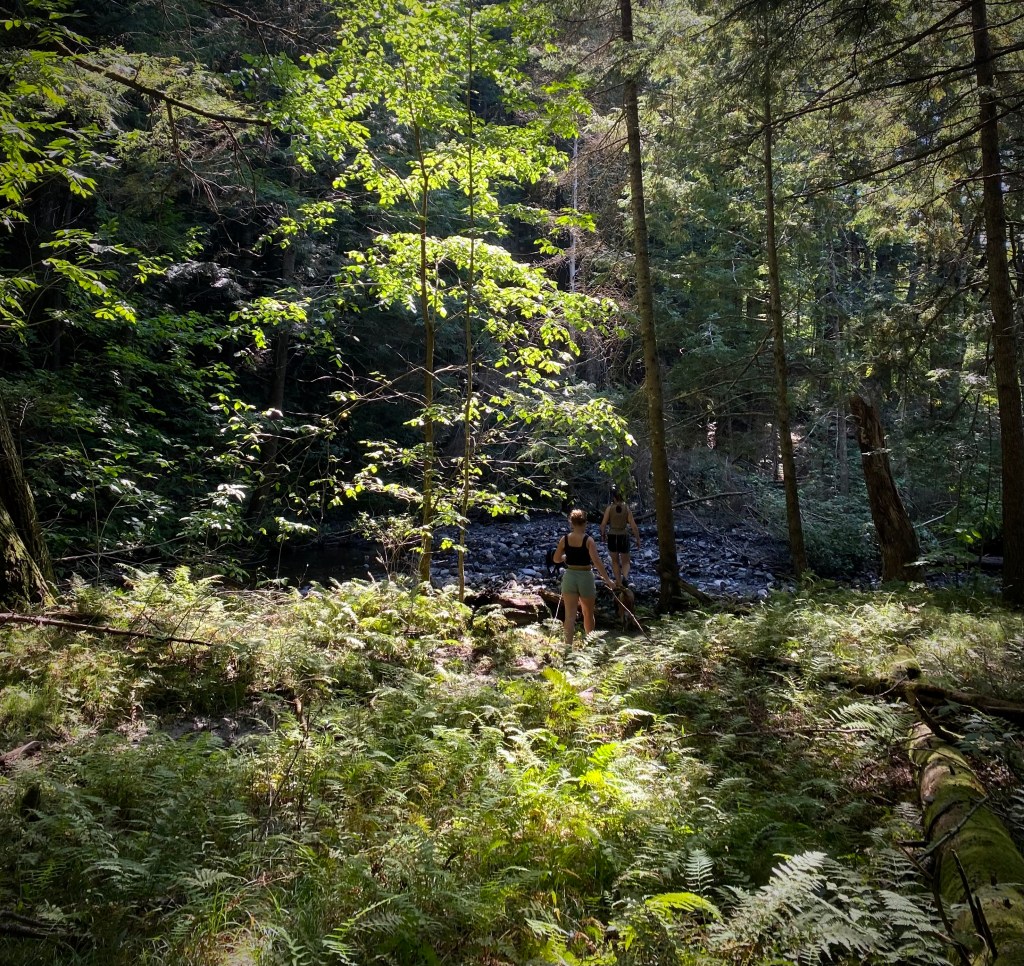
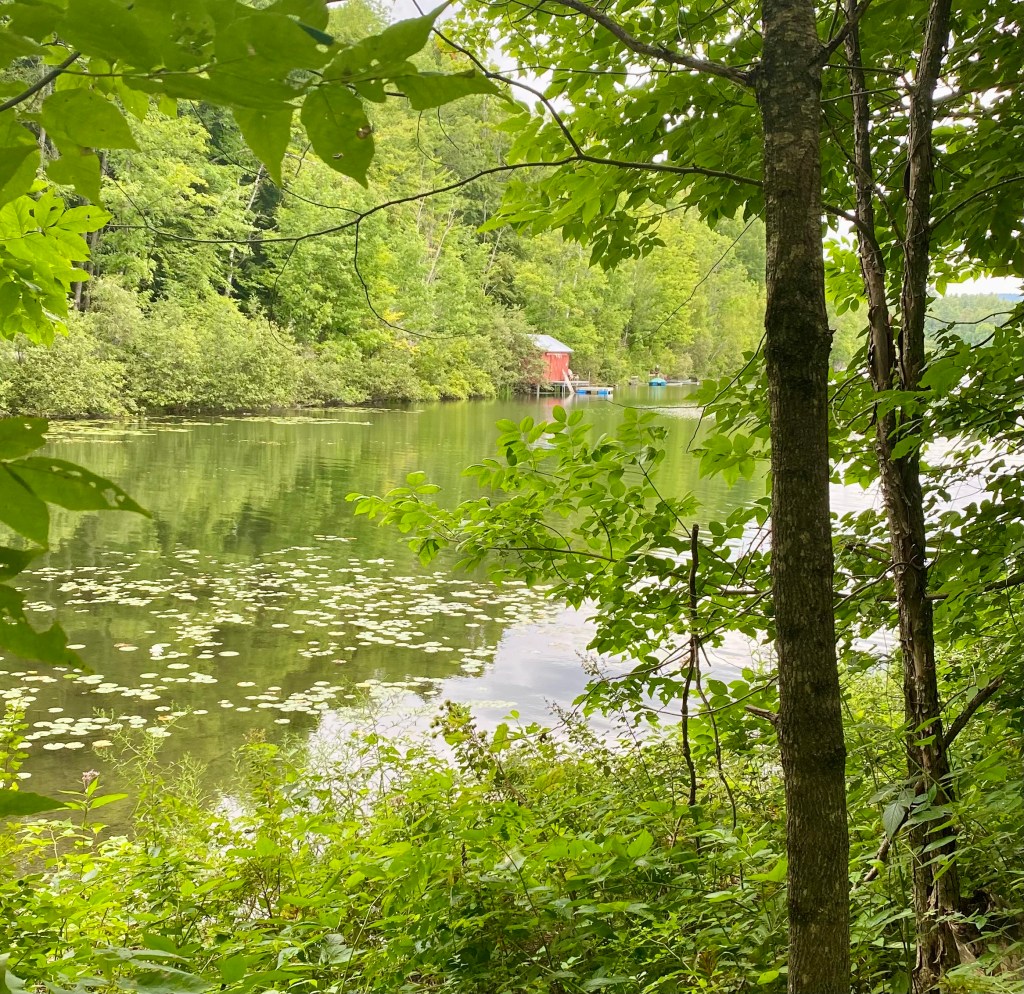
Hurrying from one thing to another, I detour to my favorite swimming pond, under these overcast skies. A woman and a little girl are swimming. There’s no one else around, and the woman and I chat about the fish nibbling our toes. The girl sits on a floatie shaped like a chocolate ice cream cone and looks skeptically at us, as if her mother and I might be making up everything. Maybe, in truth, our toes are bleeding from fish fangs. The child is taking no chances. She leans back on the floatie and stares up at the sky. Her mother gently pushes her from shore.

I swim out.

My head is jammed with the conversation I just had over Pad Thai, three of us women, about writing and Vermont and friendships, about money, of course, always about money, how money winds into decisions we make. These are old conversations, worked out in new ways. As I drift out in the cold water, I keep thinking about all the material I’ve been reading about rivers and history, about farming and logging hands on the land, 100, 200 years ago, how what made sense then (sense? perhaps even seemed downright innovative, bordering darn smart) has piled up over these generations of rivers, now dredged too deep, the roads and the towns built far too near.

Because my mind works in metaphors, I keep thinking how years pile up mistakes, one after another, a real clusterfuck of thinking. There’s no one else around in the water save for me and the mother and girl. They’re both lying on their backs on the ice cream floatie now, circling around, the mother’s heels trailing in the water. All those summer days I spent at the beach with my daughters, with plastic shovels and buckets, with the sleeves of red cups that I used at the farmers’ market back in the days when I sold homemade root beer floats, $2.75 per cup…. The kids are now all (mostly) grownup, as happens. Maybe those years were nothing more than a light way to pass the days, insubstantial as dreams.

I swim out as far as I can bear in the cold water. When I return, the beach is empty. Clouds have pushed down low, and the sand is clammy. On my short walk back, two bikers ask me for directions. Go west, I advise. That’s the way out of here.

A sense of urgency…

My youngest and I are watching a track-and-field race in the Olympics when a commentator remarks that a runner needs to up her sense of urgency to medal. In the humid night, the fan whirring through the crickets’ amped-up August songs, I keep riffing on the sense of urgency… My god, what does that actually mean?

Early August, and I always remember Hayden Carruth’s poem “August 1,” its line: The world is a/complex fatigue. Which perhaps sums up these days, so humid the yellow coreopsis flowers gleam, the cats sprawl on the kitchen floor, hungry for coolness. This summer has been fat with growth, the butternut and walnut trees I planted seven years ago spreading into their own canopy, already offering shade for me to lie beneath, as I read in the late afternoons.

Someday, perhaps, I’ll look back at this year as it’s own of kind of waiting — which way will this world tip? Even as I’m busy, busy with my urgency of work and gardening, my perpetual lists, of finish these three projects and then paint the back of the house, the outside world burrows in. Some of this is our own story, as my daughter heads back to college soon, but some are my own observations — the two battered cars crammed along the riverbank from the last flood, the perpetual national dialogue — and my wondering, which way might this go?

Urgency, raw want. At the farmers market, I see my daughters’ father across the field, appeared again from wherever he’s hidden. I hold a hot cardboard box of dumplings while the market crowd swirls around me. I turn to talk with a friend and when I look back again, he’s disappeared. Meanwhile, dumplings and curry in my hands: the urgency of eating, the words and life we’ll share over this savory meal, this evening, these moments.

August First

Late night on the porch, thinking

of old poems. Another day’s

work, another evening’s,

done. A large moth, probably

Catocala, batters the screen,

but lazily, its strength spent,

its wings tattered. It perches

trembling on the sill. The sky

is hot dark summer, neither

moon nor stars, air unstirring,

darkness complete; and the brook

sounds low, a discourse fumbling

among obstinate stones. I

remember a poem I wrote 

years ago when my wife and

I had been married twenty-

two days, an exuberant

poem of love, death, the white

snow, personal purity. now

I look without seeing at

a geranium on the sill;

and, still full of day and evening,

of what to do for money,

I wonder what became of

purity. The world is a 

complex fatigue. The moth tries

once more, wavering desperately

up the screen, beating, insane,

behind the geranium. It is an

immense geranium,

the biggest I’ve ever seen,

with a stem like a small tree

branching, so that the two thick arms

rise against the blackness of

this summer sky, and hold up

ten blossom clusters, bright bursts

of color. What is it — coral,

mallow? Isn’t there a color

called “geranium”? No matter.

They are clusters of richness

held against the night in quiet

exultation, five on each branch,

upraised. I bought it myself

and gave it to my young wife

years ago, in a plastic cup

with a 19cent seedling

from the supermarket, now

so thick, leathery-stemmed,

and bountiful with blossom.

The moth rests again, clinging.

The brook talks. The night listens.

“The apparition of these faces in the crowd…”

In the Albuquerque airport, I’ve tucked myself into a corner, editing a manuscript and drinking coffee, when suddenly I see the small airport is jammed. I pack up my things. In search of my gate, I ask a man if he’s headed to Chicago. “Houston. We’ve been deplaned from the tarmac, twice, and I’m pretty sure everyone here is about to have a nuclear meltdown.” Edging away, I hear a woman cajole her child to “let daddy figure this out.” The ruddy-faced daddy glares at a monitor.

At the terminal’s far end, I join an elderly couple (retired psychiatrists), a pediatric oncologist, and a mechanic who’s hoping to visit his mother before her open heart surgery. They tell me the news of Biden’s withdrawal.

Our plane has not arrived, and we step to one side of the swirling crowd. The oncologist shares that he’s been a fan of Biden. Such suffering in that family, he says; it changed him. The psychiatrists nod, listening. He tells us that his experimental research department received a flood of funding, but that’s all ceased now, with staff layoffs in anticipation of the election. He plans to retire in a few years and return to Botswana to volunteer. I don’t want to be dismal, he says, but the need for help won’t end.

We spy two pilots, admire their youth — but not too young — and gladly note they disappear through a door towards the tarmac. The loudspeaker voice informs us the pilots will have a short meeting with the cabin crew and then we’ll board. We’re not quite sure what that huddle is about — go team? keep the plane in the air? — and the oncologist muses that airports are one of the few places he’s experienced where strangers keep the social fabric together. No one, he tells us, says anything to strangers on D.C. public transportation.

That does not bode well, I think.

Just before we board, we shake hands and wish each other well. All these matryoshka doll layers in us: I walk down the ramp with the sign maker, who confesses his worries about his mother. Like a kind of magic, then, we’re in the air. Hours later, I land in Burlington, Vermont. Under a crimson full moon, I cross the street. The night sprinklers are watering a swathe of grass. All those dark miles of driving ahead of me. At home, the hydrangeas shine in the moonlight, boughs weighted with blossoms touching the ground.

IN A STATION OF THE METRO

The apparition of these faces in the crowd:
Petals on a wet, black bough.

— Ezra Pound