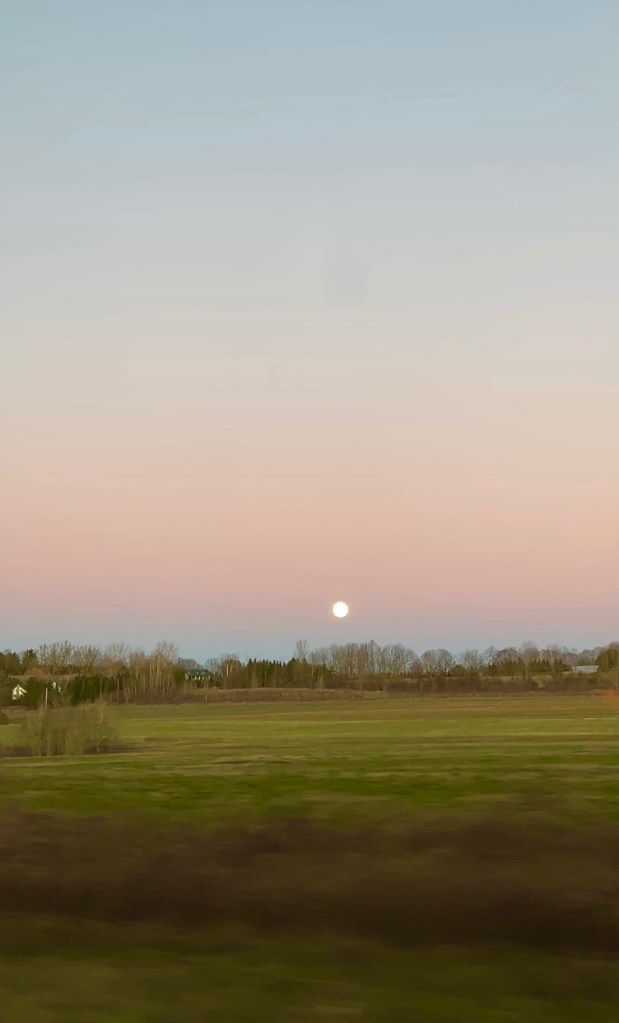
The Moon is Cheese.

Photo by Molly S.

My novel Call It Madness, slated for publication in a year and half (a small eternity away?), is arranged by places — or vessels in my mind. An apartment, an unheated farmhouse, the center of a frozen lake. To my way of thinking, places shape who we are.

Friday, wheeled on my back into a procedure room at Dartmouth-Hitchcock, I answered the usual name and date of birth and then a third question: why are you here today? A moment, a pause, and then I answered I was there for a specific biopsy.

Words are magical things, and magic is powerful. In the Dartmouth waiting room, laughing with my brother about memories from our childhood (he cheated at Monopoly, yes, I hit him over the head with a metal rod), the thought kept pulsing through my mind how much I didn’t want to be there (get out! walk out!), for this appointment I had worked so hard to finagle. But saying those words aloud sealed this very first step.

On the long drive home, the full Beaver Moon rose, lit the river and interstate, the ubiquitous Vermont hayfields still green in this lingering late autumn, the sky a blush of pink , reminding us, again, of the sheer luck of millennia of sunsets and the sailing moon, each dearly unique.

Later, later, lying on the couch, my brother and youngest sit opposite me, drinking beer and talking, eating the prized Club crackers that I never buy and a kind neighbor left. My brother disappears into the kitchen and returns.

“Cheese!” my daughter says, sparkling with happiness.

Lantern Light.

My immense thanks for so much kindness and light sent my way this week…. It’s meant the world to me.

When my daughters were in a sweet little Waldorf nursery school, around this time every year the children made lanterns from canning jars covered with colored tissue paper. The whole school gathered for a vegetable stone soup and then set out for a walk with the lanterns. This is rural Vermont, remember; the nursery school was surrounded by forest and the deep night, and parents carried lighters and matches to relight anyone’s lantern that was snuffed out. In the dark, stumbling a bit, we walked, singing.

Martinmas. I was tugged right into the Waldorf world with its heady folklore and mummers plays, the stories within stories, my natural bent of mind.

A week into the cancer world, veritable novice, walking on November 11, I was thinking of all these powerful layers — Martinmas and Armistice Day and Veterans Day (after WWII and the Korean War) — and the hidden interconnectedness of so many things, String Theory, the magical enchantment of books with stories that seem disconnected and then — whoosh! — are magically revealed at the end.

Maybe this is only my own way of thinking of things, but this uninvited and unwanted cancer that has now joined my body and story could hardly be random. Here I am, on the edge of a journey of indeterminate length, still looking to put these hard pieces together.

And for November, with her lovely gloaming light, a few lines from Adrienne Rich:

… You’re what the autumn knew would happen
after the last collapse
of primary color
once the last absolutes were torn to pieces
you could begin

How you broke open, what sheathed you
until this moment…

Abrupt turn in the story…

Photo credit Jo Dorr

For the past few months, I’ve wondered if I might want to take a different direction with my blog (head to Substack?, become more politically local?), but this blog will change, unbidden by me.

Monday, my daughter took me to the ER for severe abdominal pains. An elevated white blood cell count made the nurse reappear with bottles he filled with my blood and gave me the heads up that I might not be headed home that night. I was wearing my twenty year old Danskos and a wool sweater I’d knit years ago and have worn to felt. Slivers from the firewood I’d brought in were hooked on the sweater. My younger daughter and the older daughter’s boyfriend appeared. My girls texted my brother. The nurse kept coming and going, talking to me and my daughters.

I lay on my back for hours with very kind people around me, who gave me pain meds and noted a soaring fever. The ER doctor returned with the nurse who leaned against the cabinets. It was the briefest thing, but when the nurse walked in he looked deeply at my daughters and then at the floor. I knew then that I was not going to like what the ER doctor was about to tell me about that CT scan.

So, on election night, hospitalized with scepticemia from the cancer, a traveling nurse told me about the beaches in Alabama where he lives while he tidied up needles and tubes in my arm. We followed that up with a long conversation about housing costs. Home again on this frosty and promising-to-be-sunny morning, I’ve been humbled by the gifts of visitors and food and kindness that have poured into our little family house, which made me see what a shadowy unhappiness had been creeping into my being for these past few months.

With the hospital and my brother, a biopsy at Dartmouth was pushed. Things will change rapidly. In the meantime, I’m doing things like putting my electric bill on autopay and arranging immediate work leave. But more profoundly, this: this week centered me right back to who I am — mother/daughter/sister, friend, writer — and conversely narrowed and widened my lens, hammering home that day by day is where we are.

The other afternoon, my daughter Molly ran in the house and told us to hurry out to see a rainbow. November rainbows in Vermont are rare, indeed — rainbows in late fall of this glossiness and color even more so. I saw this as a harbinger.

Last, I was reminded of one of my favorite Jack Gilbert Poems, “A Brief for the Defense.” A few lines read:

… We must admit there will be music despite everything.
We stand at the prow again of a small ship
anchored late at night in the tiny port
looking over to the sleeping island: the waterfront
is three shuttered cafés and one naked light burning.
To hear the faint sound of oars in the silence as a rowboat
comes slowly out and then goes back is truly worth
all the years of sorrow that are to come.

The world, keep on keeping on….

The young barista in my coffee shop muses with me about the small pleasures of November: the summer slam of tourists quieted, the sudden simplicity of stillness. On a balmy afternoon, I head out in search of places where I’ve loved and been loved, the sunny afternoon so warm the crickets have struck up their chorus again.

A few days later, I’m in the diner, eating breakfast with a friend whose mind works along my hard-bitten lines. Our booth’s window looks down into the river where the patched-up cement walls have fallen flat. We are in absolute agreement that this shifting world of thoughts and opinions, all the junk fed by media and social media, come to naught. It’s action that shifts the world. And the world, despite our fears, will keep on keeping on.

I put poetry as action, too. Here’s a few lines from the incomparable Mary Ruefle’s “Glory.”

... I met a psychic who told me my position in the universe
but could not find the candy she hid from her grandkids.
The ordinary fear of losing one’s mind. You rinse the sink,
walk out into the October sunshine, and look for it
by beginning to think. That’s when I saw the autumn aster,
the sedum blooming in a purple field. The psychic said
I must see the word glory emblazoned on my chest. Secretly
I was hoping for a better word. I would have chosen for myself
an ordinary one like orchid or paw...

A Handshake and a Promise.

I leave dinner with neighbors and friends and walk home, down through the village. It’s late enough that the few restaurants in town are closing down, a few lingerers at the bars while the waitstaff wipes down the tables, doubtlessly thinking of their own homes and nights ahead.

Knowing I would savor this walk, I brought my hat and a coat, and the night is warm enough. I’d been offered a ride — “it’s dark!” — but me who is afraid of so many things (rushing semis, rats) has no fear of this autumn dark, this small town. I pass no one, not even a dog walker.

End of October, and I labor through the daily chores, now shoveling ashes from the wood stove, putting away the summer’s chairs and garden tools. My daughter phones with a homework question. Over us, the ineffable holiness of the passing of both of my daughters’ grandmothers this year, the old women who had distanced themselves from their granddaughters. What will this mean for my young women? At dinner, whisperings about the election. Which way will this split?

Just beyond the village, a U-Haul idles, lights on. As I walk nearer, I squint in the brightness. U-Haul, those rental trucks that have appeared intermittently in my life. The last time was that sleety winter day when a couple loaded up barrels of syrup from our sugarhouse driveway. I was in a desperate time in my life then, selling what I could to pull up stakes with my daughters and light out for new territory. I took a chance on this couple, watching them head down the slushy road with our liquid gold with nothing more than a handshake and a promise between us.

As I walk by, the U-Haul driver doesn’t look up, reading his phone, maybe a map, maybe a love note. I keep walking. As for that couple, the handshake and promise were gold. A week later, the check arrived in the mail.

October: where are we going?

This weekend cleaves the summer, the marker where the light changes.

As the leaves drop, the light sharpens and thins. I’ve been here before, so many times, knowing full well how the sun will continue to dwindle. October is a season of brilliant contrasts: emerald hayfields, swaddles of mist, orange remnants of zinnias.

The season mirrors the human realm, too, such a lusciously lovely summer this has been. Now I yank out spent tomato vines, stow away my garden rake and hoe. I gather a handful of kindling, an armful of wood. So much winter, so far to go.

In the co-op’s baking aisle, I run into an old friend, and we chat while her daughter shops. I’m certain we mark different sides of the ballot, but our friendship is hard-tested, solid. Our conversation swirls. Through the window, yellow leaves scatter and leap in a breeze. I lean towards her, listening to a thread of her story.

Change of season is never the same. My youngest daughter tumbles towards womanhood, our lives shift, stretch. Within, always the constants, the long threads of conversation, the joy of the natural world, my ever-present marvel at the world’s flux: where are we going? why? Is it true that other people live these steady, predictable lives? Who knows?

Overhead, those geese, honking their way out of here. And us, here, for now at least.


Each fall in New Hampshire, on the farmwhere my mother grew up, a girl in the country, my grandfather and grandmother finished the autumn work, taking the last vegetables in from the cold fields, canning, storing roots and apples in the cellar under the kitchen. Then my grandfather raked leaves against the house as the final chore of autumn.

— Donald Hall, String Too Short to be Saved