Meeting the Red Devil.

In my foolish pre-cancer days, I pretty much covered up my ears when I heard about someone’s chemo treatment. That said, I’m not a complete jerk; my heart twinged, especially for parents of young children, and I offered sympathy, meals, a compassionate ear. But in some profoundly hidden place in my thinking, I tried to pretend that my garden squash and chard and those miles of walking would inoculate me. More likely, I was too cowardly to consider a possibility that hadn’t arrived.

This morning, I texted an acquaintance, I’ve now met the Red Devil, too. Looking forward to a long conversation over coffee this spring about your experience.

Yesterday, morning sunlight filled this Dartmouth-Hitchcock infusion room. Nuthatches and chickadees and juncos flitted around birdfeeders. Two wooden reindeer were linked by a red ribbon.

Without a port, the poison/healing infusion flowed into my vein. Remembering clearly my breathless and rigors! reaction to the rituximab, I burbled my fears to the nurse, who sought consult. She told me she only had good experiences with patients; I assured her I am a striving A+ patient. Then she worked her mojo and set up some black case that was never opened, assured me the nurses’ station was actually all of five feet where I was sitting, and then, drip, drip, drip, she released the poison that presumably will save my life into my vein. She stood talking to me and my daughter about the merits of studded snow tires and a recipe for gingerbread cookies, and then showed me that I was twenty minutes along with the rituximab. All was well.

Here’s the thing: there is no ease or comfort in this cancerland. The nurse is gowned and double-gloved to protect herself against these chemicals. I’ve read my chart thoroughly and know that innocuous word complications could rapidly spin my life into a dire Shackleton sea. And yet, in the warm rare-in-December sunlight, with my daughter and her stack of Christmas cards, my knitting, a novel I’d plucked from my shelf that I’d wanted to read, those downy birds flickering — a calm outside time’s relentlessness.

As for the Red Devil (the crimson of young Lucy’s magic potion in the Narnia books), the nurse injected a long fat vial into my arm. During this, she had me eat sherbet, pressing the icy substance against the roof of my mouth as the Red Devil would seek the tender places in my body and could erupt mouth sores. My daughter held the cup as I dug into the frozen substance. The nurse pushed the liquid slowly into arm, careful, careful not to burst the vein. The infusion would burn and destroy my arm, one of the nightmarish complications which would plague me for months, maybe years, to come. At the end, this confident nurse set down the empty vial and breathed deeply.

I thanked this woman for her steady hands.

Much later, 90 miles north by interstate and state roads, my daughter and her partner hold my hands as we walk up the path into my house. If I stumbled, I imagined them holding me between the two of them.

On the doorstep, my potter friend left a package with handmade yellow candles and a flower candle holder and a mug glazed the blue hues of the midsummer sky. So many happy days my kids spent in her studio — Mud Club, Clay Camp — and the cups of tea we’ve shared as mothers and crafters. A gift of light.

Losing hair, blue dawn, foreign objects in flesh.

Before dawn, brushing my hair I sing On the road again, just can’t wait to get on the road again, that old Willy Nelson song my mother loved. In the kitchen, making coffee, my daughter calls, Wait? You know that song? We played it everyday on our road trip last summer.

A thing to savor in this cancer: how my daughters and I discover these tiny things about each other.

My youngest cut the snarls from my hair that lingered from that hospital stay, when I couldn’t raise my arm to brush my long hair. Now, hanks of my hair slip out in my brush.

Outside, I stand for a moment, the waning moon hung over the neighbors’ roof, the emerging dawn a river-stone blue. A thaw’s set in, and the air is redolent with melting snow, a hint of loosening compost and soil. Raindrops hang from the three apple trees I planted.

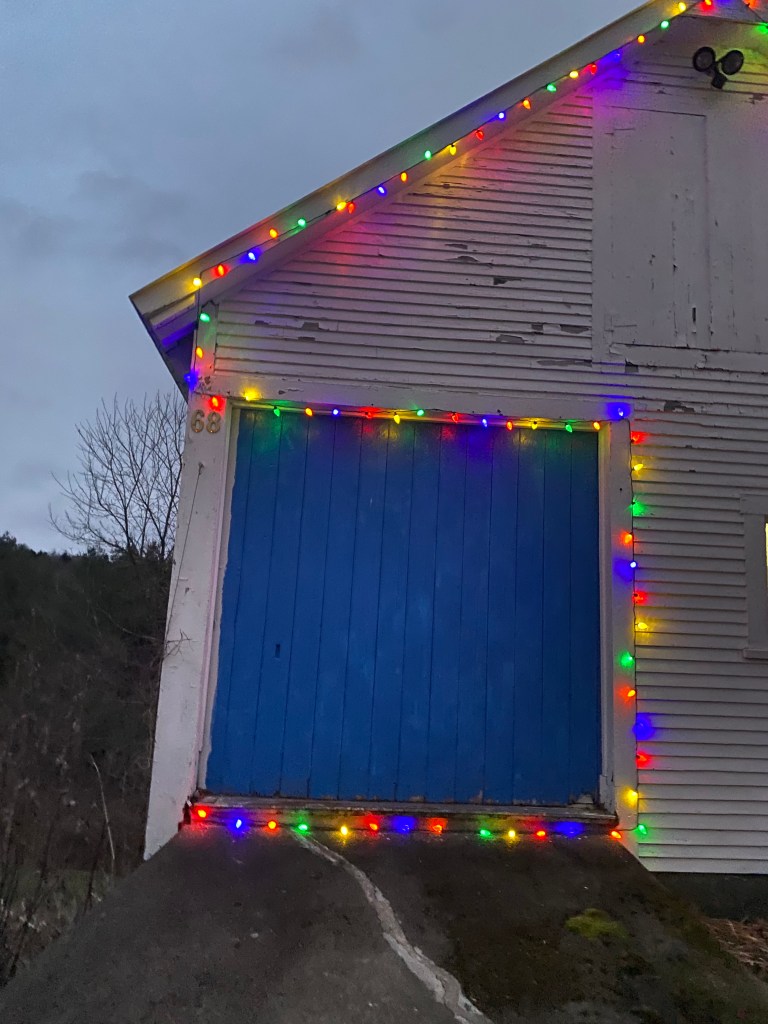
We drive through the village, the coffee shop lit up where I’ve spent so many hours writing and talking, a young woman sweeping at the door. Colored lights string through the trees and over store windows. Out of town, day warms over farm fields and forests.

At the hospital, blood’s drawn for my chemo course this week. In my rudimentary cancer thinking, while doing the darnedest I can to forget about the orange fluids that will enter my body, I reckon that this week’s treatment means one third of the way through. If I can endure a third, I can endure half. If I can endure half, I can persevere to the finish. Talking with my daughter about December monochrome, I silently counsel myself to knock off my silly math. I’ve factored in no variables, and the variables are inviolate.

Before we leave, the nurse shows me a model of a port that may or may not be inserted in my chest. I hold the pad for needles, finger the plastic tube as she explains how it will lie under my chest. At the end, in the shape of a calla lily, is the opening that will drip the chemo beside my heart. The whole apparatus seems enormous to me, that plastic calla lily wider than my small finger. I hand it back to her. In the end, with the Good Doctor, how much of this will be my decision, and how much will be wisest course forward? In this age of truth/untruth, facts are powerful. I thank her, and we leave.

It’s a pleasure to be outside again, on this tiny road trip, my daughter at the wheel, drinking coffee. The fields and mountains and sky are layered quilt batting: blue and pearl and silver. Around the trees, rain’s pushed the snow away from the trunks, opening the earth again.

From Lauren Markham’s A Map of Future Ruins:

We don’t live steadily toward epiphany; our truest stories move back and forth in time, in space, in memory. Life is a mosaic, not a line.

A smidgen of writing.

The clocks cease meaning for me. To gird myself for an appointment, a call, I set an alarm, ask a daughter for a reminder. Counting backwards proves stupidly difficult: what hour to we need to leave? Write this on a sticky, please.

The flip side: I wake early one morning, kibble the cats, open my notebook and begin writing the pieces of this book I’m rewriting in my head. Daunted, I copy my draft into a folder. Someday whole sections might become another book, an essay, trash. Weeks before I heard the cancer diagnosis, I took a class with the remarkable Lauren Markham. All these weeks, these endless hours sleeping and half-dreaming, reading hungrily, much of this solitary but never lonely, much surrounded by skilled strangers who spill snippets of their own remarkable lives in the wee hours of the night, syringe in hand.

Now, aided perhaps by exhaustion, I envision the skeleton of this revised book, the joints that hold these stories together, beginning in a moldy basement, rising to a glass complex, surely, the endless firmament.

Neuropathy comes and goes, reappears in my fingertips. The knobby bones of my wrists and knees expand beyond my dwindling muscle mass. The prednisone prescription reappears for five chemo days, beginning next week. I try not to think of that, of the force these mighty drugs will weld over my body, how I will yield, pray for their power, try to keep to my feet at least marginally, moving my body, keeping in the everyday realm.

Like anyone, I’ve hard used this woman’s body I’ve been gifted, through pregnancies and nursing, decades of sugaring and the countless cords of firewood I lifted and burned each year, churning ice cream to sell with a baby on my back, fourteen years of peddling syrup spring to snowy autumn at farmers markets. The bleeding fissures on my fingers from washing wool filters. But so much pleasure, too, the ineffable joy of cuddling a daughter in my lap, of mountain climbing, intimacy, of lying on the dewy grass under the creamy rising moon. Women my age often complain about the indignity of hot flashes, but the real indignity for me has always been when the flush of my changing body courses through me in a male-centered meeting in my difficult work of budgeting for a town.

A rambly post here….. a variation of my inside-out world where the former rules are revealed as trite. Patience, patience. An hour of work. Half a cup of tea. Another half hour. December sunlight.

The awful, the reprieve, Maurice Sendak’s chicken soup with rice.

Snow falls early on this Thanksgiving morning. The nurse wakes me for meds and vitals. I am eighty-four miles from home. My window looks out into a courtyard with a fan of three white birches. In a wind, their papery bark ripples in the breeze. Nearby, an office window glows where someone is already working.

I am here for a haul. My daughter brought me the striped blue and green quilt from my bed, the worn hand-me-down that reminds of home.

Monday, the pain and awfulness returned. My daughters drove me not to the local ER this time, but down the interstate, the two of them in front, me in the back with a pillow staring out the window, to Dartmouth-Hitchcock. At the ER, they took blood, asked my story. Someone in the waiting room, who must have been a frequent flier, had been waiting for four hours was threatening to leave to get something to eat. The nurse said she couldn’t go. I was sent out, waited less than four minutes, and was taken in for antibiotics and saline and pain meds, another CT scan.

An MD, a second. An oncologist who explains slowly that the lymphoma I have often responds well to treatment, so reassuring. This raging infection. I am taken upstairs. My daughters, folding with exhaustion — it is now late again — head back up the interstate. Shortly afterwards, the oncologist returns and bends down to look directly at me, eye level. I know this position means bad news again. In the three-week span of CT to CT, the cancer has grown and possibly eaten into my bowel. Surgeons will be in shortly to speak with me about emergency surgery to remove a section of bowel. My thoughts immediately surge from Thank god, I may be alive in May with my family and see blue squill bloom to Are you fucking kidding me? It’s the middle of the night.

Middle of the night or no, the surgery team comes in and out, talking, talking. The lymphoma renders the CT scan unclear. Because my mind works this way, I size up the head surgeon: she’s long experienced in trauma and general surgery. Her fellow tells me he’s been working with her for six years. She tells me so much, all the terrible — and these are devastating — things that could go wrong me for in the next few hours. In the end, I trust my life to her. It is the only course.

I call my brother. We call my daughters, who have not yet slept. My brother gets in his black Subaru. My youngest drives our red Subaru and drinks a quart of cold coffee, a more experienced driver than her sister after a cross-country trip this summer. Is the moon guiding them? I don’t know.

In the OR, a woman whose name I don’t know holds my hand as I instantly go under. When I wake, so confused, in an enormous dark room — it’s the still the pitch of night — I immediately lift my jonny and look at my abdomen, asking what happened? My flat abdomen has no huge bandage. The surgeon had gone in with a camera and decided what remains is sufficient, for now perhaps, forever perhaps, to change perhaps. My oldest showed me a photo she snapped of my family curled in the empty ICU waiting room, sweatshirt hoods over their heads. Let me write this: what a hard awful night, and how much worse it might have gone.

….. Then, that morning, in and out with the surgery team, with phlebotomists, nurses. The lymphoma oncology team arrives in a pack. The lead pulls out a chair, tells us to record, and begins talking. He’s brilliant and confident without cockiness in his ability to cure me. He outlines that complications of infection and my bowel will keep me here for the first chemo run, deep into dark December. I decide to do exactly he tells me.

My family again leaves. My daughters refuel with fast-food chicken and sandwiches for their drive. I sleep and wake in a drenching fever, which creates a flurry among the nursing staff. They come in and out. Somewhere in the miasma, I really wake up and decide to pull myself together. I’m going to be here for month, and I need to quit feeling sorry for myself. A nurse tells me to eat some chicken soup with rice — remember Maurice Sendak? The soup is delicious. The fever breaks. I survive a ten p.m. MRI — a blind descent into a cave where dwarfs bang around me while Freddie Mercury sings.

This is a long way of writing a fragment of how I arrived here, medical center land, not a Thanksgiving morning where the kitchen is savory with sage dressing, and I’m out in my boots, admiring the first downy snowfall in my garden. Living is a nonstop risk, the whole she-bang, but we don’t always tread such a thin pinnacle. By chance, as I packed my laptop and socks for the ER trip, I stuffed in the Vermont Almanac that had arrived in that day’s mail. Later, when I had decided to embrace where I am now, I opened the envelope. This volume, as the others, is exquisitely beautiful. A phlebotomist arrived to take blood. She admired the cover — especially the view of the mountains through the window — and she told me a little of her story from rural Vermont to Lebanon, New Hampshire.

In editor Dave Mance’s opening, he writes, now post-election, how we might return to embracing the complexity, rugged and elegant, of the natural world and our very lives. (Gracious, when I’m able to untangle myself from cords, I’ll update with his poetic words from the book just out of reach on the windowsill.:)

Complexity is precisely where I am, enmeshing in this crazy mixed-up jumble of the medical system’s turbo drugs and powerful machinery, the stories of the people who labor here, a nurse training for her first half-marathon and another with three young sons, welcome news of a friend’s first grandchild, my own energetic and loving family.

All of you, too, on this Thanksgiving or perhaps just a plain old weekday morning — in our lives, how much we’ve chosen and so much we haven’t — gratitude for being alive in this world. For chicken soup with rice.
Cat justice, homestyle.

A friend stops by with a gift of a stunning orchid. My naughty cat, Acer, immediately jumps on the kitchen table, and I swat him away. He lies on the couch, glaring unhappily as we talk. Gorgeous flower bouquets have come my way, been lavishly admired, then sent home with others to enjoy without cat destruction.

But the orchid is so stunningly beautiful I want to keep her. Later, I set this flower on the bathroom counter and shut the door. Acer is still sulking on the couch, paws stretched out before him, the epitome of cat depression, really hamming it up for my youngest daughter who mollifies him with kitty treats.

The cat and I: we are at odds. This morning, I let him into the bathroom. He sits on the counter, hungry to the core of his being to shred these velvety petals. In this new cancer world, my constant checking of time — my furious need to get stuff done — has instantly vanished. The mock orange outside the window sways in the breeze. Mid-November, this gloom is as much brightness as we’re going to get today.

Acer has no need to explain his position to me; his furriness is tense with desire. I pet his head and explain my infatuation with the orchid, which doubtlessly Acer dismisses as a weak case. And the orchid herself? Surely she wants to keep her own amazing life, both svelte and voluptuous.

The outcome is nearly certain. I’ll have to let her go. But for now, the house is warming with the wood stove, daughter sleeping upstairs, and — accusations of cat injustice be damned — just the right amount of ethical challenge and beauty, for ten minutes or so.

Cancer, Election.

In 2014, my sister was diagnosed with cancer (now healthily in remission), and I read The Emperor of All Maladies: a biography of cancer by Siddhartha Mukherjee. My marriage also fell apart that year, and I remember reading this fat library book in my car at school pickups, waiting for a job interview in Burlington, on benches waiting for court appearances. It’s a hefty book, with a lot of reading hours.

Three weeks into this flipped-upside-down world, my former life is already receding. I’ve been so surprised and grateful for the effusion of calls and emails, friends stopping by with food and gifts and simply to talk, to share news of their own world and listen to mine. I realize now how carelessly I had ebbed into a cynical place these last few months while the cancer was growing in me, weakening me.

Sure, it’s true that people sometimes give into the uglier strands of lying and cattiness and gossip, of insecurity and strange ways of playing people against each other — and sometimes engage in far worse things. In my Shire of Vermont, I see my decent state struggling with what’s playing out in national politics — and the looming threats. Which made me think, again, as I lay in bed listening to the rain this morning, how our individual lives reflect the greater society. Don’t waste your few days on junk and despair, those adolescent tricks. And thank you, all, for surrounding me with such light.

From Philip Larkin:

What are days for?

Days are where we live.   

They come, they wake us   

Time and time over.

They are to be happy in:   

Where can we live but days?