After an absence, return.

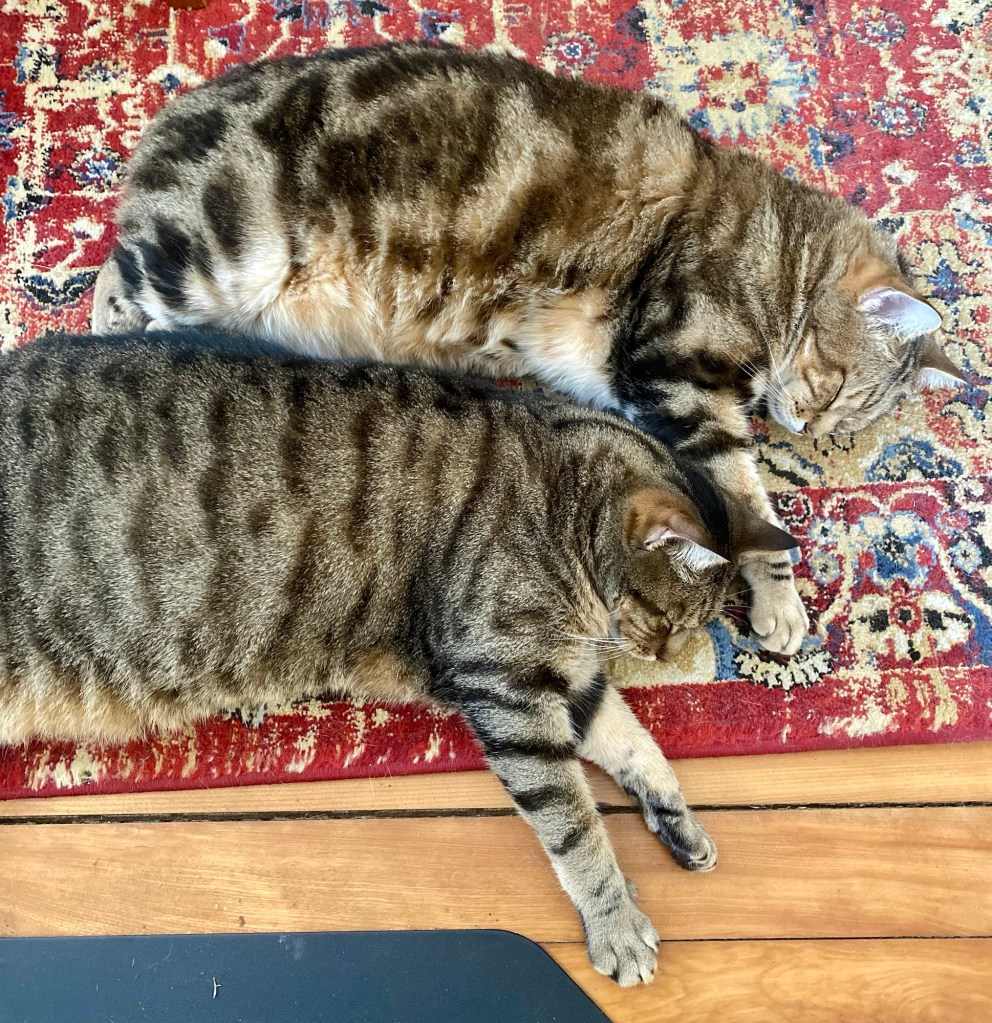
Photo by Molly S.

A long while away from this space after a day last week that began easily enough in our kitchen with my daughter and transpired into another Dartmouth ER visit and a prolonged stay. Days and nights chopped into mosaic pieces. MDs and RNs, the revolving cast of the Dartmouth surgical team, my daughters, pain meds, ice chips, me sitting up and begging for a patch-up to get me to my next chemo appointment… Get me out of this chronic patient repeat.

Now, five of the six chemo treatments completed, I am in the final haul. While my in-box filled up (thank you for your patience), and I was moved from room to room by kind people, I kept thinking of this cancer in a narrative arc. I had hit the section of story where the impossible commences. Before, things looked grim. But now, as protagonist in my own story, the arc swerves sharply, the longed-for light-at-the-end of the tunnel snuffs out, the path is hidden.

I’m not a writer for naught, for make-believe or play. I’m a writer because I know our lives tread meaningful albeit sometimes horribly hard paths. Lean in, I counseled myself, my shoulders far skinnier now but just as fierce. Use math. Get to the fifth infusion. Get to the sixth. Count down the finite days to the end of this treatment, which is, thankfully, eradicating the cancer. In the mosaic: my two daughters, the plastic IV tubing, the doctors in their masks, the ER nurse who stayed long past his shift in the middle of the night, holding my hand and assuring me that, yes, indeed, I would endure.

This is my story, but also the human story, in all our infinite variations of human desire, choice, the immutability of fate.

Sunny morning in our kitchen, birdsong, the fierce thrust towards spring.

Go for a walk around the block?

March 7, my father’s 88th birthday today in what is doubtlessly sunny New Mexico. So much for my plans, months ago, to visit him on this day.

Here’s the thing about living such a long life — I could pick countless numbers of things to write about, but what I woke up thinking about this morning was how my dad would often say, “Let’s go for a walk around the block.” At any time of day, we’d set off. Sometimes just up the street and actually around the block, or other afternoons on hours-long rambles through the woods behind our neighborhood. We walked in sunny days, through sleet, through knee-deep snow, in the sweet spring rain. It’s a habit all three of his children have continued our whole lives, and his four grandchildren, too.

Sunny, here, in northern Vermont, too, a day of such optimism that the blue sky choruses the inevitable promise of spring. And for my father, one of our favorite poems from the unmatchable Hayden Carruth.

Birthday Cake

For breakfast I have eaten the last of your birthday cake that you
had left uneaten for five days
and would have left five more before throwing it away.
It is early March now. The winter of illness
is ending. Across the valley
patches of remaining snow make patterns among the hill farms,
among fields and knolls and woodlots,
like forms in a painting, as sure and significant as forms
in a painting. The cake was stale.
But I like stale cake, I even prefer it, which you don’t
understand, as I don’t understand how you can open
a new box of cereal when the old one is still unfinished.
So many differences. You a woman, I a man,
you still young at forty-two and I growing old at seventy.
Yet how much we love one another.
It seems a miracle. Not mystical, nothing occult,
just the ordinary improbability that occurs
over and over, the stupendousness
of life. Out on the highway on the pavement wet
with snow-melt, cars go whistling past. 
And our poetry, yours short-lined and sounding
beautifully vulgar and bluesy
in your woman’s bitterness, and mine almost 
anything, unpredictable, though people say
too ready a harkening back
to the useless expressiveness and ardor of another
era. But how lovely it was, that time
in my restless memory.
This is the season of mud and thrash, broken limbs and crushed briers
from the winter storms, wetness and rust,
the season of differences, articulable differences that signify
deeper and inarticulable and almost paleolithic
perplexities in our lives, and still
we love one another. We love this house
and this hillside by the highway in upstate New York.
I am too old to write love songs now. I no longer
assert that I love you, but that you love me,
confident in my amazement. The spring
will come soon. We will have more birthdays
with cakes and wine. This valley
will be full of flowers and birds.

Giving the slip….

Back again at Dartmouth, anyone entering my room dons a yellow gown, inadvertently hiding staff name tags. Two nurses enter yesterday and pause. My daughter and her boyfriend stand at my bed’s foot.

A nurse asks, Are you two the main medical team?

The three of us look at each other. In these days where not much has been funny at all, I’m tempted to roll with this, but my daughter jumps in and says, We’re family.

Oh, the nurse says, the Main Team. You looked so intent.

I add, Talking politics….

I’d been in the ER for two nights. The fact that I didn’t care is evidence of how lousy I felt. Due to my contagious infection, I’d been squirreled away. Wheeled through the hallways, I see how jammed this place is, people waiting in hallways, tucked into corners.

In these days, my daughters arrive with their cheery energy, with stories of their lives, their patience with me. I tell them my dream to start walking again…. A few warm days and I’m imagining the four feet of snow have vanished into mud. Not so.

My girls laugh. We’re going to have to Apple chip our mother so she doesn’t wander off….

No fear of my wandering in the (very near) future. But how I’m hungering for that. Just where, exactly, would I look for that chip? Under my boot sole? In the hem of my jacket? So I can give the slip when spring calls…..

Small town, rural hospital, snapshot, tinge of the seventies.

Driving into the Dartmouth Hitchcock Medical Center, the soaring buildings with their blue-green windows inspire confidence. They’re just so darn topnotch, cream of the crest, but (in the cancer journey) I also use the nearby hospital, too.

At the local hospital, not far from our house, we arrive again in the dark, the crimson EMERGENCY sign glowing. My daughter leaves me at the door and disappears around the corner to park. Inside, it’s the same receptionist, who nods a little sadly to see me again. In the waiting room, there’s no one but me and the Mountain Dew machine, my reflection in the windows.

Months into this cancer, I’m familiar with the process (don’t ever put your feet on the ER floor without shoes!) of questions and fluids and meds, a room far away from the day’s flu and Covid patients. Here’s what has changed: the ER doctor and I know each other now. My brilliant oncologist calls me and thinks aloud, what’s going on now? and orders an unusual set of tests. The ER doctor listens, nods, yes, let’s try that. My daughter’s boyfriend appears. The three of us talk about xc skiing and DOGE.

I’ve crammed my backpack with my laptop and notebook, two books, and a few clothes. In the middle of the night, I’m admitted. The woman who takes me upstairs knows a longtime friend of mine. She tells me about growing up in eastern Montana. Wherever you go, she tells me, the sky is infinite. Vermont’s so small, I feel like I could put it in my pocket.

Having lived in the West, too, I sometimes chafe against the pocket-sidedness of Vermont but mostly I love it. I keep thinking of this woman’s description for these few days again, in this rural hospital that’s about the size of double pocket in the front of hoodie sweatshirt. The census is so low here the rooms are all singles. Each of the rooms where I’ve stayed seems to be finished with unique salvaged materials. Beadboard cabinets in my last room, painted glossy cobalt, line one entire wall. In this room, the window is trimmed with wooden rosette corners, the sill plastic faux marble.

The medical world is hurry up and wait, but this hospital leans back towards the 1970s. I drink Shasta ginger ale and chat with the LNA about the cold and maple sugaring. Here’s what changed in me: I see these people throwing everything they have at me. The hospitalist who advised me, just a day after the cancer was discovered, do not stay in bed; be part of the world. The social worker stops in and asks my daughter about her job. The chaplain and I talk Dostoyevsky and cats. The nurses who have survived their own savage cancers share their stories and let me ask my questions. I have so many questions. The questions narrow down to one: how will I survive?

Then I ask to leave. My daughter stops at the pharmacy for another prescription and texts that it will be a few minutes. I open the door and lean against her winter-salted car. I’ve been at this crossroads in this unremarkable section of town so many times. Across the road was the department store Ames where I bought this daughter her first pink ball so we could roll it between us, the baby version of Catch. In the Price Chopper parking lot, I used to meet people to exchange boxes of wedding favors in leaf or heart-shaped bottles, tied up with ribbons, for checks. Afterwards, I’d take my girls into Price Chopper and buy ice cream. Behind the pharmacy is a home center, where I’ll never go again, after my ex-husband absconded with his customers’ money and stiffed the home center… how many tens of thousands of dollars I never knew. I’d severed that cord by then. On the other side of the crossroads stands the hardware store where the girls and I used our pandemic stimulus money to buy a glass table and red umbrella for our back porch. We use those things every summer, nearly everyday.

Behind Price Chopper, craggy Elmore Mountain looms, where I and the girls and their friends have camped and hiked and swam for years. The gentlest of snowfalls sifts down, swirling. My long-legged daughter crosses the lot, shades on despite the overcast sky, grinning.

Survivors.

Friends appear at my kitchen door with a rose and gossip. Midwinter, and I’m happy to keep my cats sprawled belly up before the glowing wood stove. The creatures sleep on the hot metal floor guard, their fur gathering ashes and birch bark curls. The snow bends down my thorny rose bushes. My daughter texts with news of a robin sighting. We talk about the usual — town meeting day approaching, the strangeness of an administration determined to chop apart the country. In Vermont, we do our usual thing: heads together, we strategize how to endure, how to keep our hearts open.

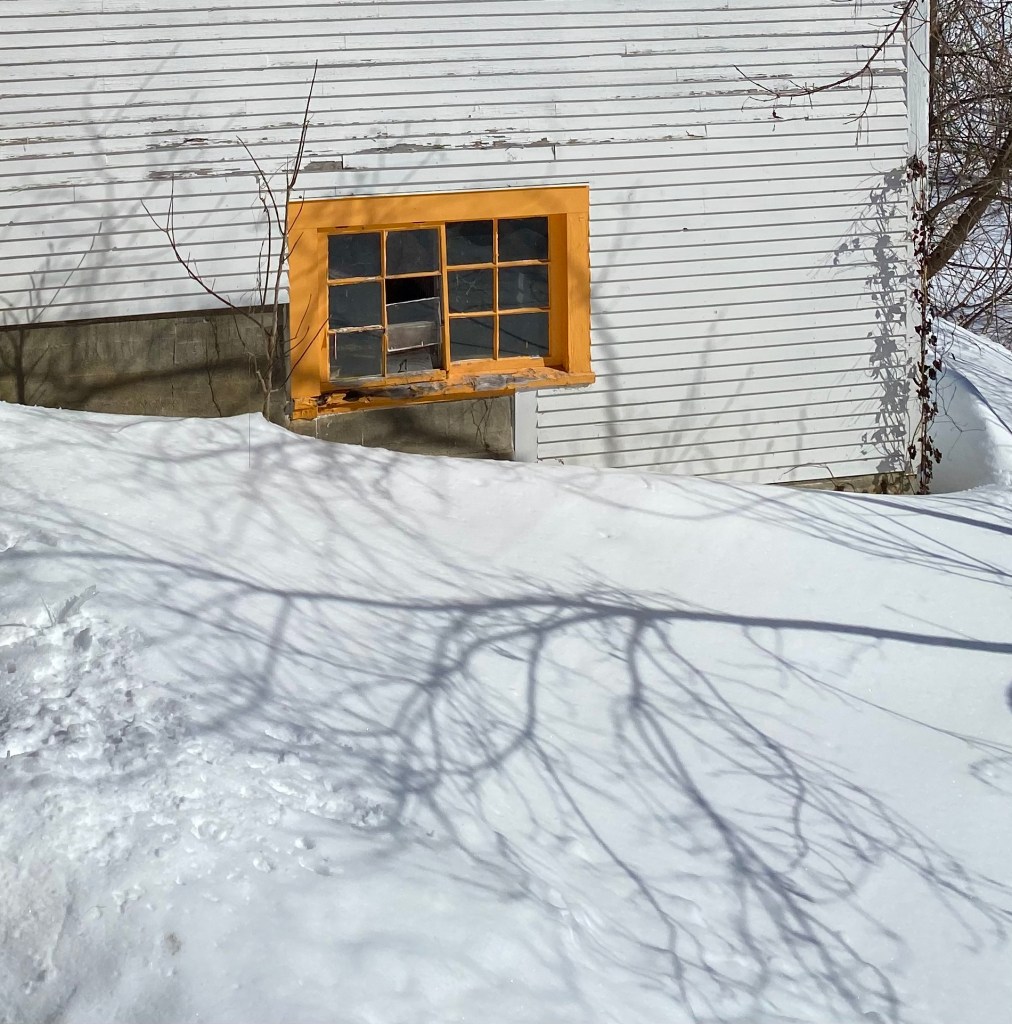
The snow is no fresh news. The unbroken cold (and hardly that awful — I’ve seen 40 below, albeit just once and that was enough 40 below for this lifetime) is no news, either. The sun begins to return, the days spreading out at either end, although the icicles remain icy, dripless daggers.

For me, this winter is the most profound of my life, surely the most sacred. I’ve had my own lovely share of winters with my newborns nestled against my chest, of small children delighted with swirling snowflakes, of long skis through woods. On the night before the Presidential election, an ER doctor gently told me I had cancer. Months later, I’ve immersed myself in the mundaneness of insurance and how to navigate the multi-levered medical system. Beyond that, my life slowed, often to simply enduring an afternoon, a night….

I’m adding to my draft of this post, a day later, now hospitalized again. Let there be no mistaking one of the world’s realities: infection is a mighty (and frequently fatal) force. Now, my daughter and I have this down: fluids and pain meds, with the curve now of puzzling out with the oncologist why I’m back. I contracted Giardia last summer from swimming in unclean water. Although I’ve been treated, the question lingers… has this bizarrely lingered?

But I wanted to return to the beginning of this short piece, about the kindness of friends and strangers. Lymphoma is my disease to bear, my bone marrow and veins and intestines and organs. But now, I — who so long saw myself as a lone running wolf — have been humbled to realize I’ve never been apart from the world, all this time. All around me, strangers and loved ones alike hold me together.

From my friend Jo, who sends me an audio poem every night:

“Survivor”
Adele Kenny

A jay on the fence preaches to a
squirrel. I watch the squirrel quiver,
the way squirrels do – its whole
body flickers. I’m not sure why this
reminds me of when I was five and

something died in our drain spout.
Feather or fur, I watched my father
dig it out, knowing (as a child knows)
how much life matters. I have seen how
easily autumn shakes the yellow leaves,

how winter razes the shoals of heaven.
I have felt love’s thunder and moan, and
had my night on the wild river. I have
heard the cancer diagnosis with my name
in it. I know what mercy is and isn’t.

Morning breaks from sparrows’ wings
(life’s breezy business), and I’m still here,
still in love with the sorrows, the joys –
days like this, measured by memory, the
ticking crickets, the pulse in my wrist.

Unsurpassable February.

For days, the forecast has trumpeted news of impending snow this weekend; still, sunlight floods into our kitchen this morning. Sure, it’s a few degrees above zero, nothing to sneeze at, but the icicles gleam, skinny stalactites, proof of this week’s warming. A crimson cardinal perches on the feeder.

We are in deep midwinter, the annual mark of collective cabin fever, of generalized bitching, of snow pile comparisons and, in precise detail, what is now hidden from view. It’s the season for skiing, for chocolate, for mooning over seed catalogs.

In my own cancer world, I mark the merge of days and nights in my own way, writing my thousand words a day (sometimes more, sometimes not at all), as my own shepherd’s crook to right my crooked self. In the afternoons, spent, I read and read, returning to that great pleasure of my youth. Around me, my family shifts and jostles, their own lives crammed full with their living, with jobs and classes and loves or longed-for loves. My daughters call me with stories about a grapefruit drink that I vow to drink this July and August, over smashed ice, my bare feet on the grass or maybe a sandy shore of Lake Champlain. It’s the time of year when we long for rain drops on our cheeks and clotting in our eyelashes. But February rain holds ice and sleet, not the green wash of spring, the scent of soaked earth, the tang of emerging garlic.

Every day, I talk with my old father in New Mexico. He asks, Are you sticking to the plan?

I am, I assure him, holding to the course of what the medical realm prescribes, meds and applesauce and so much water — but the here’s the refreshing, liberating, unbelievable thing: there’s no bones with anyone at all in the cancer world that this is a hard dirty blow. So seize this opportunity, turn your life inside out, remake it anew. Make no excuses. Take.

Driving, again driving in the dark to Dartmouth, the full moon hung over our shoulders the entire journey, a creamy light, brilliant on new snow, unsurpassable.

And here’s a poem from Ginger Andrews I used to read in my shut-in mothering-toddler days….

The Cure

Lying around all day
with some strange new deep blue
weekend funk, I’m not really asleep
when my sister calls
to say she’s just hung up
from talking with Aunt Bertha
who is 89 and ill but managing
to take care of Uncle Frank
who is completely bed ridden.
Aunt Bert says
it’s snowing there in Arkansas,
on Catfish Lane, and she hasn’t been
able to walk out to their mailbox.
She’s been suffering
from a bad case of the mulleygrubs.
The cure for the mulleygrubs,
she tells my sister,
is to get up and bake a cake.
If that doesn’t do it, put on a red dress.