The Twisty Road North

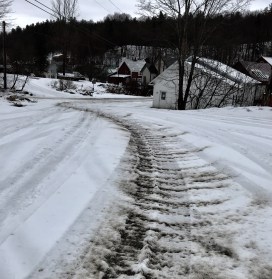
Late afternoon on a Friday, I take a winter road trip north, nearly to Canada, along Route 14 so rutted with frost heaves my little Toyota bounces. The pavement and passing cars are bleached with road salt — rust, pernicious rust, I keep thinking, apprising the mortality of my vehicle.

My daughter and I return in the dark from her concert. It’s 8:30 pm, but might as well be midnight. No one’s on the road but a tractor with blinking lights before a barn. This is farming country. The few gas stations and general stores in the small towns we pass through have all snapped off their lights, shut up, gone home.

Even in the dark, this highway is familiar, although we rarely drive this way anymore. In the dark car, eating crackers, we swap stories. My daughter tells me about the  high school she just visited and its long locker room. I point out the state’s largest landfill. Whoo-hoo, my daughter says. A claim to fame. We pass a farm where she once believed Santa’s reindeer lived. I was so sure of that! She tells me about a tiny turtle on Lake Memphramagog I’d forgotten. She repeats the story with precise details; in a flash, I remember that brilliant April morning, the black and white checked dress she wore and loved.

Listening to her, at age 13, I hear her imagining a different life. What would it be like to live here? I think of her as so young, but I’m wholly wrong. Her stories keep flowing. Along this road we hardly ever travel, she has a whole history already, a detailed map of her past.

What an age 13 is: so full of wonder, of mystery: which direction will I steer my life?

To move, stay put, say the Buddhists. To see, stop looking. Don’t imagine paradise in the sky. Make paradise in the kitchen.

— Kate Inglis, A Field Guide to Grief: Notes for the Everlost
IMG_4855.jpg

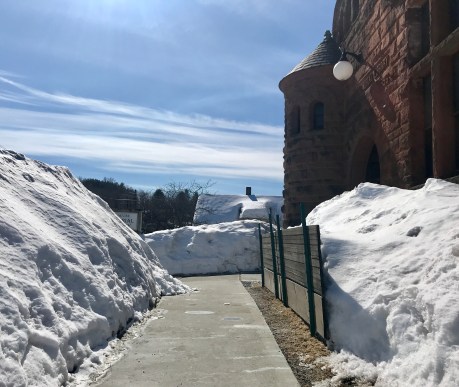
A sampling of our everyday snowbanks this March
Birthday Blessings

This afternoon, I stepped out of my library with a child to look at the sky. He was glad he had returned a stack of library books, a kind of clearing of his child conscience. In my clogs, I leaned against the building, a squall fattening in this valley, tucked up against Woodbury Mountain. What a winter this has been. Snowbanks dominate Hardwick like a pop-up mountain range.

Later, a friend and I leafed through a Vermont guide to wildflowers. Remember spring beauties? Remember trilliums?

Early March is my father’s birthday and, two days later, my mother’s. In their  80s now — old but not very old, not even close to very old — my parents who lived through WWII, the Vietnam War, Nixon’s resignation, and the eternity of the Reagan-Bush regime, through having careers and raising children, teaching and writing books and caring for the infirm and the dying, through decades of friends, through all the everydayness of living — and now through the particularly heartless regime of Trump — here’s Hayden Carruth’s birthday poem for love of a woman and love of living.

“Birthday Cake”

by Hayden Carruth

For breakfast I have eaten the last of your birthday cake that you
had left uneaten for five days
and would have left five more before throwing it away.
It is early March now. The winter of illness
is ending. Across the valley
patches of remaining snow make patterns among the hill farms,
among fields and knolls and woodlots,
like forms in a painting, as sure and significant as forms
in a painting. The cake was stale.
But I like stale cake, I even prefer it, which you don’t
understand, as I don’t understand how you can open
a new box of cereal when the old one is still unfinished.
So many differences. You a woman, I a man,
you still young at forty-two and I growing old at seventy.
Yet how much we love one another.
It seems a miracle. Not mystical, nothing occult,
just the ordinary improbability that occurs
over and over, the stupendousness
of life. Out on the highway on the pavement wet
with snow-melt, cars go whistling past.
And our poetry, yours short-lined and sounding
beautifully vulgar and bluesy
in your woman’s bitterness, and mine almost
anything, unpredictable, though people say
too ready a harkening back
to the useless expressiveness and ardor of another
era. But how lovely it was, that time
in my restless memory.
This is the season of mud and thrash, broken limbs and crushed briers
from the winter storms, wetness and rust,
the season of differences, articulable differences that signify
deeper and inarticulable and almost paleolithic
perplexities in our lives, and still
we love one another. We love this house
and this hillside by the highway in upstate New York.
I am too old to write love songs now. I no longer
assert that I love you, but that you love me,
confident in my amazement. The spring
will come soon. We will have more birthdays
with cakes and wine. This valley
will be full of flowers and birds.

IMG_4848.jpg

Wet Wool Memory

I buy my daughter a pomegranate, because she loves the fruit, because of the red it brings to our snowy Vermont landscape, and because Saroyan wrote about pomegranates. My parents did not buy pomegranates. As a kid growing up in New Hampshire, I wondered about that mysterious fruit — much like I wondered about Turkish Delight, the Narina sweet my father found in Ann Arbor and bought for us with great joy.

On a snowy day, the girls discover a coolant leak in my car. The mechanic who fixes the leak explains to my teenage daughter what the level of coolant should be in a car, when to add coolant, and when to worry. Standing between the two of them, I study his unzipped Carhartt jacket, stained with motor oil. Like Proust’s madeleine, so much of my past was redolent with wet and snowy clothes, work and words twined together.

Like that, then, the past’s gone. The girls and I stand outside the garage in a snowstorm again. I tell my older daughter as I always do, drive carefully. Laughing, they’re off again.

From one of my mentors, poet Ruth Stone:

Yes, we are everything, every experience we’ve ever had, and in some of us, a lot of it translates and makes patterns, poems. But, my God, we don’t even began to touch upon it. There’s an enormous amount, but we can touch such a little.

56866259260__FF99E9DB-165C-44FD-8B7C-9130B1EBFA24.jpg


When In Doubt, Do Handwork

My 19-year-old, pondering what to do with her life, buys fat skeins of yarn and begins knitting a blanket. The metaphor of comfort consoles me, too.

I just read David Grann’s The White Darkness, about Henry Worsley, descendant of Frank Worsley, of the Shackleton Endurance expedition. It’s hard to imagine a more manly man than Henry Worsley, who ultimately perished from complications of his solo South Pole trek. Yet Worsley sewed to calm his nerves. He was skilled at needlepoint. He volunteered to teach tatting — yes, tatting — to London prison inmates. How cool is that?

Shackleton… sought recruits with the qualities that he deemed essential for polar exploration: “First, optimism; second, patience; third, physical endurance; fourth, idealism; fifth and last, courage.”

State 14 ran the first of my monthly Postcards From Hardwick. Check out terrific Vermont voices here.

IMG_3837

#10 Pond

June 4

Here’s the story of June: I walk behind the barn this morning and the tree branches grab for me. Just the day before, mere branches with fresh leaves — this morning, fierce growth.

May is delicate, fragrant. By July, Vermont’s wildness will be tempestuous, crazy with green. By August, we’ll be picking blackberries surrounded by wild apples, a profusion of fruit on vine and branch.

This year, I’m determined savor the summer, come what may — brutal humidity, a woodchuck with an appetite, or, what’s far more likely, what I haven’t imagined.

Nonetheless….. that’s my mantra. Snow will return, soon enough.

You got to understand: here
Winter stays six months a year—
Mean, mean winters and too long.
Ninety days is what we get, just

Ninety days of frost free weather….

— David Budbill

IMG_2115

Running Away

James Joyce’s “The Dead” is one of my favorite short stories, with that remarkable line about falling snow general all over Ireland. In my corner of Vermont, these days, the sentiment generally is enough with the snow for this year. April: season of rain, of snow and ice and, somewhere, beneath all that, struggling green.

I stopped in at the Woodbury school, leaning against the foyer wall while a man who grew up on a farm in the area told me the red-winged blackbirds reminded him of childhood. When he snuck away from farm chores, he headed down to the creek where those dark birds with their signature crimson mark sang.

Ridiculously visually inclined, I rely too heavily on my vision: really, as all my photos attest, the landscape here is yet the monochrome of winter. I’m wrong about this, of course, although I won’t point to any sign of spring at my friend’s request. Too cruel, she says, when sleet falls.

And yet — dumping coffee grounds around blueberry plants, fingering their branches and imagining small, perfect white blossoms, I then close my eyes and listen to the birdsong all around, their rising, sweet melodies.

I watched the first shoots
like wings tearing the soil…

— Louise Glück

IMG_1616.jpg

Woodbury, Vermont