Small Things.

With a teenage daughter and another grown daughter, I’ve long ago sunk ruggedly into a mantra of and life goes on that has ferried me through plenty of turbulent waters into smoother waters, always determined to seek calmness to keep my head together and keep working. Life and work have so long been synonymous for me, with brief forays into the pleasantness of family, of friends, of just life itself.

But I woke this morning thinking how impossible that mantra really is. Life is “going on” for so many people in such harder ways, so far away from me.

This week, I’ve been with my own family, sorting out the challenges of aging. Meanwhile, ordinariness reigns around me, with people coming and going to work, maybe buying bread and sausages for dinner, a bouquet of sunflowers for the table. How dear family life is, mine, yours, the families in bombed apartments in Ukraine.

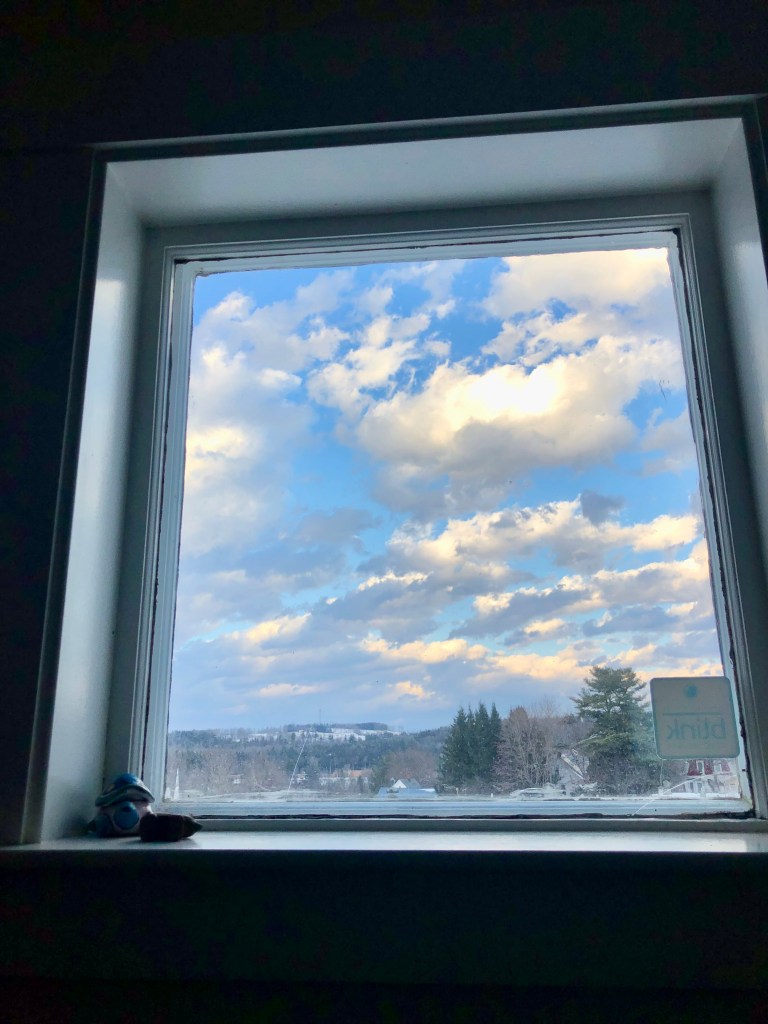
In the end, of course, how much do our small thoughts and complicated opinions matter, anyway? Here I am, a small woman in a small Vermont village. In the face of bleak nihilism and despair, I return to the things that have made the truest sense to me — the sky that exquisitely changes from sunup to sundown, the liturgy of human language, laughter. There’s no answers here, only a reminder to myself that the wind brushes over my cheeks, and the wisdom that turns the globe is wider than my own imagination.

Ordinariness.

On a day of yet more snow, of wind and cold, I’m reminded that people still keep on with their lives. Living doesn’t wait for convenience.

At the post office, I mail off a copy of my book. The woman who weighs my small package insists this is “sugar snow,” an early spring snowfall that will lengthen the maple syrup season. We sugared for years, and this kind of snow always meant a break in boiling and a chance to wash filthy snowsuits. The upcoming forecast is for as near-perfect sugaring weather as possible. Sugaring is the epitome of day-to-dayness — be smart, keep your eyes open, do the best you can — with no guarantees of a good or even decent season.

We talk for a few more minutes about shoveling snow, and then I head back out into the town’s Saturday morning. On my walk home, I stop in at the coffee shop and stand in the window drinking an espresso and staring out at the traffic struggling on snowy Main Street. There’s the usual confusion of the three-way intersection so many don’t understand — two stop signs and a blinking yellow light — as if the calculus of two stops and one yield doesn’t make sense. Standing there, I wonder if it makes sense mostly to those who use these streets day after day.

A year ago, the coffee shop’s tables and chairs were closed for seating, and I wondered if I would ever bring my laptop back here, to my favorite table where I once wrote a book. A year later, here I am, drinking coffee, surrounded by maskless people laughing and talking, writing notecards, going on about their lives. On this inclement Saturday morning, that seems nothing shy of a miracle.

“The answer must be, I think, that beauty and grace are performed whether or not we will or sense them. The least we can do is try to be there.” 

~ Annie Dillard

Birthday.

Today my father is 85 — an extremely notable birthday. My father was born in the Depression, son of Romanian immigrants. His life spans through the second World War and incredible social changes, and he’s lived in Michigan, in Europe, in New Mexico, and in New Hampshire where he and my mother raised their three children.

This morning I woke from a dream about the blue Volkswagen Beetle my parents bought in Germany, not long after they were married, and shipped back on the boat to this country. They drove that beetle most of my childhood. We hiked and walked all through my childhood, too, always getting the lay of the land wherever we were. One weekend, the VW’s battery was on the fritz. We pushed the car to get it started, then parked on a hill at the trailhead, hiked, and rolled the car back into life.

Afterward, we stopped in a New Hampshire village, parked again on a hillside, and walked into town. He bought us ice cream cones at an old soda foundation, and we stopped in a used book store. Back at the VW, he had us push the little blue car, then he jumped in and popped the clutch. At the bottom of the hill, engine idling, he unrolled the window and leaned his head out. “Hop in!” he called to his kids.

By twist of fate, my parents, like so many others, are entering very old age in a pandemic, with immense challenges there’s no need for me to reiterate. But on this March morning, I also woke remembering 24 years ago, the day my then-husband and I first made syrup from our 2,000 tap sugarbush. In the cold, I walked back up the house, called my father, and wished him a happy birthday. We had made fifty gallons of syrup, and that sweet golden flow seemed miraculous. A year later, my parents visited and met their first granddaughter.

March is the season of promise that we live through, year after year, ice and gloom yielding syrup. Such sweetness.

Testament

by Hayden Carruth

So often it has been displayed to us, the hourglass
with its grains of sand drifting down,
not as an object in our world
but as a sign, a symbol, our lives
drifting down grain by grain,
sifting away — I’m sure everyone must
see this emblem somewhere in the mind.
Yet not only our lives drift down. The stuff
of ego with which we began, the mass
in the upper chamber, filters away
as love accumulates below. Now
I am almost entirely love. I have been
to the banker, the broker, those strange
people, to talk about unit trusts,
annuities, CDs, IRAs, trying
to leave you whatever I can after
I die. I’ve made my will, written
you a long letter of instructions.
I think about this continually.
What will you do? How
will you live? You can’t go back
to cocktail waitressing in the casino.
And your poetry? It will bring you
at best a pittance in our civilization,
a widow’s mite, as mine has
for forty-five years. Which is why
I leave you so little. Brokers?
Unit trusts? I’m no financier doing
the world’s great business. And the sands
in the upper glass grow few. Can I leave
you the vale of ten thousand trilliums
where we buried our good cat Pokey
across the lane to the quarry?
Maybe the tulips I planted under
the lilac tree? Or our red-bellied
woodpeckers who have given us so
much pleasure, and the rabbits
and the deer? And kisses? And
love-makings? All our embracings?
I know millions of these will be still
unspent when the last grain of sand
falls with its whisper, its inconsequence,
on the mountain of my love below.

Overheard.

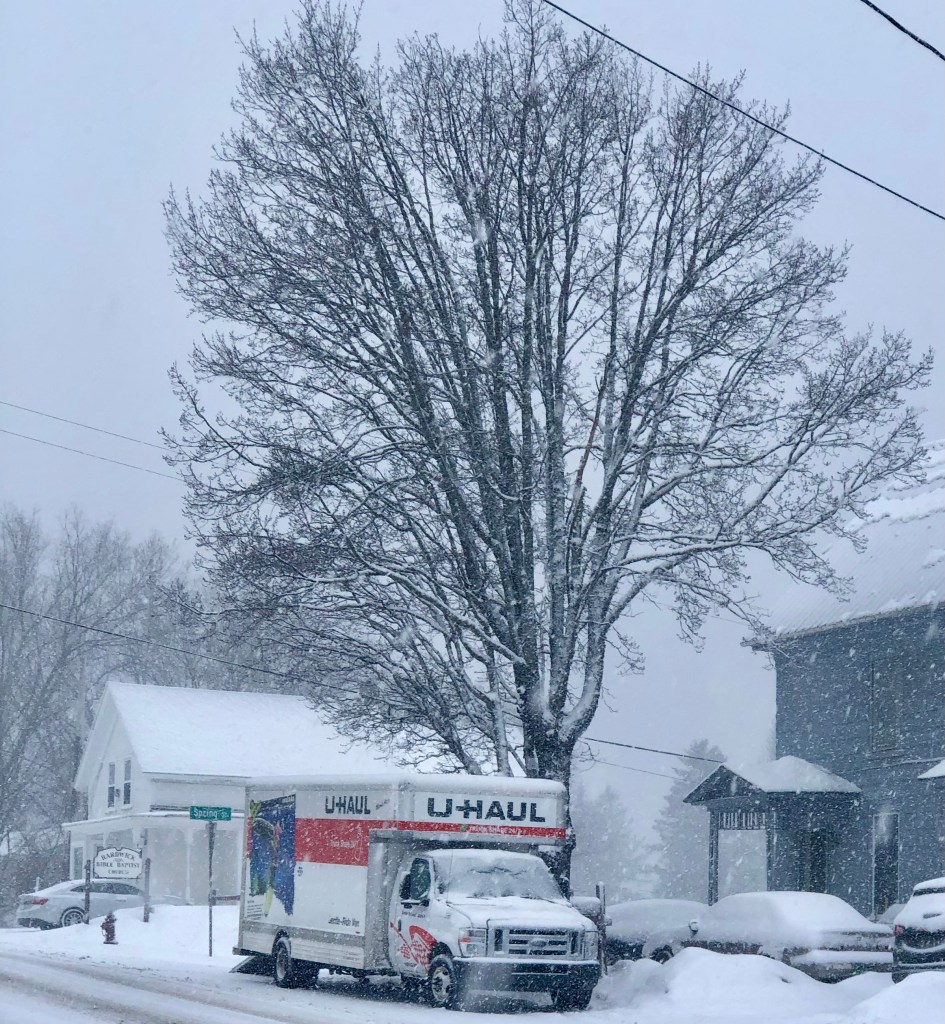
Far enough after twilight that the darkness has set in for the night, I walk up to the library to leave my returns in the book drop. The bitter cold has snapped, worn down by the day’s warmth. Cold in February will return — it nearly always does — but the tide of winter has pushed over.

Spring in Vermont is a long ways off. This is a rude truth, and it’s also true that this is the time of year I begin hungering for green. I take my time, walking back through a neighborhood. Hardly anyone is out, save for a man standing on his back step, drinking a beer and smoking. The smoke curls upward in the lamplight just above his head. Down the street, a small child comes running at me, his or her head hung down a little, tired perhaps. The child wears a knit cap and a dark coat and hurries along, keeping a wide berth from him. At the house with the man and the cigarette, the child leaps the snowbank. The man says, “Hey now, been waiting.”

The boy rambles about “sledding gone soft.” As I turn the corner, the man’s deep voice follows me. He says kindly, “Wait a week, kiddo.”

Good advice for kiddo, I think. I follow the steep street up to my house, where the cat is waiting in the windowsill for me, and the daughter is solving math equations.

Collectively, I think, we’re all in a waiting period.

Eh, Winter.

18 below zero this morning.

The cold comes at my face like a knife when I take out the wood stove ashes. The early morning is perfectly still, full of sunlight. This is not the songbird season.

I’ve now lived through a few dozen Vermont Januaries, beginning as a young woman when I spent so many January nights walking around beneath the winter sky, amazed at all those stars in the deep country dark. Januaries of nursing babies, of a long driving commute, of sledding and baking bread, and enduring the beginnings of cabin fever’s madness.

Always, there’s the cold that reminds us immediately of our own fragile mortality and an inevitable thaw. By the end of the month, daylight returns in a rush. In these chopped-up days of uncertainty, I remind myself of these constants.

We forget about the spaciousness
above the clouds

but it’s up there. The sun’s up there too.

~Naomi Shihab Nye

Walking with Skis.

Greensboro, Vermont

Someday, maybe I’ll look back at this photo of my daughter on the Christmas she was sixteen…. goodness, what will I be thinking then?

In the late afternoon, I ski up through the woods to where the farm fields meet the forest in two strands of electric fence. The fence is off now, and the fields are empty of grazers, save for the odd crow that picks in a bare spot. The day, although not sunny, has warmed, and snow clumps on my skis. The skis need waxing, which I haven’t done. Instead, I take the skis off and shoulder them, and walk down the trail through the few inches of snow.

These days, I’m working hard, the outside world coming at me in a fury. In the evening, we play cards. I’ve picked up a copy of a Mark Sundeen book that reminds me of my idealistic youth and a happy summer we spent in a tipi. The circumstances have changed; the world has changed, indeed, since my wild twenties; but the questions are the same.

I take the long trail back home through the woods, despite carrying my skis. At a stream, I stop. The ice hasn’t yet completely skimmed over the rocks. I pull off my mitten and dip my fingers in, the water so clear and cold.

How can a man hope to promote peace in the world if he has not made it possible in his own life and his own household?” 

― Mark Sundeen, The Unsettlers: In Search of the Good Life in Today’s America