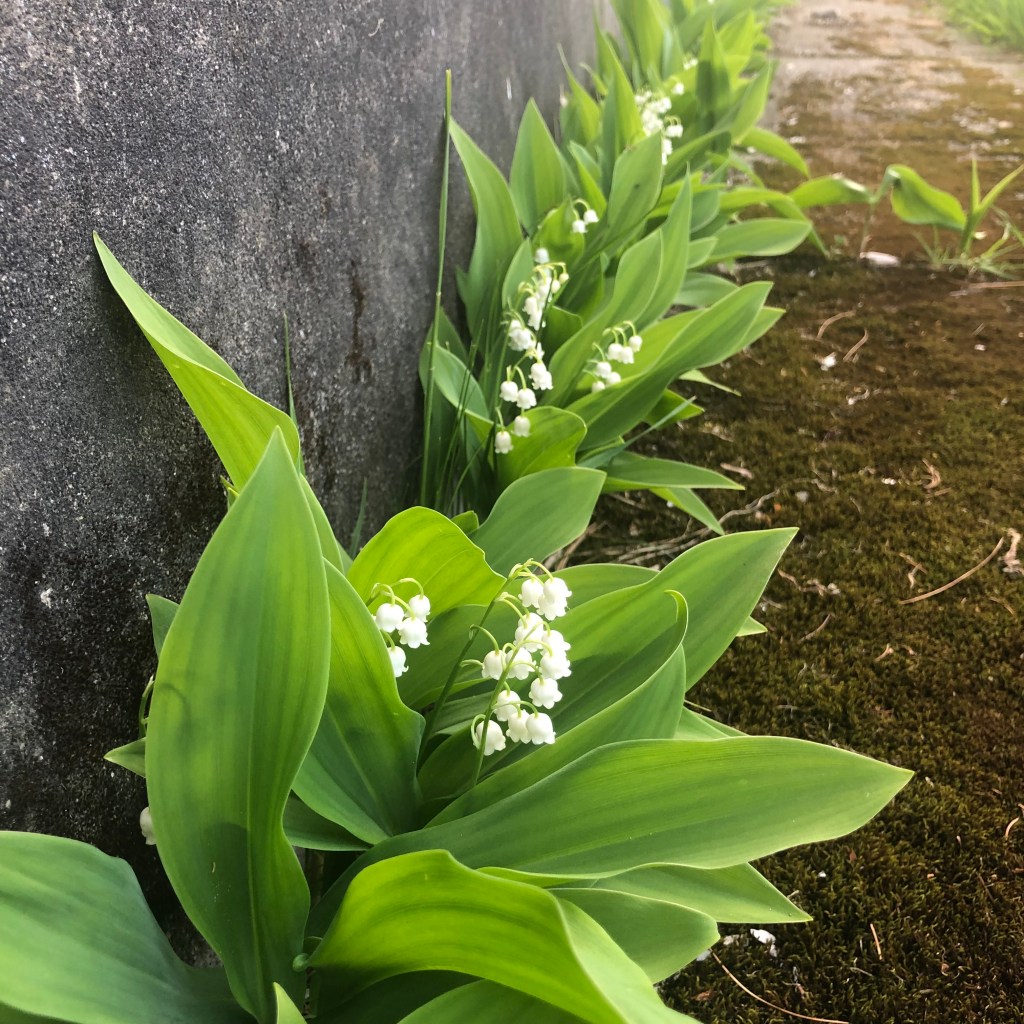
Foxes. Friends.

June, and I work in the garden or the outside tables as much as possible, countering my indoors job and the pandemic years that have thrown me (and humankind) off-balance. Despite the unusual cold and wind, I often read outside in the evenings while the neighbors’ boys bike on our dead-end road, calling out my name.

Just beyond the pin cherry trees, the foxes come and go, reddish-brown, their front legs black. They’re not disturbed in the least by the man who walks his leashed dog in the cemetery, both man and dog head down, preoccupied with what, I have no guess. Across the milkweed and lupine, the foxes and I stare at each other, before I silently head my way, or they head theirs.

They go about their lives of hunting and playing, their ears and eyes alert to the world around them. I go about my human life of language and thought — a life that sometimes seems fixated on lists and transactions. For these moments, coming and going like the sun through clouds, this relationship feels like one of the realest in my life, devoid of our human tendencies towards deceit and self-absorption. I’m not about to become a fox, but I might become a slightly better human for these true friends.

The gods, we are taught, created humankind in their own image. Everyone has an urge to create. Its expression may flow through many channels: through writing, art, or music or through the inventiveness of work or in any number of ways unique to all of us, whether it be cooking, gardening, or the art of social discourse. The point is to honor the urge. To do so is healing for ourselves and for others; not to do so deadens our bodies and our spirits.

~ Dr. Gabor Maté, In the Realm of Hungry Ghosts

On the Road.

On a rainy Saturday, I pause on an empty road and snap a photo. I’d been listening to NPR’s coverage of the January 6 insurrection, one more plot point along the disintegration of the American Empire.

For June in Vermont, it’s darn cold. I’m wearing a winter hat, and the damp wind reminds me of the ocean, how the salt air cuts into you. Listening, I remembered August 1974 when Nixon resigned. My family was moving that day, and my father, fixated, insisted on setting up our tiny black-and-white television. My sister and I asked what the word resignation meant. My father, dealing with movers and three little children and a curious pack of new neighbors, paused to teach us the meaning of that word and gave a comedic impression of I am not a crook, and then explained what that meant, too.

Decades later, and a whole lot of crooked politics later, I still think of the open road as my family’s version of Huck Finn’s Mississippi River. Not long after we moved that August, my parents drove their three little kids in our green Jeep to the ocean. We had lived in the southwest and never seen the ocean — so much water, so much sky, the impossible proved possible. My father taught us how to fly a kite, its long tail fluttering in the wind.

...Yet I like driving at night
in summer and in Vermont:
the brown road through the mist...
— Hayden Carruth, "The Cows at Night"

Peony Metaphor.

A few years back, owners of a stellar nursery gave me a cardboard box with a twisted root inside, tangled ends clotted with dirt. I planted as directed, and then the bartzella was at the mercy of nature and its own self whether it would grow, or not.

This June, the irises have flooded a purple pond around the lilacs. The mock orange is opening its snowy petals. And these yellow peonies with their ugly name — a few days of inimitable beauty.

A day of cold rain in the forecast today. A Saturday of writing and catch-up chores and my determination to do something about the mold on the bathroom ceiling. It’s mid-June. We’ve lived in this house for five years. The blossoms are rampart. I’ve added my own gifted dull root. For a few days, heart-pausing beauty.

This morning the green fists of the peonies are getting ready

to break my heart

as the sun rises, 

as the sun strokes them with his old, buttery fingers…

— Mary Oliver, “Peonies”

Acquaintance. Full Moon.

In an evening walk, I meet a woman I haven’t seen in years. We stop and talk for a few moments. She’s hardly been anywhere for the past two years, and we talk about how that feels. In the balmy evening, little bits of tree pollen float through the sunlight.

Never tall, she’s about my height now, and I’m really short, and I’ve gotten shorter in the past two years. But here we are, talking about lupines, happy to be alive. We exchange a hug — something that seemed forbidden, utterly scary, not that long ago.

Later, as I close up the house for the night, I walk across the dark lawn to my garden. The round moon, like a perfect drop of cream, rises. Frogs chirp.

Here’s one thing: the pandemic has made me think of each day as each day. A whole day — filled sometimes with hard things, or dull things, sweetness, or all kinds of things. But what does a day mean? A night? Nothing more, perhaps, than this: full and frogs and a moment to revel in this.

Mother Noise.

Summer study…

In the middle of the night, I read Cindy House’s memoir Mother Noise. House struggled with a heroin addiction. Eventually, I turned off the light and lay awake, listening to the cricket song through the open window. It was the deepest, loneliest part of the night, somewhere in the stretch from midnight to four a.m. Four a.m. is the hour that seems reasonable to rise and get the coffee brewing. For years, I dreaded this time of night. One of the great pleasures of sobriety is that the nether world of dreaming has returned to me.

For days, the trifecta of my daughter’s 17th birthday, her junior prom, and the anniversary date I was married 28 years ago has soured my mood. Here’s the thing about being a solo parent: you’re forever cut in half, wondering why the hell the other parenting half of the children is attending a party elsewhere.

But in those hours, thinking of Cindy Noise, I began wondering about what else might have happened rather than the story I keep telling myself of a father still parenting his daughters. The thing is, my life — like anyone’s — might have turned out entirely differently. I became sober. But I could have become a heroin addict. Given a different set of circumstances, sure, why not? I loved inebriation, as long as it was good. For the first time, the real possibility of this looms before me.

The crickets chirp on. I begin to sense my life shifting, just a little, just the smallest way out of sour.

Later that afternoon, I’m driving with my daughter. She parks at an empty storefront beside the run-down laundromat in town. On the granite steps of that former bank building, a little girl, about five or so, is sitting beside a large stuffed giraffe. The giraffe is hard-worn, well-loved. The little girl holds a picture book between the two of them, her lips moving. She stops when she sees me standing on the sidewalk. I glance down at her pink sandals, her purse open with a memo notebook inside. Then I nod and hurry along, leaving this child to what she’s doing.

Oh, sweet world. So much harshness. So much to cherish.

Somewhere in the Pandemic.

A colleague and I discuss our somewhere-in-the-pandemic plans: gardening and creativity and as much outdoor time as possible. We’re somewhere in the pandemic; that’s our determination. This somewhere might extend for a very long time yet.

This week, I was invited to a FB event where people all over the country signed in. I began by talking a little about my own dear state — tiny Vermont — whose entire population of 650,00 souls is less than many cities in this country. Some villages have a post office and a single paved road, a scattering of houses, streams and trees, gardens and swing sets. Since I was talking about my book and addiction, I spoke about how the wide world seeps into the most hidden places in my world, too. And yet, our lives go on. That same, age-old question — how to find meaning in our lives?

Memorial Day in Vermont is a big deal. The town cemetery beside my house is freshly mowed. New flags wave near stones. All week long, families have been tending gravestones. May is the season of lilacs and green. I make notes for the weekend: tend my garden. Make friends with the new neighbor and the scary dog.