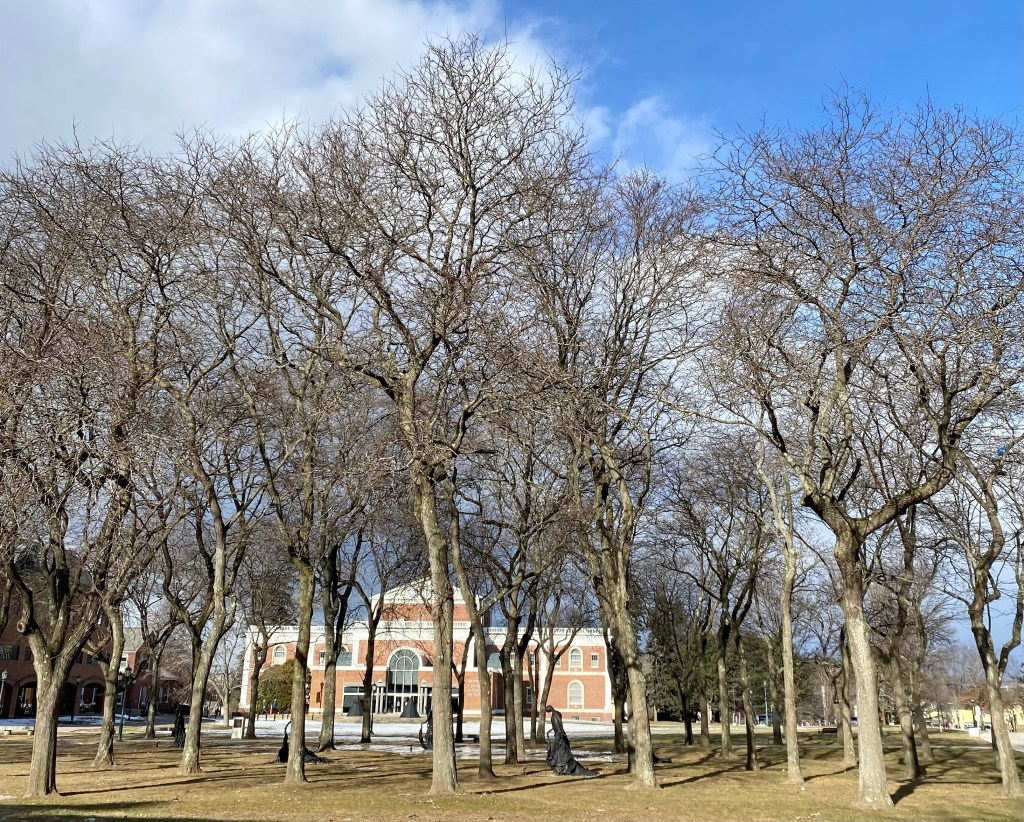
Household chores and world events.

The last day of 2023, I let the fire in my wood stove extinguish, and I take my stove apart. The stove has been spitting ash and spark through a damper, a chore I’m driven to by sheer necessity.

I unscrew the stovepipe and the back heat shield and plate, and carefully remove the two honeycomb metal filters that are choked with fine ash. It’s a messy job, and I’m a messy woman. My curious cat walks through the cinders and leaves dirty paw prints on my white enamel kitchen sink.

When I’ve put the stove together again, I find the driest kindling I can in my barn and build a small fire and slowly heat the stove again, kneeling before the glass where the flames ripple, listening to public radio hash over the year. I add wood, study the flames, murmur to my cat who is seriously invested in this warmth and the doubtless impending feline nap.

I’d once torn a photograph from a New Yorker issue and thumbtacked it near my desk of Marina Oswald, taken the morning after her husband Lee Harvey Oswald was arrested for assassinating President Kennedy. Her face twisted unhappily, she’s pinning cloth diapers on a line. So it goes: the necessity of domestic life as the great events of the world unfold.

My stove burns merrily. I bake spanakopita and invite a few dear ones who bring chocolate. This morning, January. A drift of snowflakes. The lean winter light.

The snow is melting
and the village is flooded
with children.

— Issa

Where’s the Calvary?

I stop by a friend’s house with some cookies, and we talk for a few moments on her back porch. Sunlight streams in through the windows, rare and cherished in December.

Driven more by the solstice than the calendar, this time of year is the time of reckoning: what’s happened, what’s lying fallow, what might emerge next year? 2023 was a year in my immediate world of wildfire smoke, of floods and more floods, of a social fabric thinning with half-truths and deception and irascibility. A year of people around me who suffered losses in ways that matter immeasurably.

The world we’ve created drives us to reduction, to categorizing our lives in an Instagram post, a hashtag. For anyone who’s even remotely following our personal or national stories, the facts align otherwise. History may likely prove that the precipice of 2024 was a still moment before a tsunami. A handful of years ago, on a sunny autumn afternoon, I faced a still point in my life when I realized the cavalry I’d relied upon to get me out of a marriage gone sour was not saddling up and heading my way. In what was really no joke, I sized up my assets, secured my perimeter, and penned myself a map to head out for new territory. I was, in fact, my own cavalry. Fresh horses arrived, thankfully, at key places. What surprised me the most was the generosity of strangers who, in passing, offered me small precious things like swallows of magic elixirs.

Here’s the thing: in my way of thinking, December is the holy month because of its deep darkness, utterly mysterious, profoundly unknowable, utterly unnegotiable, sometimes terrifying. It’s the season to open our hearts beyond that reduction. On her porch, the cold gnawed my hands holding those cookies. As we spoke, I thought of the songbirds that flock around this house in summer. We are the cavalry, in ways we often don’t rationalize or consider. Perhaps this is the dearest part of December: that in the darkness that transcends any human doing, our eyes are always searching for the moon and starlight, for luminosity. And the light is always there.

Stitching, in Friends & Wool.

December, and by five o’clock, the dark has hammered in for the night. A friend and I walk to the post office, talking about work and family, laughing as we avoid icy patches glowing beneath the streetlamps. We meet a neighbor walking home with her two children from the afterschool program. The boys have glowing strips wrapped around their wrists, red and green, that draw lines through the darkness as they pinwheel their arms.

We return to my dead-end street where the light glows on my back porch. At the silhouette of mountains across the valley, an immense column of amber light illuminates the night sky. Moonrise. It’s not particularly cold. We linger and watch the stars and planets rub on against the darkness, one by one, and keep talking about those complicated stories of family, of how history bends back upon itself and what this might mean for our children who are in the time of their youth.

Above, stitches of a sweater I knitted for a faraway friend, something I created with pleasure and gratitude, that I’ll box up and mail away. Who knows when I’ll see these friends again. But it’s the only way forward that lends any illumination for me: stitch. When need be, unravel and begin again.

“The products of science and technology may be new, and some of them are quite horrid, but knitting? In knitting there are ancient possibilities; the earth is enriched with the dust of the millions of knitters who have held wool and needles since the beginning of sheep. Seamless sweaters and one-row buttonholes; knitted hems and phoney seams – it is unthinkable that these have, in mankind’s history, remained undiscovered and unknitted. One likes to believe that there is memory in the fingers; memory undeveloped, but still alive.”

Elizabeth Zimmermann

Duskier and Duskier.

Chickering Bog

My brother and I have this odd (and likely annoying) habit of repeating the same word or phrase back to each other. In a November weekend interlude, he says duskier, which sums up these November days. I toss it back to him — duskier — then add gloaming.

To break the gloom, we walk through woods not far from my house. Little streams run. Somone has built enchanting steps of fieldstones. At the path’s end, a bog stretches out, the tamarcks’ gold faded pale. Spring, summer, the birds sing wildly happy here. Now, the flutter of wings, nothing more.

There’s a place for all of this: silence and settling down, the drawing in for winter.

Come, for the dusk is our own….

— Lucy Maude Montgomery

Autumn Mysteries.

Around a bend in the interstate, a rainbow leg glows. I’ve handed over the keys, and I’m in the passenger seat, knitting forgotten in my lap, as we hurtle along the pavement, rushing over bridges that rise over the Winooski River. Mid-October, dark is not far in the offing. I’m texting my daughter at home who’s feeding the cats and stirring the embers in the wood stove. It’s hopeless to tell my daughters that not so long ago whether someone was home or not was a mystery. Domestic life relied on a vein of faith.

Has the world less mystery now? Surely not. This autumn rainbow beckons us. Around us, an infinity of things we will never understand.

Between us, there’s a bit of discussion about which exit to take, but my driver humors me. There’s those maples before the gold-domed statehouse I want to see, the silver maple beside the library that holds its green longest. By then we’re laughing about a little joke between us — bulk foliage and bulk syrup — tossing those words back and forth for no clear reason at all except for a moment of pleasure.

Autumn: the swinging door between summer’s glory, the myriad folds of winter.

Above the fields,

above the roofs of the village houses,

the brilliance that made all life possible

becomes the cold stars.

Lie still and watch:

they give nothing but ask nothing.

From within the earth’s

bitter disgrace, coldness and barrenness

my friend the moon rises:

she is beautiful tonight, but when is she not beautiful?

— the incomparable Louise Glück, “October”

A Mixed Delight.

All week, we say to each other, This might be the last nice day or Only a few good days left, as if our Shire-ish Vermont realm teeters on the brink of disappearance. Not so, of course.

I leave work early and disappear into the town forest, stepping off the main trails which suddenly seem populated, and hurry down the narrow bike paths, picking up speed and running in my shoes that I’ve meant to replace with their torn toes and worn soles. Add that chore to the list of the mundane: clean the upstairs closet, shake out the living room rug, replace the burned-out lightbulb over the bathroom sink.

October is a hard reckoning month in Vermont, the sizing up of the summer (not enough swimming, surely not enough sunlight) and the letting go of gardening as winter edges in, steadily, inexorably. I rake leaves, mulch the garden, put away my shovel and hoe.

For years, I canned crazily, hundreds of jars of beans and tomatoes and apples. This year, the mainstay of my garden is flowers. Months ago, the flowers gained the upper hand, and I can scarcely pick my way through the tangle of vine and petal: a patch of succor for pollinators, slow moving now, and birds.

My mother asks what’s new, what’s happening: skeins of geese fly over our house. Like the skeins of yarn I unwind and then rewind into fat balls. Sprawled on the windowsill beside my desk, my cat studies a gray squirrel fattening its cheeks with sunflower seeds. Red, gold, green: autumn.

We must risk delight. We can do without pleasure,
but not delight. Not enjoyment. We must have
the stubbornness to accept our gladness in the ruthless
furnace of this world. 

— Jack Gilbert