Autumn Mysteries.

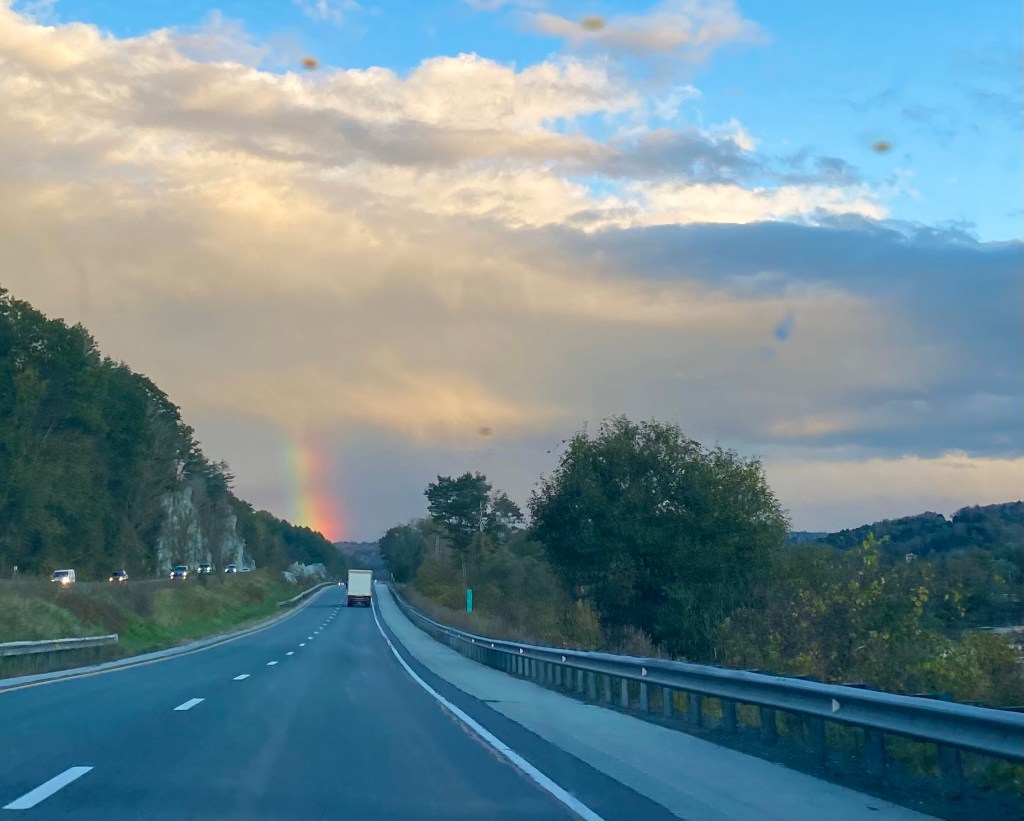
Around a bend in the interstate, a rainbow leg glows. I’ve handed over the keys, and I’m in the passenger seat, knitting forgotten in my lap, as we hurtle along the pavement, rushing over bridges that rise over the Winooski River. Mid-October, dark is not far in the offing. I’m texting my daughter at home who’s feeding the cats and stirring the embers in the wood stove. It’s hopeless to tell my daughters that not so long ago whether someone was home or not was a mystery. Domestic life relied on a vein of faith.

Has the world less mystery now? Surely not. This autumn rainbow beckons us. Around us, an infinity of things we will never understand.

Between us, there’s a bit of discussion about which exit to take, but my driver humors me. There’s those maples before the gold-domed statehouse I want to see, the silver maple beside the library that holds its green longest. By then we’re laughing about a little joke between us — bulk foliage and bulk syrup — tossing those words back and forth for no clear reason at all except for a moment of pleasure.

Autumn: the swinging door between summer’s glory, the myriad folds of winter.

Above the fields,

above the roofs of the village houses,

the brilliance that made all life possible

becomes the cold stars.

Lie still and watch:

they give nothing but ask nothing.

From within the earth’s

bitter disgrace, coldness and barrenness

my friend the moon rises:

she is beautiful tonight, but when is she not beautiful?

— the incomparable Louise Glück, “October”

A Mixed Delight.

All week, we say to each other, This might be the last nice day or Only a few good days left, as if our Shire-ish Vermont realm teeters on the brink of disappearance. Not so, of course.

I leave work early and disappear into the town forest, stepping off the main trails which suddenly seem populated, and hurry down the narrow bike paths, picking up speed and running in my shoes that I’ve meant to replace with their torn toes and worn soles. Add that chore to the list of the mundane: clean the upstairs closet, shake out the living room rug, replace the burned-out lightbulb over the bathroom sink.

October is a hard reckoning month in Vermont, the sizing up of the summer (not enough swimming, surely not enough sunlight) and the letting go of gardening as winter edges in, steadily, inexorably. I rake leaves, mulch the garden, put away my shovel and hoe.

For years, I canned crazily, hundreds of jars of beans and tomatoes and apples. This year, the mainstay of my garden is flowers. Months ago, the flowers gained the upper hand, and I can scarcely pick my way through the tangle of vine and petal: a patch of succor for pollinators, slow moving now, and birds.

My mother asks what’s new, what’s happening: skeins of geese fly over our house. Like the skeins of yarn I unwind and then rewind into fat balls. Sprawled on the windowsill beside my desk, my cat studies a gray squirrel fattening its cheeks with sunflower seeds. Red, gold, green: autumn.

We must risk delight. We can do without pleasure,
but not delight. Not enjoyment. We must have
the stubbornness to accept our gladness in the ruthless
furnace of this world. 

— Jack Gilbert

The Pouring Glory of the World.

Saturday, I’m on the bridge in Winooski taking pictures of my daughters, in a strange, almost dreamy smoke-tinged sunset, the kind that’s become more par for the course than not these days. The river snakes through Winooski, a former mill town beside Burlington. Such effort has gone into this town, converting mills to upscale housing, the downtown bustling with restaurants that spread onto the sidewalks. My brother asks me if the town is on the rise. Wrong question, I think.

We’re at the end of a day of walking and sunlight. My brother owns a brewery, and so, while it’s been many years now since my drinking days ended, we’ve gone in and out of bars and breweries, and I’m reminded that the bars I once loved were such good places, full of the people and their stories, their weariness and joy, these things that have always tugged me.

Oh Vermont, my beloved state, in the gem of October. Walking through the woods with friends, golden light falls through the trees. Roads defined my twenties, mountains and rivers my decades after that. I’m well aware that living in Vermont, living in my hillside house with one foot in the village, the other hidden in a wild ravine, is a kind of undeserved luck. Yet the rivers, jammed with debris of broken buildings and busted vehicles, human junk, are a visible siren call of so much and so many things.

Sunday morning, we drink coffee and eat cornbread on my back porch, and solve, as my brother says, not one whit of the world’s problems. October: redolent of wet soil, broken leaf. Yellow and scarlet, a finale of gray. The month when the leaves will fall, the world open up.

From Jessica Hendry Nelson’s Joy Rides Through the Tunnel of Grief:

Wonder is accepting what we cannot control, which is damn near everything. This, the pouring glory of the world. It goes in all directions.

The Swedish Word for Joy.

The dental hygienist tells me about fishing trips to Lake Ontario, sailing far out into the lake where the land was no longer visible. Like the ocean she tells me. You can’t do that in Vermont.

With her gloved thumb, she presses on my lower jaw, my source of infection and misery and a veritable hemorrhage of money. The December before the pandemic, an oral surgeon took a scalpel to my gum and cut. A few days later, my brother and his girlfriend arrived for the holidays. He grilled on the back porch and drank beer while I leaned against the clapboards. In the kitchen, my daughters and his girlfriend cooked and baked.

On his phone, we studied footage of China, closed up and quarantined, back in the days when we couldn’t envision our own streets and highways closed up, the border closed between Vermont and my brother’s house in New Hampshire.

In a world of enormous possibilities, that bone infection is currently on the down low. The hygienist tells me I wouldn’t believe the things she’s seen — fishing, and in the dentist’s office. On my way out, she cheerily reminds me about floss.

Here’s a 100-story of mine published this morning about happiness.

“The ability to tell your own story, in words or images, is already a victory, already a revolt.” 

— Rebecca Solnit

The 10,000 Things.

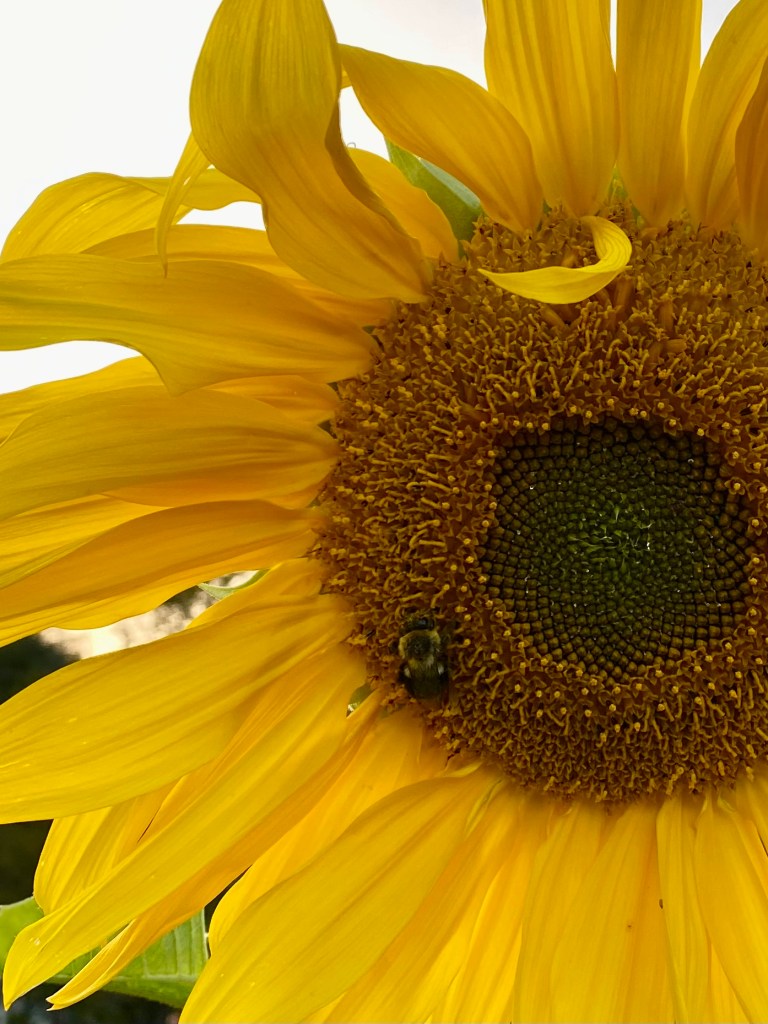
The last night I am in New Mexico, I can’t sleep, so I slip on my sandals and walk. The moon hangs over my parents’ house, luminescent as a giant drop from a sun-shot waterfall. It’s dark yet, a cool-nearly-cold breeze stirring the desert. No human wanders at this early hour. It’s just me and the singing crickets and birds, the sun pushing a golden curve over the black mountains, the desert stirring in a language I have no words for: the rush of lizards and hustle of rabbits, the sharp-eyed coyote and fox, the wild sunflowers silently bending towards the rising light.

So many pieces to this journey — from the shuttle driver who happily counsels a passenger not to rush as “we’re in the Land of Mañana,” to the flight to Chicago where the Brandeis student beside me whispers about her fear of flying, to the stunningly beautiful flight over the Great Lakes through voluminous white clouds. I keep thinking how unworldly, but that word is ill-chosen. Better said would be of this world. Then the brilliance ends as we fly into the soot of the Canadian wildfires. All through this day, I read Lily Brooks-Dalton’s The Light Pirate (the novel Ben Hewitt told me read), this novel about a family and the collapse of our world, and the brutal irony doesn’t escape me for one moment that as I’m mourning and fearing those sooty clouds I’m entirely part of this 21st century….

In Vermont, my daughters greet me with their 10,000 stories and cheerfully announce I’ve missed the two good kayak days through the lily pads. The humid night air stinks of diesel exhaust. In the parking garage, I strip off my leggings. My youngest drives out of Burlington, along the river through the Winooski Valley, and through the state capital. The girls tell me sunflowers are blooming around the statehouse, and my daughter’s dog fell off a dock into a lake (what clumsy dog does that?) and the swimming has been stunning in Caspian, the water perfectly clear.

My youngest tells me about exploring Burlington with her sister. She says she can’t believe how lucky she is to move there this fall.

In this dew-soaked morning, I realize I haven’t missed the hollyhocks’ bloom. Lucky.

…. Seriously, can’t recommend The Light Pirate enough.

Because everything is changing…. We should all be curious about it, because the way we live has to change, too.

— Lily Brooks-Dalton

Worms for the Body, Philosophy for the Soul.

A little light rain falls as I pull a few weeds from the Sweet William in my garden. I planted these flowers when I moved here, putting my shovel into this terrain, vying for flowers and vegetables versus lawn. At the moment, the flowers flourish. I’m thinking a little about a writers roundtable I participated in the morning before, how I urged writers to remember that cause and effect drive the world we live in. All the pretty and noble thoughts we have about ourselves are only illusions. Character lies in our actions, for good or ill, whether we chose to see this or not.

On this Father’s Day, I remember those conversations my siblings and I had with my father at our kitchen table, so many decades ago. This sense of the world comes from the Aristotle he had us read. It’s a lesson that I’ve been hammering out, over and over and over in my life, through garden (what truer way to learn cause and effect), through writing and childrearing, through work, divorce, friendship.

On my deck, the robins’ nest has open-beaked fledglings, tufted and mewling. All day, the parents fly in and out, worms draping from their beaks, feeding their young, this great Herculean parenting endeavor. My cat Acer lies on a kitchen chair, staring through the glass door, mesmerized. The robins, in their robin way, have taken a chance nesting just above my door. Will this pan out? Will the young survive?

Wendell Berry wrote that “Parenthood is not exact science.” Nor, by any means, is bird or human life. My father gave his three children worms and philosophy. He taught us to love bread for the body, wine for the soul.