The Revenge Business.

Washing dishes this morning, I catch a little of NPR’s Morning Edition. Mandy Patinkin who starred in The Princess Bride says his famous line about avenging his father’s death. As I’m scrubbing out the coffee pot, Patinkin says the more important line is about how revenge never got anyone what they wanted. Ever.

For February, this Saturday is crazy warm. I hang the laundry outside to dry and open the windows. I finish up some work at the coffee shop and talk with a school board member from the board I quit, abruptly, last spring. A few raindrops are falling as we step outside on the sidewalk.

In the little rain, I walk home, thinking about that revenge line. Families, nations, epochs, have run on revenge. And the math always works out in its own calculation. Check out the NPR segment.

Onset of Pre-Cabin Fever.

I shake stunningly beautiful snow from my mittens onto my cats. Mid-January. Winter’s loveliness has just arrived. My house is again the three of us, two fluent in Cat and one marginally fluent in Human. The one who speaks Human gets the deciding vote, so we get up very early. The Cat speakers are wholly in favor of this, as the wood fire is fed and the cat kibble rationed into bowls. Eventually, the dawn finds us, and the rest of the world creeps in.

If this keeps us, the prognosis is mad-as-a-hatter by Honest Abe’s birthday. No fear of that. Any hermiting is constrained around here. Two small excerpts from my novel are accepted by journals. The cats and I nestle into our narrative. I let them lick butter from my fingers. Snow silently fluffs around us, concealing the stars, the sunflower stalks, the ash bucket I left by the step.

Household chores and world events.

The last day of 2023, I let the fire in my wood stove extinguish, and I take my stove apart. The stove has been spitting ash and spark through a damper, a chore I’m driven to by sheer necessity.

I unscrew the stovepipe and the back heat shield and plate, and carefully remove the two honeycomb metal filters that are choked with fine ash. It’s a messy job, and I’m a messy woman. My curious cat walks through the cinders and leaves dirty paw prints on my white enamel kitchen sink.

When I’ve put the stove together again, I find the driest kindling I can in my barn and build a small fire and slowly heat the stove again, kneeling before the glass where the flames ripple, listening to public radio hash over the year. I add wood, study the flames, murmur to my cat who is seriously invested in this warmth and the doubtless impending feline nap.

I’d once torn a photograph from a New Yorker issue and thumbtacked it near my desk of Marina Oswald, taken the morning after her husband Lee Harvey Oswald was arrested for assassinating President Kennedy. Her face twisted unhappily, she’s pinning cloth diapers on a line. So it goes: the necessity of domestic life as the great events of the world unfold.

My stove burns merrily. I bake spanakopita and invite a few dear ones who bring chocolate. This morning, January. A drift of snowflakes. The lean winter light.

The snow is melting
and the village is flooded
with children.

— Issa

Where’s the Calvary?

I stop by a friend’s house with some cookies, and we talk for a few moments on her back porch. Sunlight streams in through the windows, rare and cherished in December.

Driven more by the solstice than the calendar, this time of year is the time of reckoning: what’s happened, what’s lying fallow, what might emerge next year? 2023 was a year in my immediate world of wildfire smoke, of floods and more floods, of a social fabric thinning with half-truths and deception and irascibility. A year of people around me who suffered losses in ways that matter immeasurably.

The world we’ve created drives us to reduction, to categorizing our lives in an Instagram post, a hashtag. For anyone who’s even remotely following our personal or national stories, the facts align otherwise. History may likely prove that the precipice of 2024 was a still moment before a tsunami. A handful of years ago, on a sunny autumn afternoon, I faced a still point in my life when I realized the cavalry I’d relied upon to get me out of a marriage gone sour was not saddling up and heading my way. In what was really no joke, I sized up my assets, secured my perimeter, and penned myself a map to head out for new territory. I was, in fact, my own cavalry. Fresh horses arrived, thankfully, at key places. What surprised me the most was the generosity of strangers who, in passing, offered me small precious things like swallows of magic elixirs.

Here’s the thing: in my way of thinking, December is the holy month because of its deep darkness, utterly mysterious, profoundly unknowable, utterly unnegotiable, sometimes terrifying. It’s the season to open our hearts beyond that reduction. On her porch, the cold gnawed my hands holding those cookies. As we spoke, I thought of the songbirds that flock around this house in summer. We are the cavalry, in ways we often don’t rationalize or consider. Perhaps this is the dearest part of December: that in the darkness that transcends any human doing, our eyes are always searching for the moon and starlight, for luminosity. And the light is always there.

Stitching, in Friends & Wool.

December, and by five o’clock, the dark has hammered in for the night. A friend and I walk to the post office, talking about work and family, laughing as we avoid icy patches glowing beneath the streetlamps. We meet a neighbor walking home with her two children from the afterschool program. The boys have glowing strips wrapped around their wrists, red and green, that draw lines through the darkness as they pinwheel their arms.

We return to my dead-end street where the light glows on my back porch. At the silhouette of mountains across the valley, an immense column of amber light illuminates the night sky. Moonrise. It’s not particularly cold. We linger and watch the stars and planets rub on against the darkness, one by one, and keep talking about those complicated stories of family, of how history bends back upon itself and what this might mean for our children who are in the time of their youth.

Above, stitches of a sweater I knitted for a faraway friend, something I created with pleasure and gratitude, that I’ll box up and mail away. Who knows when I’ll see these friends again. But it’s the only way forward that lends any illumination for me: stitch. When need be, unravel and begin again.

“The products of science and technology may be new, and some of them are quite horrid, but knitting? In knitting there are ancient possibilities; the earth is enriched with the dust of the millions of knitters who have held wool and needles since the beginning of sheep. Seamless sweaters and one-row buttonholes; knitted hems and phoney seams – it is unthinkable that these have, in mankind’s history, remained undiscovered and unknitted. One likes to believe that there is memory in the fingers; memory undeveloped, but still alive.”

Elizabeth Zimmermann

Duskier and Duskier.

Chickering Bog

My brother and I have this odd (and likely annoying) habit of repeating the same word or phrase back to each other. In a November weekend interlude, he says duskier, which sums up these November days. I toss it back to him — duskier — then add gloaming.

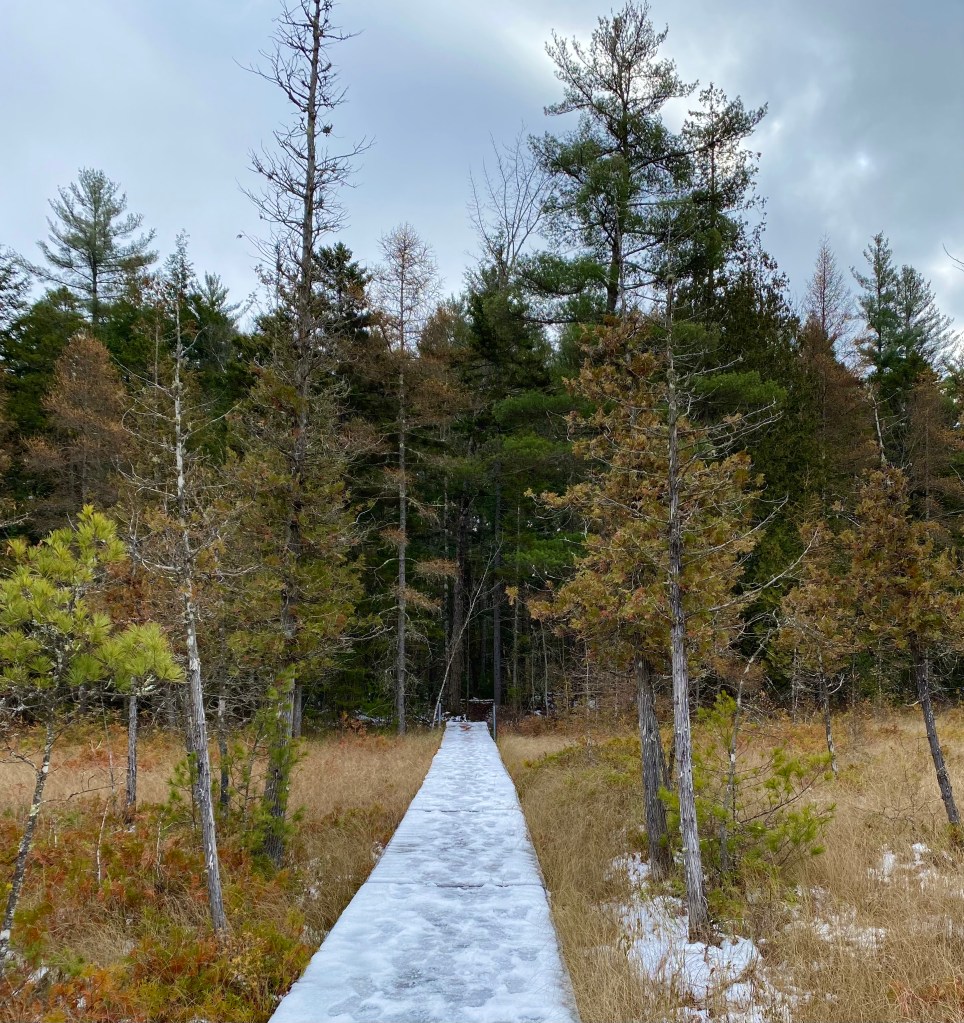
To break the gloom, we walk through woods not far from my house. Little streams run. Somone has built enchanting steps of fieldstones. At the path’s end, a bog stretches out, the tamarcks’ gold faded pale. Spring, summer, the birds sing wildly happy here. Now, the flutter of wings, nothing more.

There’s a place for all of this: silence and settling down, the drawing in for winter.

Come, for the dusk is our own….

— Lucy Maude Montgomery