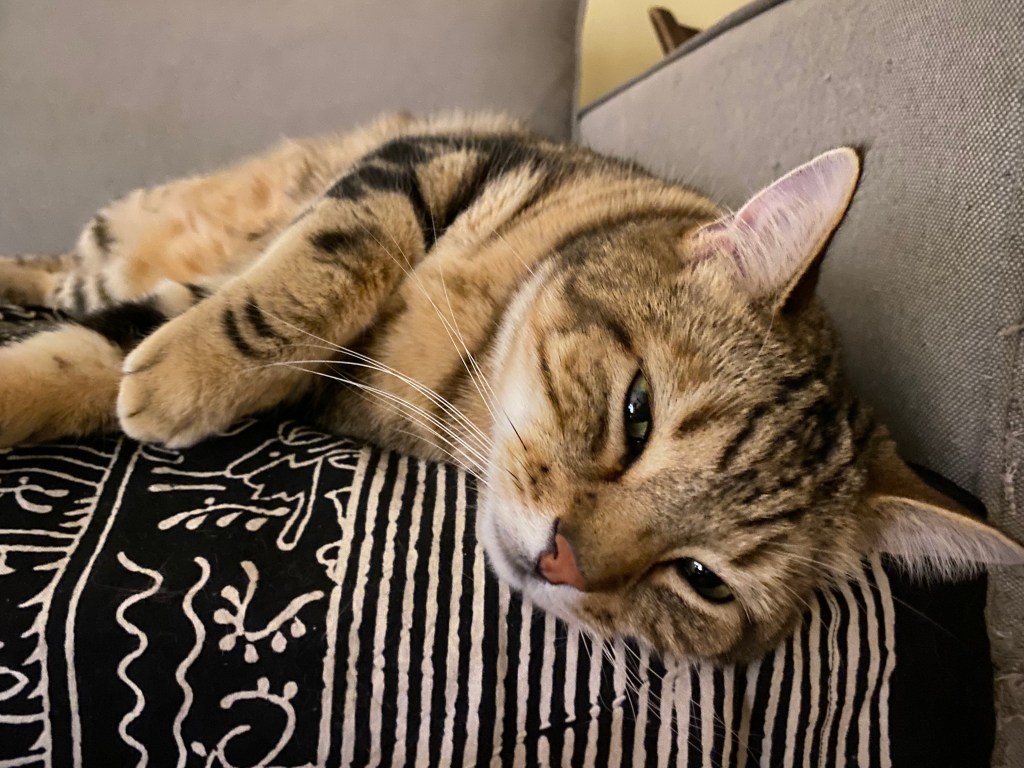
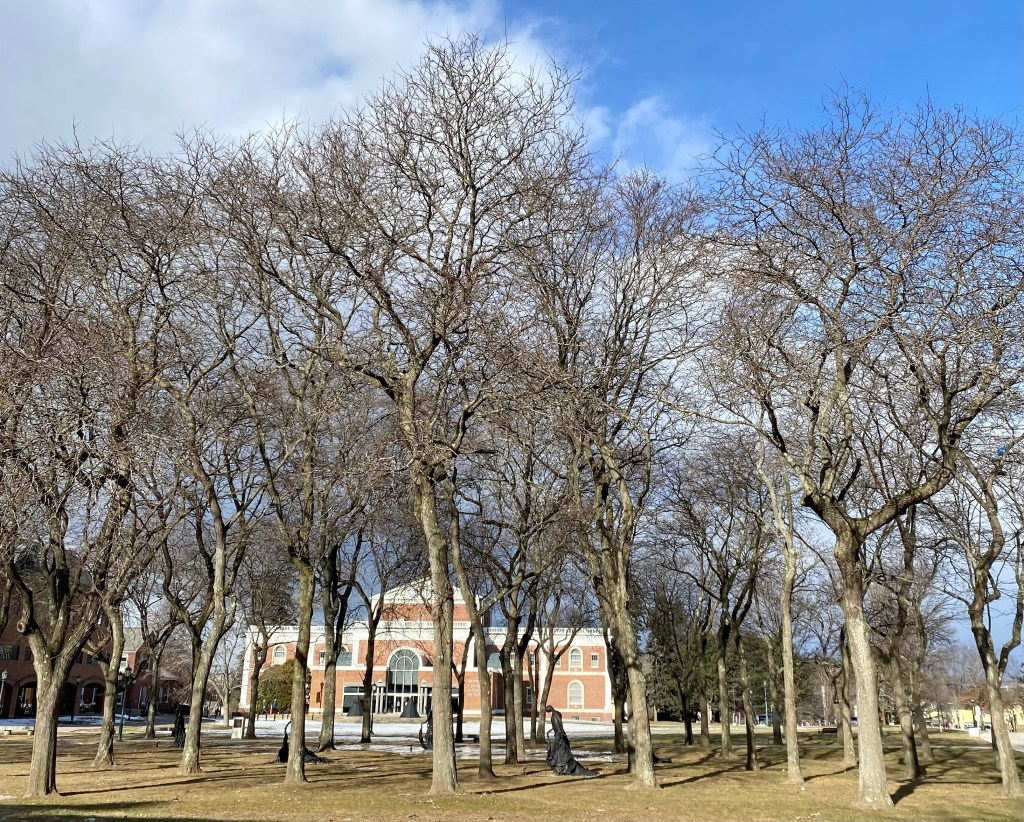
Birthday Cake.

March 7 is my father’s 87th birthday. My daughter, the oldest grandchild, visited my parents a few days ago and asked what to do for my parents’ birthdays. Cake and flowers. And be sure to eat the whole cake.

At town meeting, on the fly, I had to add a few numbers, tally a total. Writing with my pencil, the 100 or so audience members looking at me, I thought of those childhood evenings when I handed my dad an algebra or calculus problem and asked for help. He always made me sharpen my pencil, align the numbers so the problem made sense, and exhibit some respect for mathematics, please. These three things have stuck with me my entire life.

Every year on my father’s birthday, I think of this Hayden Carruth poem. My father — a man who taught his kids about Arkhipov Day and Ancient Greek philosophy, and spent so many nights in the desert, playing cards with his kids at a picnic table lit by a battery lamp….

Birthday Cake

For breakfast I have eaten the last of your birthday cake that you
had left uneaten for five days
and would have left five more before throwing it away.
It is early March now. The winter of illness
is ending. Across the valley
patches of remaining snow make patterns among the hill farms,
among fields and knolls and woodlots,
like forms in a painting, as sure and significant as forms
in a painting. The cake was stale.
But I like stale cake, I even prefer it, which you don’t
understand, as I don’t understand how you can open
a new box of cereal when the old one is still unfinished.
So many differences. You a woman, I a man,
you still young at forty-two and I growing old at seventy.
Yet how much we love one another.
It seems a miracle. Not mystical, nothing occult,
just the ordinary improbability that occurs
over and over, the stupendousness
of life. Out on the highway on the pavement wet
with snow-melt, cars go whistling past. 
And our poetry, yours short-lined and sounding
beautifully vulgar and bluesy
in your woman’s bitterness, and mine almost 
anything, unpredictable, though people say
too ready a harkening back
to the useless expressiveness and ardor of another
era. But how lovely it was, that time
in my restless memory.
This is the season of mud and thrash, broken limbs and crushed briers
from the winter storms, wetness and rust,
the season of differences, articulable differences that signify
deeper and inarticulable and almost paleolithic
perplexities in our lives, and still
we love one another. We love this house
and this hillside by the highway in upstate New York.
I am too old to write love songs now. I no longer
assert that I love you, but that you love me,
confident in my amazement. The spring
will come soon. We will have more birthdays
with cakes and wine. This valley
will be full of flowers and birds.

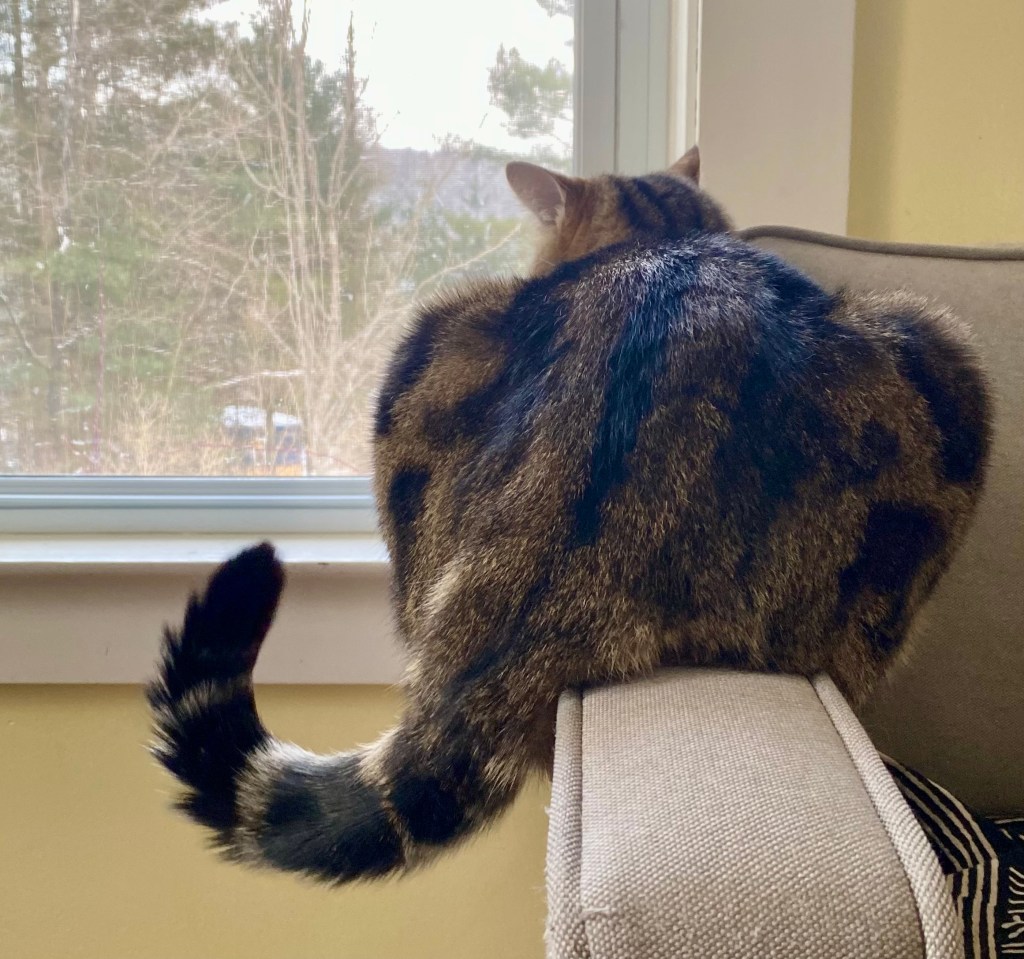
‘Soon it will be the sky of early spring…’

Wild February!

At noon, I stand talking to the road crew in a sparkling snowfall. I wax on about the prettiness of snow on the emerging earth. The crew, who’s endured the strange vagaries of mud season in December, the fickleness of Vermont’s winter weather made weirder by climate change, humor me with a nod.

Fifty degrees and rain forecasted for today, followed by more, followed by bitter cold, then rain and wind, the sun I lean towards…. Late winter, again, and I remember when I could distinguish the years: the spring we boiled sap from March 1 to the 31st. The year we made 540 hard-earned gallons, two of us and a five-year-old, and I wore through three pairs of gloves carrying in wood and feeding the arch.

Walking around my snow-scattered garden, I envision where I will plant the bare root Japanese lilac I’ve ordered, for me or someone else to admire and love. The path down to my compost is both icy and soft mud, the conundrum of winter reluctantly losing its teeth to spring. The true joy is the inevitability, the earth’s order to proceed from twinkling snowflake to downy crocus, the planet’s sheer opinionlessness regarding skunks and black flies.

The road crew and I kick around a few more pithy remarks about government corruption, and then we head along….

From my one of my favorite Louise Glück poems, March:

The sea doesn’t change as the earth changes;
it doesn’t lie.
You ask the sea, what can you promise me
and it speaks the truth; it says erasure.

Finally the dog goes in.
We watch the crescent moon,
very faint at first, then clearer and clearer
as the night grows dark.
Soon it will be the sky of early spring, stretching above the stubborn ferns and
violets.

Cats, Coyotes.

The return trip from my parents’ house in New Mexico to my own Hardwick, Vermont, house was 20 hours. When I stepped off the plane, I was effusively grateful to see my daughters waiting to drive me home, to wrap me again in our own particular kind of family — loving and funny, with the fierce rivers of stories that run between us.

A friend texts me and sweetly offers to make me a meal; these days, about all I’ve done is trudge into work, then lie on couch with my cats, reading Michael Crummy and soaking in Jon Stewart’s election update. When my daughters were babies, I lived in a rarefied kind of atmosphere, of warm milk and scant sleep and intense curiosity: what now? what next? As if bookended, my parents in very old age live in a unique world, too, suffused with New Mexican sunlight, and with a similar uncertainty: what next?

In that middle-of-the-night drive to Albuquerque, circling through the airport parking lot, I spied a coyote. I pulled over, opened the car door, and looked back. Under the amber streetlights, the coyote hurried along, brushy tail bouncing, not so much as glancing over its shoulder at me. Around us, so much cement, then the desert, undulating, spreading up into the hills, disappearing from sight.

The wild creature vanished into the dark.

“A body must bear what can’t be helped.”

— Michael Crummy

Travel in Out-of-Everyday Places.

In the quietest hours of the night, driving by the twinkling line of Santa Fe’s lights in the immense desert, a crimson half moon cupped in the firmament like a bowl full of mystery, I have the strange sense of transmogrifying into a Russian novel. Maybe in part because of the Bulgakov novel from my sister crammed in my backpack with my laptop and half-written notebook, or maybe it’s my family story unfurling simultaneously at lightspeed and also breath by labored breath.

At the Albuquerque airport, the shuttle bus holds just me and the driver who says he’s from the Chicago suburbs. He remarks that I’m shivering and wonders how that can be, as I’ve told him I’m flying back to Vermont. I’m tell him I’m just tired. Perhaps. But the illuminated city and the airport floodlights and mundane directional signs for United and Alaska Air bedazzle my 3 a.m. eyes: there’s so much of the world, so many people and stories braiding and twisting, from the sweet simplicity of a child cradling a beloved doll to an old woman gasping her way to the end of her life.

The driver asks me about the church scene in Vermont. I rattle off about white steeples in every town. Driving incredibly slowly, he launches into his story of knowing that he wanted to be a better man but kept falling into sin, and then a page in the book of his life turned. I can see this is doubtlessly headed to a pamphlet he wants to hand me. Yet, as he speaks, I wonder what that really means: Knock, and Jesus will open the door.

Later, in the terminal, drinking coffee, I sit in a space crowded with strangers, all on their meaningful journeys. My heart swells full with so many things: the robins singing in my parents’ aspen, last night’s dream of wandering through a sugarbush, forest floor sprinkled with spring beauties, the luminous crimson bowl of the moon in the infinite darkness. Nature never builds a door. Maybe those doors and windows we’re forever using as metaphors are illusions.

The driver had forgotten his bag, so the pamphlet was a no go. I take his words and tuck the sliver of his story into my writer’s mind with the hard-boiled egg I’d split down the middle and shared with a young woman yesterday morning. While we ate, she told me about her son’s heart surgery, and the surgeons who saved the boy’s life. With my fingers, I sweep the eggshells into a pile on the plate we’ve shared.

The Revenge Business.

Washing dishes this morning, I catch a little of NPR’s Morning Edition. Mandy Patinkin who starred in The Princess Bride says his famous line about avenging his father’s death. As I’m scrubbing out the coffee pot, Patinkin says the more important line is about how revenge never got anyone what they wanted. Ever.

For February, this Saturday is crazy warm. I hang the laundry outside to dry and open the windows. I finish up some work at the coffee shop and talk with a school board member from the board I quit, abruptly, last spring. A few raindrops are falling as we step outside on the sidewalk.

In the little rain, I walk home, thinking about that revenge line. Families, nations, epochs, have run on revenge. And the math always works out in its own calculation. Check out the NPR segment.

Onset of Pre-Cabin Fever.

I shake stunningly beautiful snow from my mittens onto my cats. Mid-January. Winter’s loveliness has just arrived. My house is again the three of us, two fluent in Cat and one marginally fluent in Human. The one who speaks Human gets the deciding vote, so we get up very early. The Cat speakers are wholly in favor of this, as the wood fire is fed and the cat kibble rationed into bowls. Eventually, the dawn finds us, and the rest of the world creeps in.

If this keeps us, the prognosis is mad-as-a-hatter by Honest Abe’s birthday. No fear of that. Any hermiting is constrained around here. Two small excerpts from my novel are accepted by journals. The cats and I nestle into our narrative. I let them lick butter from my fingers. Snow silently fluffs around us, concealing the stars, the sunflower stalks, the ash bucket I left by the step.