Strangers’ sweetness, flying United.

In a sleepwalking haze, I make my way from Albuquerque’s sunny airport to slushy gray Denver (winter, again?!) On the cross-country flight, I make friends with my seatmate, tossing away the nap option for our conversation about camping at Zion National Park. We part ways at Dulles. Walking through the airport’s chaos, I remember that Zion trip in our green Jeep when I was a girl. We tubed down the river all day. I smacked my hip on a rock. That evening, we devoured sausages roasted over a fire, admired the moonrise. Such happy hours.

Later, descending into Burlington, Vermont, the plane cuts down through the brilliant clouds, the underbelly smoky gray, furled with nascent rain or snow. A crimson blush scrims over the mountains, the merest beginnings of tree buds. Dusk hovers. I think of my daughter waiting for me in the nearly empty airport, all grown up now, car keys in her hand. I’m hungry for whatever food she’s brought and, mostly, for the conversation on our drive home.

As the plane brakes on the tarmac, the young couple with the baby beside me remarks that this was their baby’s first plane trip. Around me, the passengers cheer, “What a baby!” but quietly, so the little one isn’t frightened. The parents glow with happiness, the baby coos contentedly, the crowd keeps on, “Great baby! Great baby!” Such a long journey this has been and will be; so happy I am to hear this joyful mantra.

…. Last, a little more about my mother.

What twenty bucks brings.

My father asked me to include the whole W.H. Auden poem I quoted in the previous post. The poem reads:

Stop all the clocks, cut off the telephone, 
Prevent the dog from barking with a juicy bone,
Silence the pianos and with muffled drum
Bring out the coffin, let the mourners come.

Let aeroplanes circle moaning overhead
Scribbling on the sky the message He Is Dead,
Put crepe bows round the white necks of the public doves,
Let the traffic policemen wear black cotton gloves.

He was my North, my South, my East and West,
My working week and my Sunday rest,
My noon, my midnight, my talk, my song;
I thought that love would last for ever: I was wrong.

The stars are not wanted now: put out every one;
Pack up the moon and dismantle the sun;
Pour away the ocean and sweep up the wood;
For nothing now can ever come to any good.

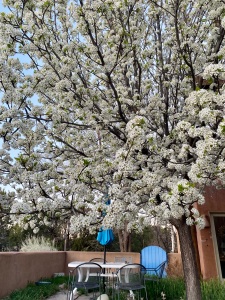
I’ll add this, too: a stunning blossom year for the plum tree my parents planted years ago. They bought the tree for twenty bucks. Would a fruit tree take in the desert, my mother wondered. My father reasoned, Heck, it’s twenty bucks. The tree will grow, or not. The tree thrived.

Stop all the clocks.

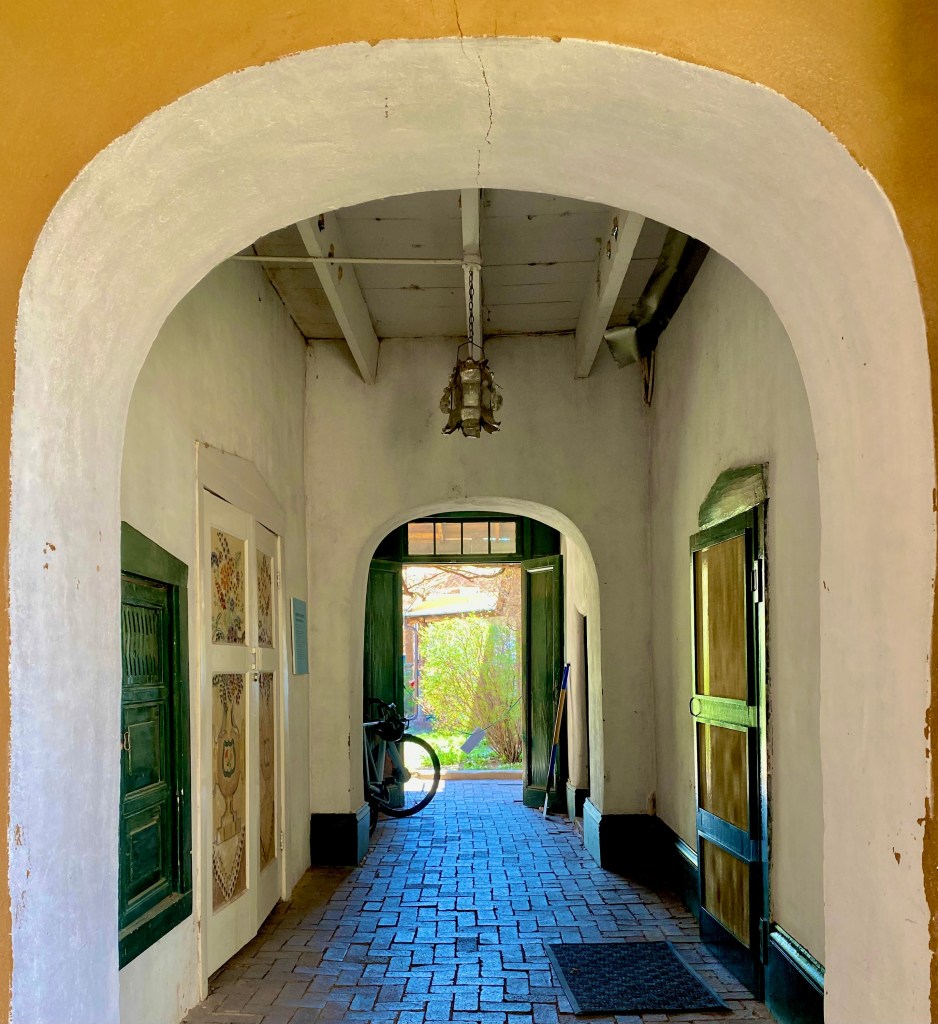
Santa Fe, many years ago

In this space, I’ve stepped between the mossy threads of my own life. For many years, my mother who lived far from me kept up with my life through my blog. I’d started writing stonysoilvermont the summer my then-husband and I split up. I was about to publish my first book. Although I’ve considered quitting, I’ve kept on, the disciplined scraps of this writing feeding into my creative life.

So it seems right to acknowledge my mother’s passing over into the next realm. A woman of nearly indomitable strength, she was ill for many years and surmounted multiple surgeries and illnesses. But none of us are mortal. My mother, who was a nurse for decades, knew this more keenly than most people. When I was a girl, she returned every morning at breakfast with stories from the hospital, some funny and some heart-wrenching — a child with leukemia, a cab driver shot point-blank in his head. One July morning, she carried home an orange kitten. We named him Oliver, and he lived a long full cat life.

Same, too, with my mother, a woman whose strength and passion shaped my own. In her later years, disease made her wander back and forth in time, into places where none of us could follow. My mother would have wanted us to grieve the end of her life, but not to fall dramatically on our knees. Raised a Lutheran, she was imminently practical. Nonetheless, I remember when I was 21, and my mother grieved her own mother. She stopped all the clocks.

Awe.

Photo courtesy Molly S.

Just about a year ago, my daughter and I climbed multiple stone steps in the Cathedral of Santa Maria del Fiore in Florence, the stunning cathedral finished before Columbus set sail on a journey that changed the fate of the globe. As we climbed, the organ played. The windows were holes in the stone, and wind washed in. Suddenly, we stepped out onto a narrow ledge where we could see down into the giant cathedral. I knew myself part of this ancient building — alive in the most beautiful structure, in a time that flew back to medieval Europe.

Awe. I’ve participated in so many radiant experiences, but peak awe? It’s a rarity. Right? We couldn’t live if we were always in awe: the Florence Duomo, childbirth, a night of the constellations and some psychedelics….

For those of you not in the know, northern Vermont has been amping up anticipation for the total eclipse. For once, the weather cooperated absolutely perfectly. The state shut down. Go home! Enjoy! We sprawled over the wet grass with neighbors. As the moon and sun began to cross, traffic sounds ceased. Did the wind pick up, or could we simply hear better? I had expected a few moments of the lovely night sky in the middle of the afternoon. But no, no. Instead, a radiant world abruptly glowed. Along the mountains where the sun rises scarlet these mornings, the sky was heavenly blue, rimmed with the purest gold. There were no three minutes of totality. No time at all. It was simply us — all of us — breathing and gasping with great joy.

Kindness of strangers.

If there’s a sadder building in Vermont than the county courthouse in Barre, I don’t know where that might be. Over the last nine years, I’ve been here again and again and again and again. On Friday, I arrive again, stepping through the metal detectors and removing my knitted hat to show my barrette. My errand is to leave a handful of copies. I wait behind a man in an orange jacket at the counter who cannot understand what the clerk is saying. She repeats her instructions. Another clerk calls to me. I ask my questions, repeat back her answers to confirm. The man beside me weeps.

The last time I was here, I waited in a room of women waiting to be heard by a judge. In those days, I had survived those court appearances and the craziness of my life by imagining myself a mother wolf. I slunk in, took what I needed, and ran. All morning, the room gradually emptied, until only myself and one other woman remained. She was young enough to be my daughter. The bailiff appeared and said it was the judge’s lunchtime, and we could return in two weeks. Wolf, I stood up, all 4’9″ of rage, and said I wasn’t leaving. The bailiff muttered and disappeared behind the wooden door.

The woman’s name was before mine on the court’s list. She offered to let me go before her. You have a child, she said, and I don’t. I didn’t one single strand of this woman’s story. The judge delayed his lunchtime.

On this Friday afternoon, six years later, when I return to this courthouse I had promised myself never to enter again in this lifetime, I carry the memory of this stranger’s kindness.

Outside, at my car, I can’t find my keys, and so I return again, back through security, back to the window where the man is yet weeping, the clerk repeating the same impossible words. Then I realize my keys were in my hand; I hadn’t looked.

Here’s a poem very much in this sentiment, emailed from my father. Listening to the audio is highly recommended.

“Dear March—Come in—”

I stand outside eating a cheese sandwich stuffed with a handful of the lettuce I bought for my cat Acer. The trees across the road shake furiously in a wind as if outraged. What’s your complaint, I wonder.

Such a strange winter: a handful of skiing days, no ice skating, the hard cold a distant memory. The yuck of this winter has been the lack of sunlight, the sodden clouds that have lingered from last year’s rainy summer through January’s gloom. We kvetch. My own antidote is the early morning, my insistence that writing, that order and beauty, are a transformative might. There’s nothing new in that approach; it’s the ancient path of seeking luminosity, of Rumi’s words that the wound is where the light comes in.

In March, of course, sudden sunlight in your living room is apt to reveal the dirty cat hair clusters balled beneath your couch, the cobwebs trailing from the ceiling corner, drenched in dust. Make of it what you will.

Oh March, my long-time friend, giver of fine weather, betrayer with your miserable cold snowstorms. In the lengthening days, the sun returns like a long-ago lover. My friend the sun and I take long walks, my sunny friend whispering in my ear that brighter lovelier days are already here.

A few lines from Emily Dickinson:

Dear March—Come in—
How glad I am—
I hoped for you before—
Put down your Hat—
You must have walked—
How out of Breath you are—
Dear March, how are you, and the Rest—
Did you leave Nature well—
Oh March, Come right upstairs with me—
I have so much to tell—