‘Ask Me.’

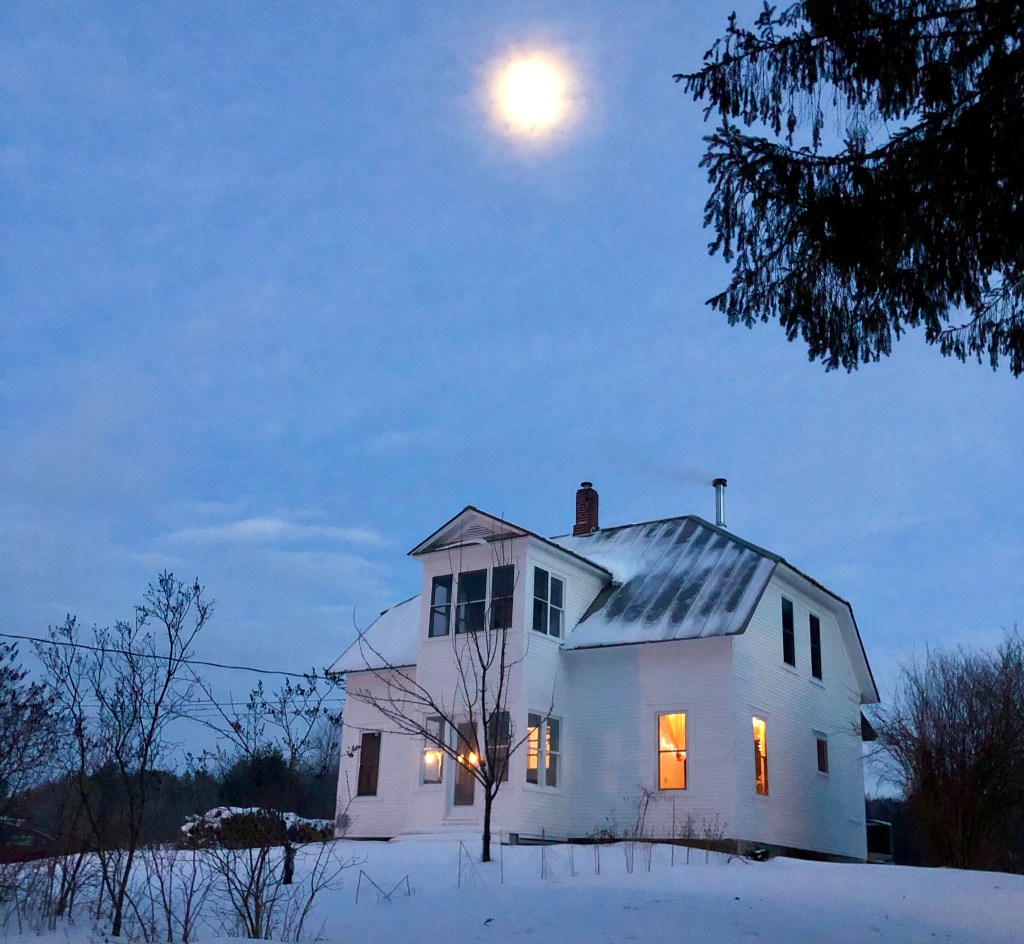
Twilight drags out again — not a sign of spring by any means but a hopeful sign. The light’s returning to us. After work, I rush through my outside chores, then keep walking and walking. I’ve somehow slightly twinged my knee, and so I walk with the faintest of limps, which amuses my athletic daughter no end. Why wouldn’t your body hurt? she asks me.

We live in such a crazy, mixed-up time. Some of this is just us — a high school student, a grown daughter, four jobs between us, an EMT class, a recently published book and another I’m writing, an absent father, my single motherless — and then a world where the Expected Everydayness is suddenly flipped inside out. The rules have all changed, or at least it’s worth rethinking all the rules.

No phones, ever, at dinner. But then my youngest asks why? and we call my brother. He’s working at his brewery and steps into a quiet place. My daughter and I eat calzones and talk skiing and Covid. We talk bread making. And that is really darn nice.

“’Ask Me’

Some time when the river is ice ask me
mistakes I have made. Ask me whether
what I have done is my life. Others
have come in their slow way into
my thought, and some have tried to help
or to hurt: ask me what difference
their strongest love or hate has made.

I will listen to what you say.
You and I can turn and look
at the silent river and wait. We know
the current is there, hidden; and there
are comings and goings from miles away
that hold the stillness exactly before us.
What the river says, that is what I say.” 

— William Stafford
Kindling.

Kitchen table, Hardwick, Vermont

In below zero temps, I stop by the library on my way home from work to pick up an interlibrary loan book. My friend in her mask runs down from her balcony office, and we huddle against the library’s 100-year-old radiator.

She tells me about the death of a person in town, from Covid. My friend is wearing a sweater from yarn she spun and dyed, from goldenrod blossoms she gathered. The sweetness of early fall is a long, long way from us. I’d been thinking that someday these days will be but a remembrance to us, and here I’m hearing word of family who will never forget these bitter January days.

I finish the afternoon chores I’ve set out to do — buy cheese at the co-op, get the mail at the post office, stop by the superintendent’s office to sign the high school budget warning we voted on last night. At home, I feed the wood stove and the cats and set pizza dough to rise.

Then I do my final outside chore — I gather bits of bark and kindling from the barn floor and a few dry sticks into a cardboard box. In the early, dark morning, I’m up first, and this kindling box is my easy way to begin the day. I think of it as a little gift to myself.

The cold is fierce around me. I stand in the barn, holding that box in my leather gloves, thinking of nothing at all. Just standing there.

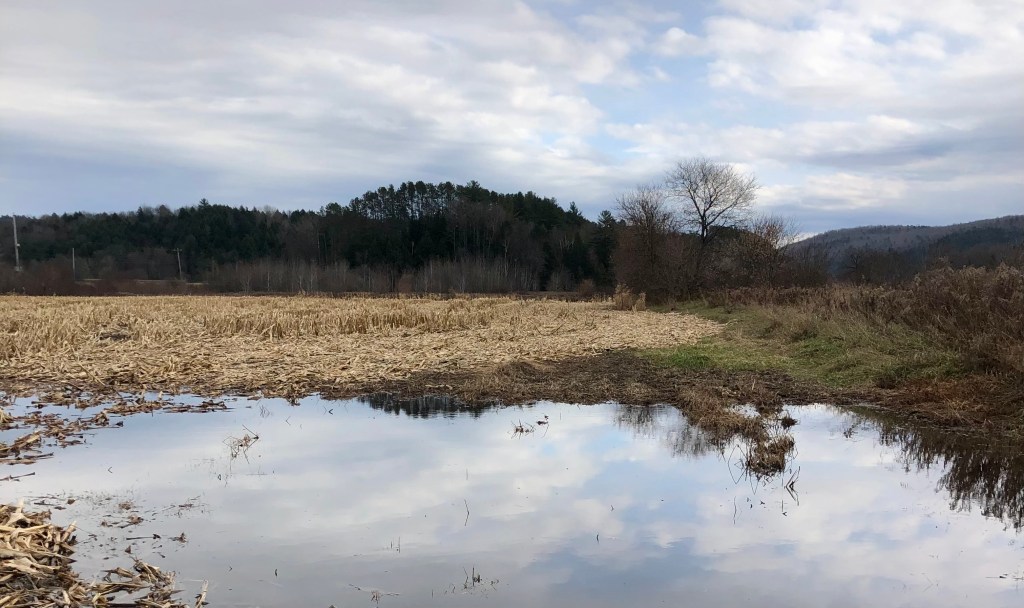
Reflective Waters.

Hello, November. Hello, time of reflection. Hello long holiday season, and all that complicatedness.

In that vein, here’s a few lines from Lawrence Weschler’s essay Vermeer in Bosnia.

… what that story [of Jesus parting the Sea of Galilee] is trying to tell us is simply that in times of storm, we mustn’t allow the storm to enter ourselves; rather, we have to find peace inside ourselves and breathe it out.”

I would add to this — do this through cooking or writing or knitting or painting the living room wall. Hands, hearts, and minds.

Zen. Broken Sink Drain. A Meaningful Life.

back porch view

I’m lying on the couch reading Sigrid Rausing’s Mayhem when my daughter calls from the kitchen, ‘Mom, you’re not going to like this!’

The sink drain has split apart again and gray water floods the kitchen floor. For a moment, I think, whatever, and then ask her to get an old towel.

I have now repaired this drain three times, each time in nothing but sheer annoyance and impatience.

The problem, naturally, has something to do with PVC and epoxy, but more to do with me. My ex-husband put in this drain, in his trademark cob-job way, fitting together scraps of plastic pipe. I’m irritated at my own ineptness, my unwillingness to devote real time to YouTubing a solution, the scantness of my nonworking hours.

I’d rather paint a wall than repair a drain.

After we mop up the water and pile the unwashed dishes on the sink drainboard, we put on our boots and take a walk in the falling snow. It’s the first snowfall of the year. Snow is our old friend, falling silently, sparkling in house and streetlights. This first bit will melt today and return again soon.

Sunday morning. Put the house in order. Take the broken pieces to the hardware store. Ask for advice.

True recovery is a profoundly ethical journey, finding meaning and dignity through solidarity and restitution. Without that, there may be a cessation of drinking or substance use, but there is no real recovery.”

— Sigrid Lausing

Somewhere in Summer.

Vermont’s summer mugginess settles in, and I lie awake at night, remembering the much stickier summers of my childhood in southern New Hampshire, a thousand days of no school and bike riding and eating salted cucumber and playing Acquire with my brother and the neighbor — the ultimate game of capitalism.

But those were likely much less than a thousand days.

My youngest texts me at work. She and her friend explore different swimming holes and go hiking. Together, as new drivers, they match route numbers with roads, beginning to master maps. I worry about her — my youngest navigating the world on her own — this place of such ineffable beauty and real badness. This is the summer she’s learning the price of a tank of gas — a transaction between labor and coin. But it’s also the summer she’s beginning to realize the phrase girls travel in packs has much more meaning than looking for the women’s room.

This is the summer of phenomenal sunsets and sunsets, of studying the sky, wondering if rain might move in.

Quit counting, I counsel myself. The hot days unwind into hotter nights, but the dawn is cool, the dew lush over my toes.

Promises.

A thunderstorm rumbles in early Saturday morning, in that darkest spot before dawn. We’re nearly at the solstice, and the days are long and lovely, full of just the right amount of warmth. Our Vermont world is in bloom.

The rain this morning is welcome. When the downpour passes, I lie in bed beside the open window, listening to the pattering of a gentle rainfall on the leaves of the mock orange below my window. In bloom now, its flowers are white as snow.

In my memory runs a few lines from an Eric Clapton song. The day before, I had driven to St. Johnsbury, a road I had often driven when I was first married. As I crested a mountain, VPR cut out, and that song came over my radio, scratchy. Long ago, we had a second-hand turntable, and a few cast-off records, and that album we played over and over.

The thing is, I didn’t like the album much at all, but I gradually came to like it, maybe simply through habit. That one sweet song had always been my favorite. Now, over the radio, my past returned, fuzzy and unclear, but never forgotten.

A year ago, George Floyd had recently been murdered, his death replayed endlessly around the planet. Riots erupted around the country. Now, under a different administration, Juneteenth is honored.

So much. All that great wash of the past — from immense societal waves to the tiny trickles of our own lives — pushes us along. And yet, sweet rain on this quiet morning. Even the hungry cats press their whiskers against the screen, welcoming in the morning.