Continuing without a sign.

An inveterate list-writer, at the end of each day, I’m often summing what I’ve done. Somedays, my hands and my hand seem to come up empty. Or my heart has articulated a question.

I pass a few days drinking coffee and talking with my daughters, walking through the woods, along rivers and streams and a rock-throated gorge. They’ve teased me for years about my focus on the gritty and hardscrabble, my fascination with wandering into abandoned cellar holes, my curiosity about abrupt turns in human stories. But when has the world ever not been falling into pieces? There’s this, though: surely at times the world’s misery spins harder and swifter and unbearably more painful.

In those cellar holes, gardens of flowers and sustenance once bloomed at doorsteps, their seeds dormant in the soil. Sunday, nearing dark, I brake for wild turkeys meandering across a dirt road. There’s no one around. I pull over and walk down the road to snap a photo, but the turkeys suddenly rush, hearing my footsteps, and I’ve forgotten my phone in the car anyway. I’m at a driveway that bends up the hillside, the house of out sight. Many years ago, the man who lived there offered me his dead wife’s fur coat. He must be long gone, too. I’ve long since lost any sense of who lives there now.

“Matins”

You want to know how I spend my time?
I walk the front lawn, pretending
to be weeding. You ought to know
I’m never weeding, on my knees, pulling
clumps of clover from the flower beds: in fact
I’m looking for courage, for some evidence
my life will change, though
it takes forever, checking
each clump for the symbolic
leaf, and soon the summer is ending, already
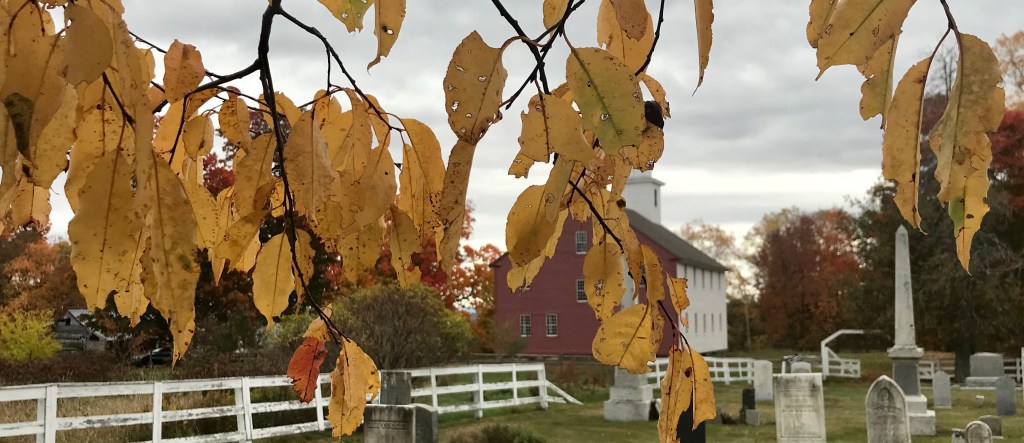
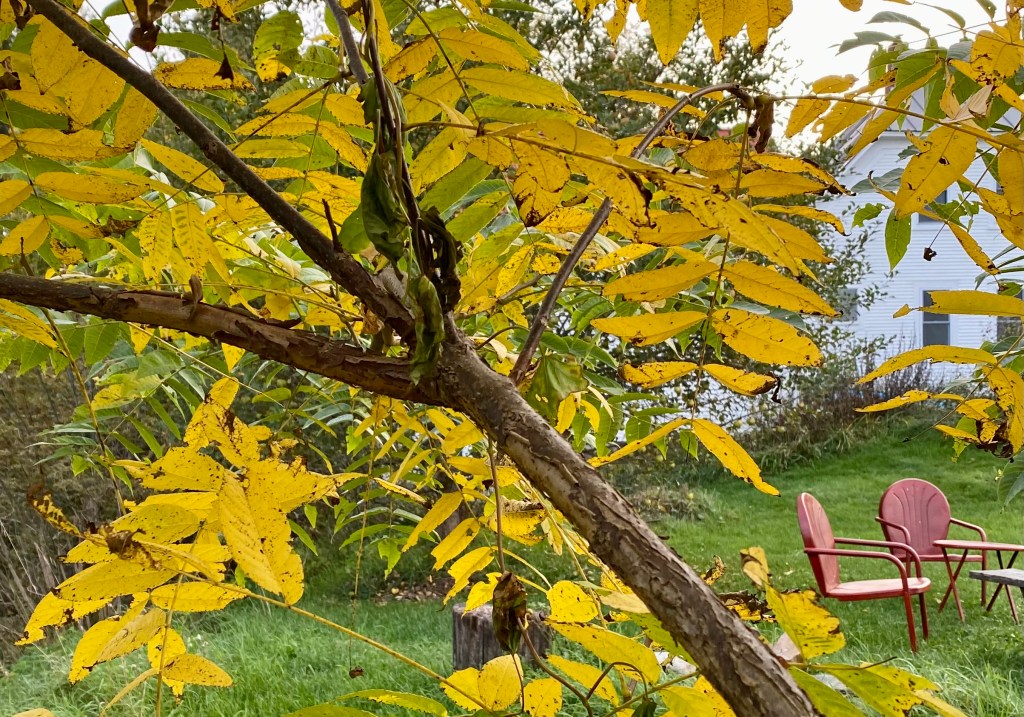
the leaves turning, always the sick trees
going first, the dying turning
brilliant yellow, while a few dark birds perform
their curfew of music. You want to see my hands?
As empty now as at the first note.
Or was the point always
to continue without a sign?

— Louise Glück

A Mixed Delight.

All week, we say to each other, This might be the last nice day or Only a few good days left, as if our Shire-ish Vermont realm teeters on the brink of disappearance. Not so, of course.

I leave work early and disappear into the town forest, stepping off the main trails which suddenly seem populated, and hurry down the narrow bike paths, picking up speed and running in my shoes that I’ve meant to replace with their torn toes and worn soles. Add that chore to the list of the mundane: clean the upstairs closet, shake out the living room rug, replace the burned-out lightbulb over the bathroom sink.

October is a hard reckoning month in Vermont, the sizing up of the summer (not enough swimming, surely not enough sunlight) and the letting go of gardening as winter edges in, steadily, inexorably. I rake leaves, mulch the garden, put away my shovel and hoe.

For years, I canned crazily, hundreds of jars of beans and tomatoes and apples. This year, the mainstay of my garden is flowers. Months ago, the flowers gained the upper hand, and I can scarcely pick my way through the tangle of vine and petal: a patch of succor for pollinators, slow moving now, and birds.

My mother asks what’s new, what’s happening: skeins of geese fly over our house. Like the skeins of yarn I unwind and then rewind into fat balls. Sprawled on the windowsill beside my desk, my cat studies a gray squirrel fattening its cheeks with sunflower seeds. Red, gold, green: autumn.

We must risk delight. We can do without pleasure,
but not delight. Not enjoyment. We must have
the stubbornness to accept our gladness in the ruthless
furnace of this world. 

— Jack Gilbert

Chance Encounter.

I pause my afternoon run when a couple waves me down in a little memorial park in Hardwick. I’m guessing they’re looking for directions, maybe a suggestion where to eat an early dinner or the road to another town. Instead, they’re curious as heck about Hardwick.

What drove the economy in the 1800s and 1900s? When was the beautiful granite town office building constructed? Do I know the population?

Weirdly, I know the answers to all these questions, and ask a few of my own. Where are they from? Where are they headed?

They’re from the northern shore of Lake Champlain — St. Albans — a town where I once bought a sizable (and expensive, oh, was it expensive) piece of maple sugaring equipment.

We stand beneath a gold-leafed maple, talking about this and that, and I share my speculations about what living in Hardwick might have been like in the early 1900s. It’s all speculation, as my daughters would readily point out.

At the end, just before we part, they ask if I know someone who lives in town. He’s a high school teacher, and I met his family over twenty years ago. In fact, I live beside his mother-in-law.

We laugh. How little separates us. Then they get in their car, and I head off on my run.

Relish This.

We’re at the point in Vermont’s fall where our world makes me ask, What’s happening? but in the loveliest, most wonderful way. The fall colors are stunningly gorgeous — so much vibrant red, so many shades of gold — the trees silently going about their business. Our hillsides are amazing, but so is each tree an individual marvel.

We’d had rainy day upon rainy day, but the weather looks to be clearing, at least for a short stretch. In New England, heading into later fall, sunlight can be sparse. These handful of days are the time to soak up color and light.

When I stopped on Hardwick’s Main Street to snap this photo yesterday, a man walking by said, “Winter’s not far.”

True, but at the moment, autumn in all her radiance.

I’m so glad I live in a world where there are Octobers.”

— L. M. Montgomery

The Obvious

In a terrible mood on Friday afternoon, I’m driving too fast through town when I round a corner and see a rainbow spread over Hardwick.

The arc shines so brilliantly and near I imagine I can reach out and touch its particularly vibrant green. I pull into the Village Market, and a woman I know gets out of her car, wearing a mask, too. For a moment we stand there, marveling, then walk towards the market door.

Another woman — vaguely familiar to me, in the way of small town Vermont — is loading her car with groceries. My companion and I urge her to go see the rainbow; it’s just a few steps around the building.

She shakes her head, saying she can’t see it.

But we insist and walk those few steps with her. The rainbow by then has morphed into a double arc. Then, as we watch, the rainbow fades.

Over her mask, the woman looks at us and says, “Well, that’s a nice thing after all today. Something good.”

October 5. So much more winter to come. Watch for rainbows.

It was the Rainbow gave thee birth,

And left thee all her lovely hues;

“The Kingfisher” by William Henry Davies