Real v. Unreal, Doorway in Seasons.

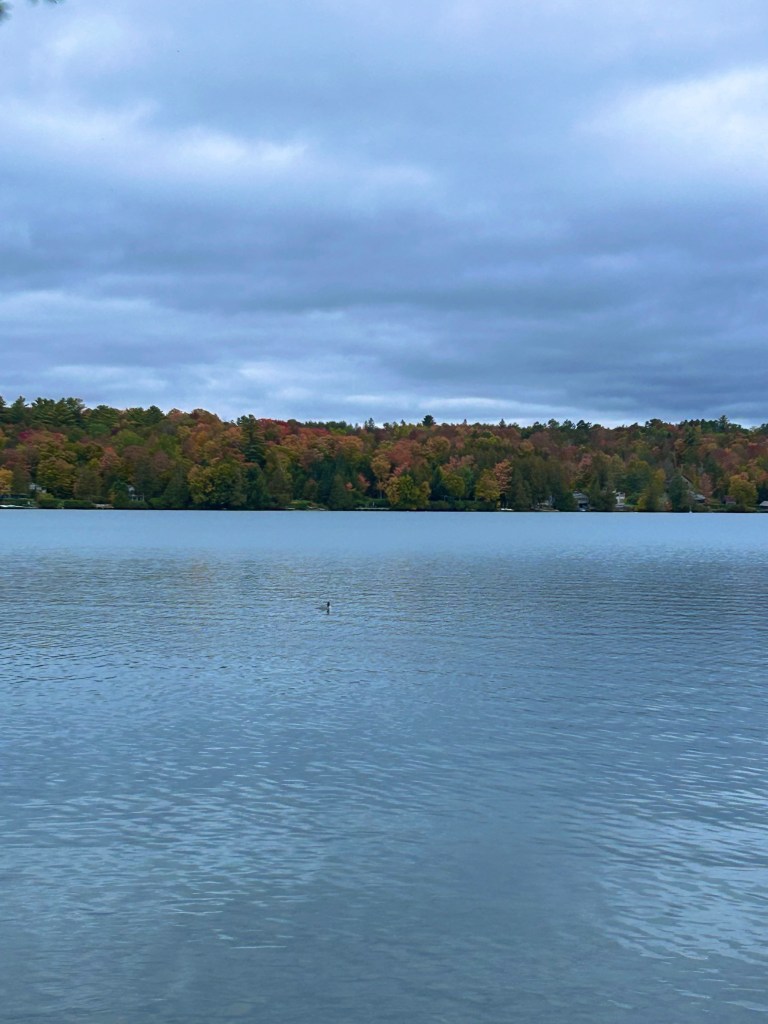
Evening, I visit with a friend on her porch. I’ve forced myself from the couch, leaving behind a Carl Hoffman book. My friend talk about little things—knitting mittens, a curry recipe—and the submerged currents that drive our lives—poetry and sex and a vision to transform my side yard into perennials. The daylight dwindles. Today, foliage colors hum at their radiant best, and I say goodbye, gather my hat, and head out on a walk into the twilight. That afternoon, I’d stopped along the Rail Trail to run. A man had parked a long RV in the otherwise empty lot, watercolors and an easel propped on the granite block wall. When I returned, gasping and sweaty, we talked for a bit. I just want to be here, he says, outside. Which mirrors my own sentiment.

There’s no one else out this night, but two boys on bicycles, racing and shouting, crossing the nearly empty road.

Twice, today, I’ve had that otherworldly sense of déjà-vu. While listening to this stranger with his watercoloring and my friend with her library book in her lap, I’m also in a consultation room and the oncologist tells me the lymphoma has returned. I understand the seriousness in his voice; we’ve laughed about many other things, but there’s no laughing now. In this strange state, I leap up and stand in the doorway, one foot in the room, one in the halfway. Real, or not?

For years, I’ve endeavored to hone my discipline, to keep writing, keep working, read, walk, pay attention, listen to the story around you, for goodness sake, but the physical pain of cancer forced me to be here now, in ways I didn’t want. Nonetheless. And that’s one enormous nonetheless.

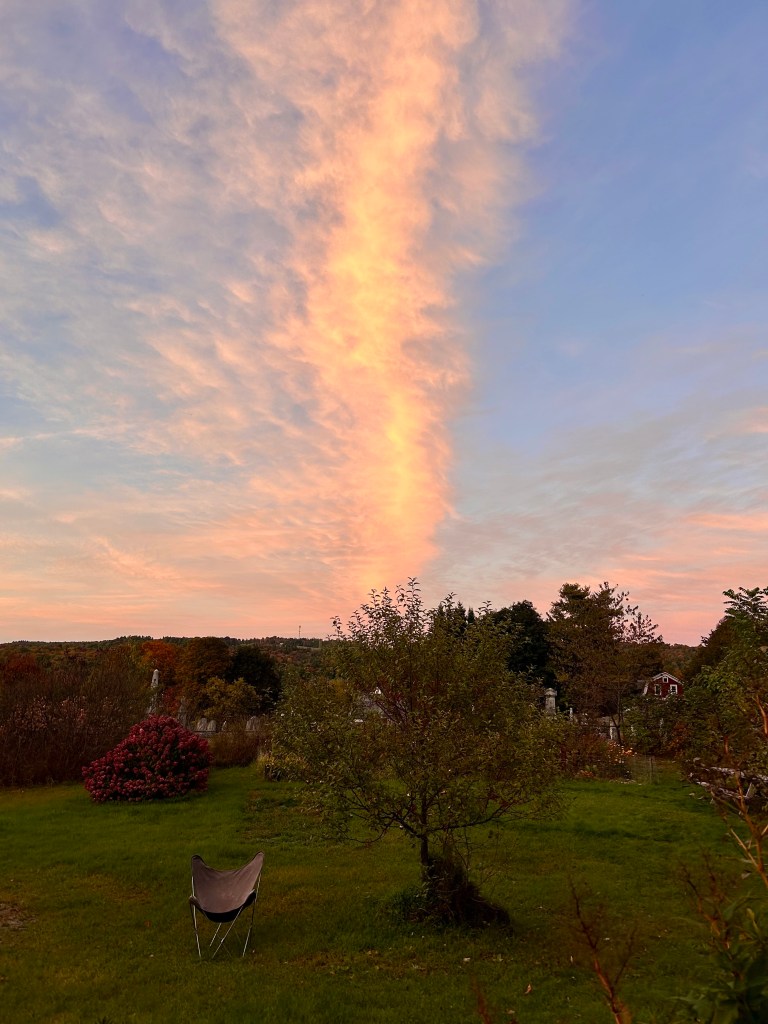
I loop around the village and return up my short steep road in the darkness. I’ve been on that threshold for years, half in, half out, always running for the woods and the trails along the river, the mountain path, gathering little scraps of conversations and friendships into my pockets, never trusting their radiance, like this foliage, won’t fade. Cancer, of course, as disease will, rendered running impossible. Across that lawn where I intend to sow a wider garden, a fox streaks, shadowy in the night. For a few moments, I stand in the surprisingly warm end-of-September night, breathing in the fragrance of fallen apples, juice sweetening the earth.

And that Hoffman book about the Asmat? The shifting realm of what’s real and what’s not? Unlearn the questions.

“But the world is in motion, we are but small pieces, and control is an illusion. We make our own luck, our own destiny, but only to a point, and we never know what could happen at any moment…”
― Carl Hoffman
Wild Apples: Details of Living.

The red of my friend’s daughter’s hair matches this autumn—sunshot red—remarkable. Walking along a dirt road flanked by immense maples, abundant with purple asters, the child races forward, drags behind, curious as heck about the world as she gathers stones from the road and wonders if we might follow this inviting path in the woods. Where does it go?

She’s curious, too, about me and what I might say. My dog loves to bite. (The dog does not.) She holds out her hand to illustrate that it looks like mine. Walking, talking with my friend who’s doing her own fascinating unique adult things, a line from Dr. Paul Kalanithi’s book When Breath Becomes Air returns to me. Holed up in my hand-me-down chair from another friend, nearly incoherent with fatigue by the working week’s end, I’ve just reread this little gem. “There is a moment, a cusp, when the sum of gathered experience is worn down by the details of living. We are never so wise as when we live in this moment.”

In ways, the book is a meditation on that Buddhist proverb, for advice post-enlightenment: “Chop wood, carry water.”

One result of what appears to be a permanent stamp of intermittent fatigue (not a sleepiness alleviated by a nap) is a double-edged parsimony and generosity. I’ve refining a few simple sentences in email and meetings—that’s all I have for this—but I also often ignore the hours; I lose track of time in ways I never allowed myself before.

My friend climbs an apple tree and shakes the fruit loose. Her daughter considers an apple seriously. The tree was planted years ago and has now gone wild, unpruned, its branches an immense tree bouquet. The apple’s skin is crimson, tart, the flesh sweet. The child rubs her thumb over a bump in the skin and then bites into the apple. She eats gleefully.

If I timestamped this, I’d note, somewhere in Vermont, late September, gnawed apple cores tossed back into the wild.

Touching the Earth.

Right at the solstice, frost.

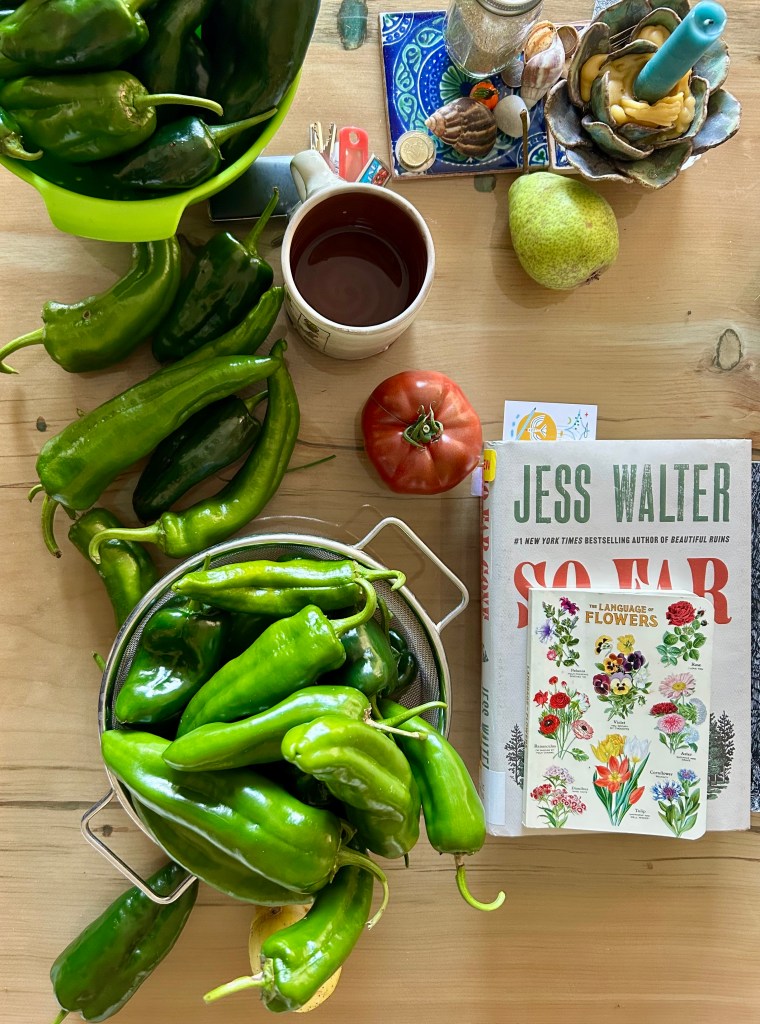
My garden planting this spring was a combination of friends who appeared and weeded and planted, of the sunflower seeds I sowed and the woodchucks ate and I replanted and the woodchucks devoured again, of volunteer calendula and love-lies-bleeding and towering gold sneezeweed, and the pepper plants from a friend that produced in enthusiastic abundance.

Hurray for the garden. These evenings when I light the first wood stove fires of the autumn, my cats chew shreds of birchbark, sprawl before the warm stove. Hurray, they purr in their cat way.

Season’s change again, so familiar and yet different, each day fresh and welcome. Season’s change for me, too, some days filled with friends and colleagues, other days I hole up and get my work done. Writing now about cancer, I imagine holding this keen awareness of my mortality, of the perishable world, in my hands: a tender-eared rabbit, a vicious rat, or maybe simply a handful of sunlight.

In the deep fall
don’t you imagine the leaves think how
comfortable it will be to touch
the earth instead of the
nothingness of air and the endless
freshets of wind? And don’t you think
the trees themselves, especially those with mossy,
warm caves, begin to think
of the birds that will come – six, a dozen – to sleep
inside their bodies? ~ Mary Oliver

This Glorious Autumn Light.

My sister, a caner survivor, once told me that a cancer diagnosis was a great leveler. This was years before my own cancer experience, and, sure, I had an intellectual understanding of this. Lymphoma schooled me in many ways, among these that I live in my body. Such a simple, profound thing. I had never lived in a body that couldn’t walk up the stairs in my own house, not just because of a sprained ankle or a new baby in arms, but because of weakness in my bones and flesh. I had never considered that I might never be able to enter the bedroom whose walls I painted, where I have slept for so many years.

These days, after a summer devoted to learning how to eat and sleep again and to walk those stairs, outside as much as possible in this gloriously sunny, perishingly dry Vermont summer, I no longer embody the near-translucence of cancer-and-chemo patient. Such pleasure I have when people ask why I’ve cut my hair, and I can reply that I didn’t snip, I lost. The hair I’ve lost is now returning in a metaphor that I can’t ignore: softer but with my childhood cowlick.

Disease hasn’t magically transformed me; if anything, my thorns have proliferated. But here’s a thing: the world where I live is descending into spectacular autumn. Sure, some years the fall foliage bursts brighter than other years, but always, always, heartstopping in beauty. Autumn’s a reminder of my mortality, your mortality, the dearness of this fleeting world. A reminder to pause in our gardens, on our house steps, the sidewalk, whatever trail we may be following. Take a moment. Breathe in, out, in….

From Stephen Jay Gould’s essay “The Median Isn’t the Message”:

Of course I agree with the preacher of Ecclesiastes that there is a time to love and a time to die—and when my skein runs out I hope to face the end calmly and in my own way. For most situations, however, I prefer the more martial view that death is the ultimate enemy—and I find nothing reproachable in those who rage mightily against the dying of the light.

October: where are we going?

This weekend cleaves the summer, the marker where the light changes.

As the leaves drop, the light sharpens and thins. I’ve been here before, so many times, knowing full well how the sun will continue to dwindle. October is a season of brilliant contrasts: emerald hayfields, swaddles of mist, orange remnants of zinnias.

The season mirrors the human realm, too, such a lusciously lovely summer this has been. Now I yank out spent tomato vines, stow away my garden rake and hoe. I gather a handful of kindling, an armful of wood. So much winter, so far to go.

In the co-op’s baking aisle, I run into an old friend, and we chat while her daughter shops. I’m certain we mark different sides of the ballot, but our friendship is hard-tested, solid. Our conversation swirls. Through the window, yellow leaves scatter and leap in a breeze. I lean towards her, listening to a thread of her story.

Change of season is never the same. My youngest daughter tumbles towards womanhood, our lives shift, stretch. Within, always the constants, the long threads of conversation, the joy of the natural world, my ever-present marvel at the world’s flux: where are we going? why? Is it true that other people live these steady, predictable lives? Who knows?

Overhead, those geese, honking their way out of here. And us, here, for now at least.


Each fall in New Hampshire, on the farmwhere my mother grew up, a girl in the country, my grandfather and grandmother finished the autumn work, taking the last vegetables in from the cold fields, canning, storing roots and apples in the cellar under the kitchen. Then my grandfather raked leaves against the house as the final chore of autumn.

— Donald Hall, String Too Short to be Saved

October Afternoon.

On my way back to Hardwick, I’m stopped in road construction on the County Road. While I wait for the steamroller, I glance at the passenger seat and notice my knitting has slipped from my bag. The project is a simple hat, and the yarn slid from the needles. To save my work, I lift the unfinished hat and slide the stitches back on the needles.

Just before my car hood, the woman in bright yellow holding a STOP sign leans against the pole. I turn off my Subaru engine, thinking of where I’ve come from and the high school soccer game where I’m headed. How quickly cold shadows edge in when the sun slips behind the mountains at this time of year. The mountains around the road dazzle with crimson and gold, but gray is visible in patches, too. Stick season marches in inexorably.

I’m at the town line somewhere between Montpelier and Calais. A few years ago, I sold our arch — the long firebox and pans used for making syrup — to a man who said he’d pick it up in a few months. His address was in this area. I promptly cashed his sizable check. He didn’t return. More than a few months later, I had sold the house, too, and my daughters and I were moving. I wrote list after list with things like pack canning jars and Salvation Army drop-off and get rid of Toyota transmission in shed. On those endlessly reworked lists, I added arch must be moved. While tracking down the buyer, I discovered an unspeakably sad thing had happened to his family a number of years before he wrote me that check.

I found him. He arrived with a friend and loaded the arch on a trailer. He and his friend were older than me, in a different phase of their lives than I was. They spoke kindly to my daughters.

For just a fleeting moment, still waiting for that steamroller to move, I remember that arch precisely. Stainless steel, black metal, the scrape of a shovel on firebrick.

The woman with the STOP sign appears at my open window. I expect her to chide me for daydreaming. Instead, she points to a nearby pond where a flock of geese have landed. The sun hits the sugar maples around the water. There’s so much in that moment — the clamoring and splashing birds, the stunning leaves, that crystalline memory, the sunlight and green yarn in my lap. The woman tells me, “Head on when you’re ready.”