Things Left on the Back Porch

A woman I worked with for one summer in Craftsbury, Vermont, lived the rest of the year in New York City. Before she left, I offered to mail her a few books. Don’t, she said, really alarmed. The mailman leaves packages on my doorknob in my apartment building, and people steal them.

Really? She assured me, yes, people did, in fact, steal.

People steal in lovely Vermont, too, but not like that. On my back porch, I leave my friend’s vest and a jar of peaches my daughter and I canned last summer. When my daughter returns from school, she discovers a gift of chocolate cookies and a cat calendar.

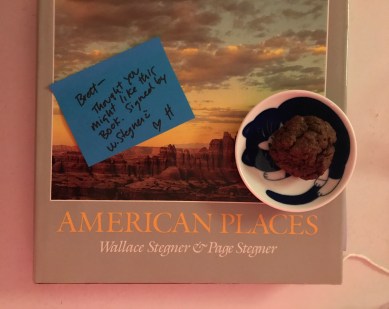
While boiling pasta for dinner, I leaf through the Eliot Porter photography book my friend left, too. In it, I discover a chapter written about nearby Glover, Vermont, not far from us.

The passage below reminds me of when I was 18 and moved to Vermont, and knew this state was exactly where I wanted to live — with a kind of certainty I’ve known about a handful of things — being a mother and a writer, tending a garden, the necessity of laughter…. and handing things from friend to friend.

Vermont is a great character mill, and it grinds exceedingly fine. It is too rough a country for pretenders, but it will make room for anyone, however odd, if he doesn’t on airs or show himself incompetent or think himself above the homespun and the calluses and the hard-mouthed virtues that Vermonters have come to the hard way, and don’t intend to lose.

— Wallace Stegner

img_4465

Wild and Tame Creatures

On his favorite perch on the dining room windowsill, my daughter’s cat suddenly stiffens his back and presses his nose near the November-cool glass. Beside him, I’m typing, and I rub his back. He mews an inquiry, looking at me.

Through the window, I see eight wild turkeys, nosing through my young asparagus bed, planted just last spring. The turkey nearest us steps toward the window, raising its long odd legs. The cat and the bird stare at each other, the turkey’s head tipped slightly to one side, so its eye gazes at this little furry tiger cat.

The bird’s bigger than you, I murmur.

For the longest time, these two creatures stare at each other. Then the turkey goosesteps on its way, and the cat, true to his nature, curls up on the table beside my laptop and takes a nap.

Midterm elections, 2018.

I always feel the movement is a sort of mosaic. Each of us puts in one little stone, and then you get a great mosaic at the end.

— Suffragette Alice Paul

IMG_3839.jpg

Vocab Lesson

I’m reading The New York Times on the couch when I look over at my middle school daughter on the couch who’s reading. She’s in her athletic pants, her hair carefully up in a bun like her friends, her face still tawny from a summer mostly outside. When she’s finished with her chapter, she tosses the library book on the couch, and I ask if she knows what the word anti-Semitic means.

She doesn’t.

The word is so terrible, I’m not sure what to say. In our house, we sometimes joke about language. This week, the girls have been tossing voluminous around playfully, like a half-deflated, helium-filled balloon.

I glance into the dining room I’ve spent all weekend painting a color described as lemon custard, my motivation simply love of color and warmth.

And then I look back at my daughter who’s waiting, patiently, on the couch.

It did not really matter what we expected from life, but rather what life expected from us. We needed to stop asking about the meaning of life, and instead to think of ourselves as those who were being questioned by life — daily and hourly… Life ultimately means taking the responsibility to find the right answer to its problems and to fulfill the tasks which it constantly sets for each individual.

Viktor E. Frankl, Man’s Search for Meaning

IMG_3811.jpg

Happy Arkhipov Day

Two mothers relax on the floor of my library with their babies when my dad sends me an email reminding me that October 27 is Arkhipov Day. Not yet a year old, the babies haven’t begun to walk. Their smiles rise so radiantly joyous you instinctively smile back. Sleet drills against the library windows.

On October 27, 1962, Vasili Arkhipov refused to agree with his fellow Soviet submarine officers and fire a nuclear-tipped torpedo at the USS Randolph, preventing the nuclear holocaust that would have World War III.

The mothers check out children’s books, bundle up their babies again, and head out into the sleet that’s turned to wet snowflakes: everyday Vermont.

World War III was averted not by decisions in the White House or in the Kremlin, but in the sweltering control room of a Soviet submarine. Vasili Arkhipov saved the world. We should celebrate his obedience to humankind, not to the Nation-State, on October 27, Arkhipov Day, a proposed international holiday by students of the Cuban Missile Crisis.

— George Stanciu. For more about Vasili Arkhipov and my dad, read here.

IMG_3759.jpg

Stockpiling

As the garden withers for the winter, I collect seeds — tithonia, marigold, coneflower — pulling the dry seeds with their tufted ends with my fingers, secreting them in my coat pockets.

My daughter takes a handsaw to the mammoth sunflower stalks fencing the garden, their heavy heads picked nearly clean of seeds from marauding birds. From a scant palmful of seeds, what pleasure these beauties have given us this summer. Now, the birds and the scavenging squirrels feast, too.

A friend stops by with a bare peony root, cushioned in paper, transported in a Negra Modela box. I’m out that evening. When I return, my daughter carefully unwraps the root — not merely a stick but a complicated branching — and then lifts another smaller root. Good luck, she says. They may not grow.

Or, they might.

Wait, for now.
Distrust everything, if you have to.
But trust the hours. Haven’t they
carried you everywhere, up to now?

— Galway Kinnell

IMG_3757.jpg


Juncos flock the double glass doors in our kitchen, tantalizing our cat.