Revision.

On the most perfect spring morning, I’m driving along route 107, a stretch of highway I’ve always loved that curves along the river. I’m listening to a This American Life story about two boys (and if you listen, listen all the way to the end, please), when the revision path for my novel abruptly unfolds before me, like a Jacob’s Ladder toy.

I’m in somewhat familiar territory, and so I pull over and scrawl down a few sentences. The day is suffused with dandelions and violets. I get a little lost to where I’m going, but not too lost. Later, I take a different road home, up route 100 along the White River Valley. Last year’s corn stubble patterns black fields that stretch to mountains where leaves freshen the gray with new green. The fruit trees are blossoming. I stop and finish the remains of my sandwich —pickles and sprouts and a coarse sharp mustard — keeping company with pink petals and pollinators.

My lunch companion remarked how a forest will do what a forest will. As I eat, I remember how poet David Budbill railed against writers taking themselves too seriously. He wrote, wrote hard, wrote productively, and revered the mystery of the imagination, the murkiness of creativity. His advice to writers, “Don’t think. Listen.”

On my way home, I listen to another This American Life story about a bird who sang to itself. I’m not making this up.

Flattening the Road.

I drive home in a pouring snow, remembering when we bought a Toyota pickup years ago, and I drove with four-wheel drive, how the road suddenly flattened out. I’m driving my daughter’s car. In Hardwick, I stop at the auto parts store. Her right wiper is torn. I’ve known the person my daughters call The Auto Parts Man for years. He opens the wiper packages on the counter and then puts on his coat and heads out in the snow and replaces my wipers, too.

It’s the last day of February, and he says he’d rather winter just quit. He laughs and shrugs.

Nonetheless, for the moment, my windshield is clear.

This hill
crossed with broken pines and maples
lumpy with the burial mounds of
uprooted hemlocks (hurricane
of ’38) out of their 
rotting hearts generations rise
trying once more to become
the forest

just beyond them  
tall enough to be called trees  
in their youth like aspen a bouquet  
of young beech is gathered

they still wear last summer’s leaves   
the lightest brown almost translucent  
how their stubbornness has decorated   
the winter woods

— Grace Paley

Chasing Dreams.

With our household size decreased, so is our garbage. On a sunny Friday afternoon, I swing by the transfer station with two bins of recycling and a bag of trash. The roving raccoon who appears regularly outside my kitchen door, pre-dawn, apparently found a way into my barn and enjoyed the trash far more than I did.

At the transfer station, I interrupt a woman who’s eating her lunch salad. I apologize, and then I stand at the open window as we kick around a weather conversation for bit — flowers blooming in my garden and all. She tells me she’s headed to Florida next week — not for the winter, but to drive down her convertible and store it at her father’s house. Where he lives, he’s eight hours from New Orleans, eight hours from Nashville, eight hours from just about anywhere worth going. The trash business slows in the winter (something I’d never considered), and she’s looking forward to doing some traveling this winter.

I’m no fan (who is?) of consumption and trash, but the transfer station has a particular allure to me: so many stories here. When I moved from our last house, I negotiated with the transfer station owner about swapping used tires for metal, and what could he offer for two old pickups in the woods? We each held up our end of the bargain we struck.

A flock of juncos settled around my house this afternoon. While I folded up the laundry I had hung on the back porch, I imagined my acquaintance driving south, roof cranked down and the breeze in her hair, speeding towards her dreams.

On some nights, I still believe that a car with the gas needle on empty can run about fifty more miles if you have the right music very loud on the radio.

— Hunter S. Thompson

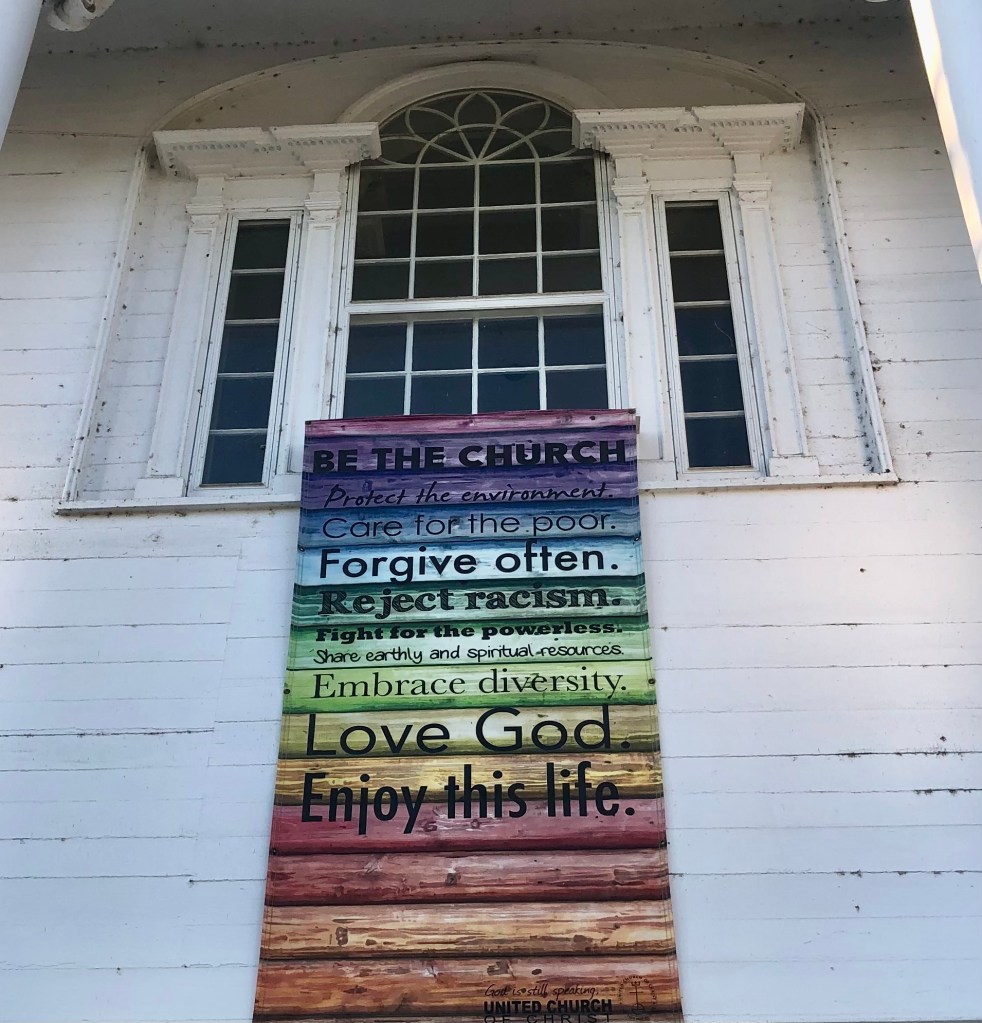
Found Sign: Enjoy this life.

Late on a Friday night, I’m reading on the couch when my oldest calls. There’s no heat, yet, in her apartment. The evening is tinged with near frostiness. I’ve returned home from an interstate drive in the darkness, thinking over the pieces of my manuscript. In my imagination, I see Lena, my main character, with her emerald green haircut.

A half-moon rises in the darkness as I drive along the Connecticut River. These days — long days — I’m grateful for these imposed breaks, for the opportunity to see the moon rise along an unfamiliar horizon, to stop before a church and read the congregation’s exhortation: Enjoy this life.

My dear cats are sprawled before our glowing wood stove. Listening to my daughter reminds me of my mother — our spunk and sassy irreverence and love of flowers — but my daughter is utterly herself. I close Beth Macy’s Raising Lazarus, and our conversation unfolds over the few miles between us. September, and the swimming season has passed. I hope for decades ahead to see what my daughter makes of her life. For now, this September evening.

... I like driving at night
in summer and in Vermont:
the brown road through the mist

of mountain-dark, among farms
so quiet...
Hayden Carruth

Somewhere in Summer.

Vermont’s summer mugginess settles in, and I lie awake at night, remembering the much stickier summers of my childhood in southern New Hampshire, a thousand days of no school and bike riding and eating salted cucumber and playing Acquire with my brother and the neighbor — the ultimate game of capitalism.

But those were likely much less than a thousand days.

My youngest texts me at work. She and her friend explore different swimming holes and go hiking. Together, as new drivers, they match route numbers with roads, beginning to master maps. I worry about her — my youngest navigating the world on her own — this place of such ineffable beauty and real badness. This is the summer she’s learning the price of a tank of gas — a transaction between labor and coin. But it’s also the summer she’s beginning to realize the phrase girls travel in packs has much more meaning than looking for the women’s room.

This is the summer of phenomenal sunsets and sunsets, of studying the sky, wondering if rain might move in.

Quit counting, I counsel myself. The hot days unwind into hotter nights, but the dawn is cool, the dew lush over my toes.

Our Perpetual Holiday

To practice night driving, my daughter and I set off after dinner, delivering a book and knitting needles to a friend. We’re laughing on the way there, and my daughter remarks, Why is it so dark?

I answer that I’m going to let that question lie.

At our friends’ house, we can see through the windows where the family is around the wood stove, talking, the walls painted yellow. I have a sudden flash of envy at the intactness of mother, father, two children, and then that passes quickly, too. At our house, warm and well-lit, with interior walls painted limoncello, we’re as intact as any family, too.

With my friend’s book in my lap, my daughter drives up the back roads, over ice and sand, through all that darkness. We reach the crest of hillside. There, as she drives and talks, I see across the valley to where a barn is lit in a long string of lights on the opposite hillside. Sporadic houses glow in the cold night, and not much more.

She drives down, then along the S curves along the river where I remember a terrible accident years ago. We stop and fill the gas tank. Beneath the bright gas station lights, it’s just us. I walk around the car, washing windows. In the driver’s seat, she watches me, and then I step back and bow. She shakes her head at me, amused.

Middle of February. Cold. A little chit in our collage.