A Handshake and a Promise.

I leave dinner with neighbors and friends and walk home, down through the village. It’s late enough that the few restaurants in town are closing down, a few lingerers at the bars while the waitstaff wipes down the tables, doubtlessly thinking of their own homes and nights ahead.

Knowing I would savor this walk, I brought my hat and a coat, and the night is warm enough. I’d been offered a ride — “it’s dark!” — but me who is afraid of so many things (rushing semis, rats) has no fear of this autumn dark, this small town. I pass no one, not even a dog walker.

End of October, and I labor through the daily chores, now shoveling ashes from the wood stove, putting away the summer’s chairs and garden tools. My daughter phones with a homework question. Over us, the ineffable holiness of the passing of both of my daughters’ grandmothers this year, the old women who had distanced themselves from their granddaughters. What will this mean for my young women? At dinner, whisperings about the election. Which way will this split?

Just beyond the village, a U-Haul idles, lights on. As I walk nearer, I squint in the brightness. U-Haul, those rental trucks that have appeared intermittently in my life. The last time was that sleety winter day when a couple loaded up barrels of syrup from our sugarhouse driveway. I was in a desperate time in my life then, selling what I could to pull up stakes with my daughters and light out for new territory. I took a chance on this couple, watching them head down the slushy road with our liquid gold with nothing more than a handshake and a promise between us.

As I walk by, the U-Haul driver doesn’t look up, reading his phone, maybe a map, maybe a love note. I keep walking. As for that couple, the handshake and promise were gold. A week later, the check arrived in the mail.
Kindness of strangers.

If there’s a sadder building in Vermont than the county courthouse in Barre, I don’t know where that might be. Over the last nine years, I’ve been here again and again and again and again. On Friday, I arrive again, stepping through the metal detectors and removing my knitted hat to show my barrette. My errand is to leave a handful of copies. I wait behind a man in an orange jacket at the counter who cannot understand what the clerk is saying. She repeats her instructions. Another clerk calls to me. I ask my questions, repeat back her answers to confirm. The man beside me weeps.

The last time I was here, I waited in a room of women waiting to be heard by a judge. In those days, I had survived those court appearances and the craziness of my life by imagining myself a mother wolf. I slunk in, took what I needed, and ran. All morning, the room gradually emptied, until only myself and one other woman remained. She was young enough to be my daughter. The bailiff appeared and said it was the judge’s lunchtime, and we could return in two weeks. Wolf, I stood up, all 4’9″ of rage, and said I wasn’t leaving. The bailiff muttered and disappeared behind the wooden door.

The woman’s name was before mine on the court’s list. She offered to let me go before her. You have a child, she said, and I don’t. I didn’t one single strand of this woman’s story. The judge delayed his lunchtime.

On this Friday afternoon, six years later, when I return to this courthouse I had promised myself never to enter again in this lifetime, I carry the memory of this stranger’s kindness.

Outside, at my car, I can’t find my keys, and so I return again, back through security, back to the window where the man is yet weeping, the clerk repeating the same impossible words. Then I realize my keys were in my hand; I hadn’t looked.

Here’s a poem very much in this sentiment, emailed from my father. Listening to the audio is highly recommended.

Pigeons.

On the train to Florence, we strike up a conversation with a couple from Australia who are traveling with both their mothers. He’s interested in American universities and chats with my daughter about dorms and loans and degrees. He’s in banking. His wife works from home and hasn’t gone into the office in two and a half years. Sometimes, she says, she stands in the backyard and talks to the birds for company.

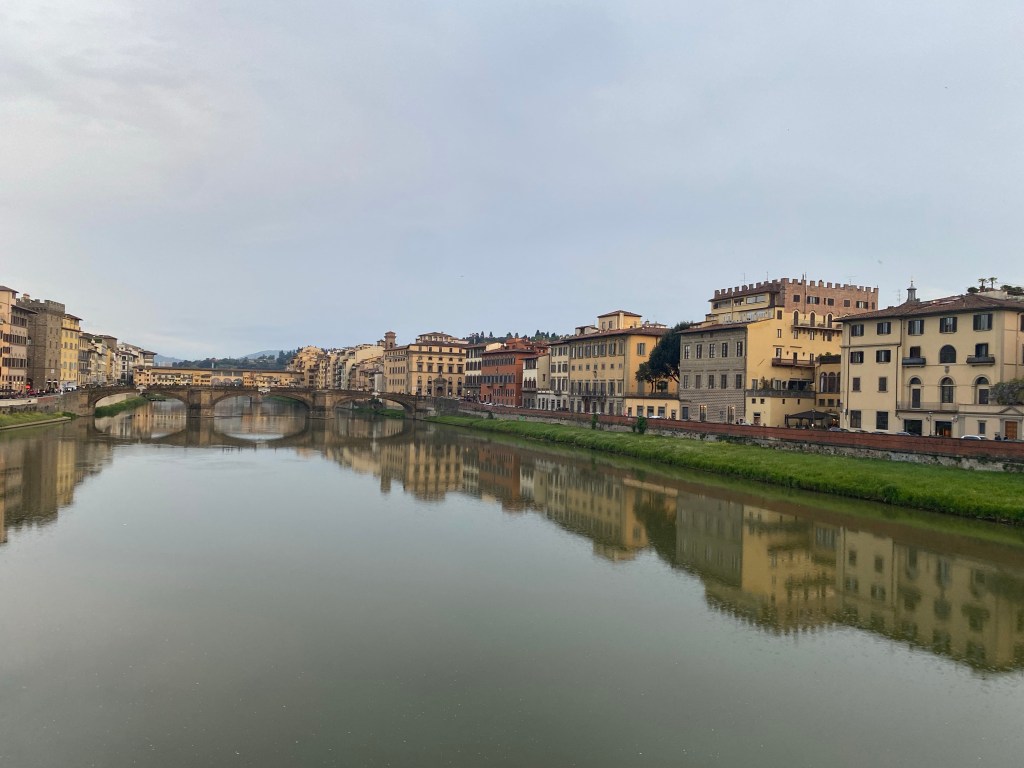
In Florence, our windows look over red roof tiles. Pigeons nestle in the ivy.

October Afternoon.

On my way back to Hardwick, I’m stopped in road construction on the County Road. While I wait for the steamroller, I glance at the passenger seat and notice my knitting has slipped from my bag. The project is a simple hat, and the yarn slid from the needles. To save my work, I lift the unfinished hat and slide the stitches back on the needles.

Just before my car hood, the woman in bright yellow holding a STOP sign leans against the pole. I turn off my Subaru engine, thinking of where I’ve come from and the high school soccer game where I’m headed. How quickly cold shadows edge in when the sun slips behind the mountains at this time of year. The mountains around the road dazzle with crimson and gold, but gray is visible in patches, too. Stick season marches in inexorably.

I’m at the town line somewhere between Montpelier and Calais. A few years ago, I sold our arch — the long firebox and pans used for making syrup — to a man who said he’d pick it up in a few months. His address was in this area. I promptly cashed his sizable check. He didn’t return. More than a few months later, I had sold the house, too, and my daughters and I were moving. I wrote list after list with things like pack canning jars and Salvation Army drop-off and get rid of Toyota transmission in shed. On those endlessly reworked lists, I added arch must be moved. While tracking down the buyer, I discovered an unspeakably sad thing had happened to his family a number of years before he wrote me that check.

I found him. He arrived with a friend and loaded the arch on a trailer. He and his friend were older than me, in a different phase of their lives than I was. They spoke kindly to my daughters.

For just a fleeting moment, still waiting for that steamroller to move, I remember that arch precisely. Stainless steel, black metal, the scrape of a shovel on firebrick.

The woman with the STOP sign appears at my open window. I expect her to chide me for daydreaming. Instead, she points to a nearby pond where a flock of geese have landed. The sun hits the sugar maples around the water. There’s so much in that moment — the clamoring and splashing birds, the stunning leaves, that crystalline memory, the sunlight and green yarn in my lap. The woman tells me, “Head on when you’re ready.”

Zen. Broken Sink Drain. A Meaningful Life.

back porch view

I’m lying on the couch reading Sigrid Rausing’s Mayhem when my daughter calls from the kitchen, ‘Mom, you’re not going to like this!’

The sink drain has split apart again and gray water floods the kitchen floor. For a moment, I think, whatever, and then ask her to get an old towel.

I have now repaired this drain three times, each time in nothing but sheer annoyance and impatience.

The problem, naturally, has something to do with PVC and epoxy, but more to do with me. My ex-husband put in this drain, in his trademark cob-job way, fitting together scraps of plastic pipe. I’m irritated at my own ineptness, my unwillingness to devote real time to YouTubing a solution, the scantness of my nonworking hours.

I’d rather paint a wall than repair a drain.

After we mop up the water and pile the unwashed dishes on the sink drainboard, we put on our boots and take a walk in the falling snow. It’s the first snowfall of the year. Snow is our old friend, falling silently, sparkling in house and streetlights. This first bit will melt today and return again soon.

Sunday morning. Put the house in order. Take the broken pieces to the hardware store. Ask for advice.

True recovery is a profoundly ethical journey, finding meaning and dignity through solidarity and restitution. Without that, there may be a cessation of drinking or substance use, but there is no real recovery.”

— Sigrid Lausing

Promises.

A thunderstorm rumbles in early Saturday morning, in that darkest spot before dawn. We’re nearly at the solstice, and the days are long and lovely, full of just the right amount of warmth. Our Vermont world is in bloom.

The rain this morning is welcome. When the downpour passes, I lie in bed beside the open window, listening to the pattering of a gentle rainfall on the leaves of the mock orange below my window. In bloom now, its flowers are white as snow.

In my memory runs a few lines from an Eric Clapton song. The day before, I had driven to St. Johnsbury, a road I had often driven when I was first married. As I crested a mountain, VPR cut out, and that song came over my radio, scratchy. Long ago, we had a second-hand turntable, and a few cast-off records, and that album we played over and over.

The thing is, I didn’t like the album much at all, but I gradually came to like it, maybe simply through habit. That one sweet song had always been my favorite. Now, over the radio, my past returned, fuzzy and unclear, but never forgotten.

A year ago, George Floyd had recently been murdered, his death replayed endlessly around the planet. Riots erupted around the country. Now, under a different administration, Juneteenth is honored.

So much. All that great wash of the past — from immense societal waves to the tiny trickles of our own lives — pushes us along. And yet, sweet rain on this quiet morning. Even the hungry cats press their whiskers against the screen, welcoming in the morning.