
Before dawn, brushing my hair I sing On the road again, just can’t wait to get on the road again, that old Willy Nelson song my mother loved. In the kitchen, making coffee, my daughter calls, Wait? You know that song? We played it everyday on our road trip last summer.
A thing to savor in this cancer: how my daughters and I discover these tiny things about each other.
My youngest cut the snarls from my hair that lingered from that hospital stay, when I couldn’t raise my arm to brush my long hair. Now, hanks of my hair slip out in my brush.
Outside, I stand for a moment, the waning moon hung over the neighbors’ roof, the emerging dawn a river-stone blue. A thaw’s set in, and the air is redolent with melting snow, a hint of loosening compost and soil. Raindrops hang from the three apple trees I planted.
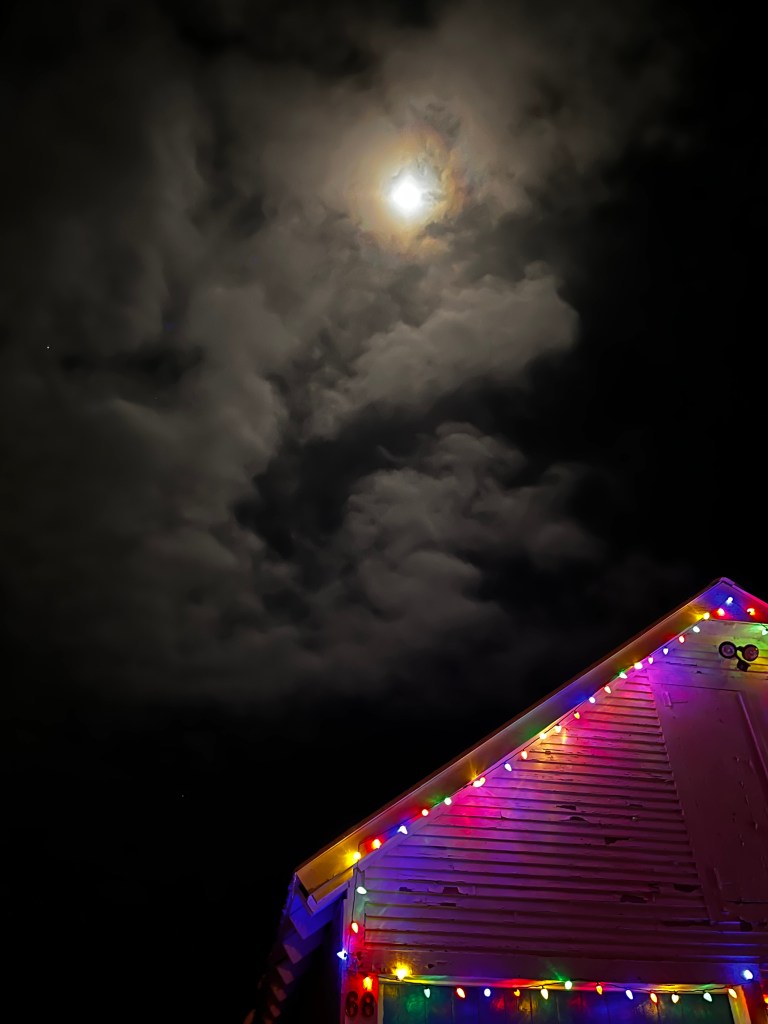
We drive through the village, the coffee shop lit up where I’ve spent so many hours writing and talking, a young woman sweeping at the door. Colored lights string through the trees and over store windows. Out of town, day warms over farm fields and forests.
At the hospital, blood’s drawn for my chemo course this week. In my rudimentary cancer thinking, while doing the darnedest I can to forget about the orange fluids that will enter my body, I reckon that this week’s treatment means one third of the way through. If I can endure a third, I can endure half. If I can endure half, I can persevere to the finish. Talking with my daughter about December monochrome, I silently counsel myself to knock off my silly math. I’ve factored in no variables, and the variables are inviolate.
Before we leave, the nurse shows me a model of a port that may or may not be inserted in my chest. I hold the pad for needles, finger the plastic tube as she explains how it will lie under my chest. At the end, in the shape of a calla lily, is the opening that will drip the chemo beside my heart. The whole apparatus seems enormous to me, that plastic calla lily wider than my small finger. I hand it back to her. In the end, with the Good Doctor, how much of this will be my decision, and how much will be wisest course forward? In this age of truth/untruth, facts are powerful. I thank her, and we leave.
It’s a pleasure to be outside again, on this tiny road trip, my daughter at the wheel, drinking coffee. The fields and mountains and sky are layered quilt batting: blue and pearl and silver. Around the trees, rain’s pushed the snow away from the trunks, opening the earth again.
From Lauren Markham’s A Map of Future Ruins:
We don’t live steadily toward epiphany; our truest stories move back and forth in time, in space, in memory. Life is a mosaic, not a line.


 Stony Soil Vermont