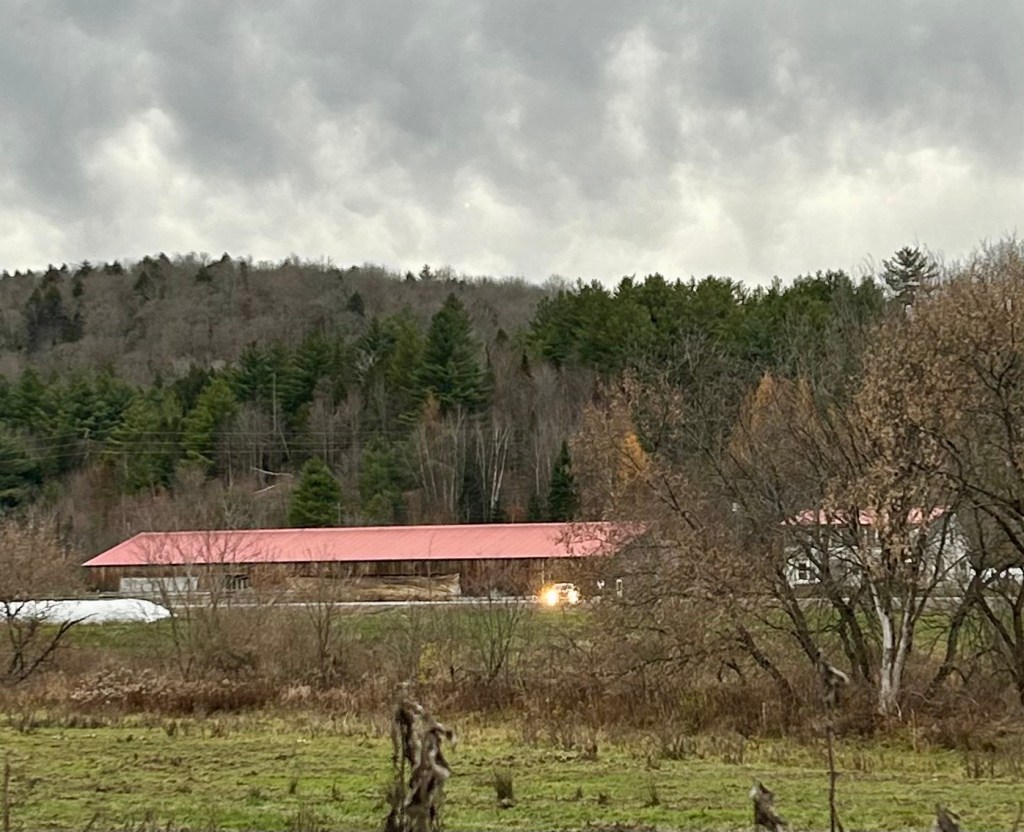
Peering Through a Window.

As a grad student, I lived for a few years in Bellingham, Washington, where the sunny summers (I kid you not) were a steady 75 degrees. The winters were New England dark, but lacked the drama of the deep cold, how (save for the conifers), the green gives way to sooty gray, flat white.

November, and I remind myself that I love Vermont in myriad ways, and one of those is how the seasons’ shift reflects our changing lives, too. In my walks along the river, it’s just me and two deer, a flock of starlings. The wildflowers have withered to dry stalks.

I have a bone scan at the local hospital (no major deal, a routine baseline). Afterwards, I walk around this building in the mid-afternoon light that’s already darkening towards dusk. Cold drizzle. Exactly a year ago, I was a patient here, and I find the window of the room where I stayed. That first morning, a social worker and nurse came into my room. The social worker gently suggested I write a will, stat. The nurse empathized with my diagnosis. Was I dismissive? She said, I have stage 4 cancer, and here I am, working again. It was not a comeuppance, but a widening.

A friend stops by with dinner. I slice apples and bake crisp. November, season of hearth.

The sick are ourselves, was a thing his father [also a country doctor] had said. When you stop understanding that, take your name off the wall and throw your bag in the river. It was advice he had only sometimes forgotten. ~ Niall Williams, Time of the Child

Mirth in the mirthless. A great mercy.

Mirth in messiness… another night drive to the ER, so cold, what were we leaning into? Five degrees, maybe six? The stars above the river ice a mockery of light. Kindness and Dilaudid, another scan, a hurry-up-and-wait, the three of us talking about nothing in particular save for a hike we once took in a thunderstorm and an orange water bottle confiscated (gone, forever) at the Albuquerque airport.

It’s the small hospital not far from our house, not the cancer complex with its soaring blue-green glass. On this zero-degree night, my daughter presses her feet against the room’s wall heater. There’s hardly any patients, save for a man we never see who insists that he must be heard. In the night of dim small lamps, I sleep and wake, talk with a woman from the high plateau country of the upper midwest. She remarks wistfully that Vermont is too tiny and cramped for the sweep of the midwestern sky. Maybe it’s just the Dilaudid, but when sleep folds over me, I dream of those childhood summers my siblings and cousins and I chased fireflies while the grownups drank bourbon and ate our leftover birthday cake and kept at their two-week conversation. The dew washed our bare feet.

The hospital morning flicks on before the sun has dulled the night’s darkness. Mirthless, indeed, I become, crabby with human lack and inhuman fate. Words, words, mine and others’, in a repeating loop. I text my nurse friend. On her lunch break, she appears, and then there’s laughter from nurses in my room. People come and go. I sign for more billing. (How much is this going to cost me, anyway?) The chaplain appears who’s read my book and wants to talk Flannery O’Connor and death. I’m not about to be funeral planning for myself anytime soon, but I plunge right into that death question. Indeed, this wretched cancer, my uninvited guest, perhaps the truest teacher of my life.

He asks, To know to savor every day?

Oh sure. But the disease has whittled me down to a glittering core, to ignore the petty fluff that not so long ago stung my eyes, and certainly my heart, too. What remains is real, both beautiful as those fireflies winking in the sultry midwest night, and ineffably, unbearably sorrowful.

I intend to live a long life; I’ll at least go on for some while, which is all any of us can say. In the meantime, this rarefied illness journey? Not lacking for writing material.

From Flannery O’Connor, The Habit of Being (1988):

In a sense sickness is a place, more instructive than a long trip to Europe, and it’s always a place where there’s no company, where nobody can follow. Sickness before death is a very appropriate thing and I think those who don’t have it miss one of God’s mercies.

Little & Big Worlds

On an incredibly warm afternoon, a little girl discovers a pencil-thin garter snake curled up in the gravel alongside the library. Snow lies ubiquitous on the playground, but the earth there has emerged from its winter hibernation: a green iris shoot, dark mud. I love snakes, the girl says dreamily.

VPR carries news of the stock market’s plunge, of quarantine, of illness. All these factors, in one way or another, may eventually — later? sooner? — reach this little girl. For now, she stands in the snow in her boots and a t-shirt, staring at the creature. Under her arm is tucked a grownup natural history guide, a book she’s checked out of the library.

Later, after a nearly six-hour-long school board meeting filled with simply stuff, we lean back in chairs. It’s nearly midnight. There’s still snacks on the table. I’ve long finished my tea. Head home? I put my forehead on the school library’s table, its wood hard beneath my bone. Eventually, I gather my papers. Outside, the air is balmy. I breathe.

IMG_7285