Disease as Teacher.

About a year ago, a friend asked to borrow knitting needles, a request I almost certainly ignored as I could hardly walk up the stairs in my house, and forget the effort of opening the closet door and searching through my needles. A year ago, my family moved my bed downstairs, and I wondered, Well, is that? Am I now confined to one floor like an old woman? I was not, thankfully.

Half a year out from chemo and surgery, my family moved my bed back upstairs. The first morning I wake, I stand at the window looking down at the mock orange planted decades ago. In June, this giant bush is covered with small white blossoms, but in November, the bush is mostly sticks, save for a few withered leaves.

Standing there staring down, I felt suffused with profound grief. Almost immediately, I chastised myself. Why grieve when I survived a terrible illness? When this might have easily gone otherwise? And yet, grief.

Nearing the holidays, I think often of my mother who died not so long ago. She and I had years ago separated our lives for reasons both silly and profound. Only at the end of her life did I begin to have empathy for her and see her not merely as my mother but a woman in her own right. So that morning, thinking of her, my grief is for her absence, for what might have been between her and my daughters and myself. So many years I invited her to holiday meals, and all those years, she refused to join us. How I would love to invite her this year. Surviving cancer (thus far) broke me in so many ways, shoved me right up against the fragility of the world, revealed my own meager strength, but it also allowed me to grieve the loss upon loss that is not endemic to me but woven integrally through our mortal lives. Cancer empowered me to hold that grief without rage, to acknowledge simply what is.

But sadness, of course, is one variation of the complex symphony of our lives. Yesterday, walking along a hillside dirt road in the November sunlight, hat pulled off my head and in my hand, eyes on the spine of the Green Mountains in the distance freshly covered with snow, pure joy suffused me at simply being in the world. Six months ago, my companion had walked with me from my house to Main Street. It wasn’t at all certain to me that I could manage that short walk there and back. Now, the two of us moved quickly through the world, talking poetry and plans. How remarkable is that?

What if we embraced the messy, evolving, surprising, out-of-control happening that is life and reckoned with its proximity and relationship to death? What if, instead of being afraid of even talking about death, we saw our lives in some ways as preparation for it? What if we were taught to ponder it and reflect on it and talk about it and enter it and rehearse it and try it on? What if our lives were precious only up to a point? What if we held them loosely and understood that there were no guarantees? So that when you got sick you weren’t a stage but in a process? And cancer, just like having your heart broken, or getting a new job, or going to school, were a teacher? — Eve Ensler

Mirth in the mirthless. A great mercy.

Mirth in messiness… another night drive to the ER, so cold, what were we leaning into? Five degrees, maybe six? The stars above the river ice a mockery of light. Kindness and Dilaudid, another scan, a hurry-up-and-wait, the three of us talking about nothing in particular save for a hike we once took in a thunderstorm and an orange water bottle confiscated (gone, forever) at the Albuquerque airport.

It’s the small hospital not far from our house, not the cancer complex with its soaring blue-green glass. On this zero-degree night, my daughter presses her feet against the room’s wall heater. There’s hardly any patients, save for a man we never see who insists that he must be heard. In the night of dim small lamps, I sleep and wake, talk with a woman from the high plateau country of the upper midwest. She remarks wistfully that Vermont is too tiny and cramped for the sweep of the midwestern sky. Maybe it’s just the Dilaudid, but when sleep folds over me, I dream of those childhood summers my siblings and cousins and I chased fireflies while the grownups drank bourbon and ate our leftover birthday cake and kept at their two-week conversation. The dew washed our bare feet.

The hospital morning flicks on before the sun has dulled the night’s darkness. Mirthless, indeed, I become, crabby with human lack and inhuman fate. Words, words, mine and others’, in a repeating loop. I text my nurse friend. On her lunch break, she appears, and then there’s laughter from nurses in my room. People come and go. I sign for more billing. (How much is this going to cost me, anyway?) The chaplain appears who’s read my book and wants to talk Flannery O’Connor and death. I’m not about to be funeral planning for myself anytime soon, but I plunge right into that death question. Indeed, this wretched cancer, my uninvited guest, perhaps the truest teacher of my life.

He asks, To know to savor every day?

Oh sure. But the disease has whittled me down to a glittering core, to ignore the petty fluff that not so long ago stung my eyes, and certainly my heart, too. What remains is real, both beautiful as those fireflies winking in the sultry midwest night, and ineffably, unbearably sorrowful.

I intend to live a long life; I’ll at least go on for some while, which is all any of us can say. In the meantime, this rarefied illness journey? Not lacking for writing material.

From Flannery O’Connor, The Habit of Being (1988):

In a sense sickness is a place, more instructive than a long trip to Europe, and it’s always a place where there’s no company, where nobody can follow. Sickness before death is a very appropriate thing and I think those who don’t have it miss one of God’s mercies.

In the cracks around kindness.

Thaw, on this New Year’s Day, hovering near freezing, my neighbor’s yard under her great pines exposed to soggy grass, the fields on the hillside across the village bare as late April.

I pull on my coat and boots and stand on my porch. The tree branches are festooned with droplets. Cold will press in again this week.

Wednesday morning, holiday, my scrawled list penciled on a post-it on my kitchen table, waiting. I perch on the covered sand bucket and sip the coffee, my hands wrapped around the mug. My memory wanders back to the Maine coast where we spread my mother’s ashes last June. My mother loved domestic spaces. She would have been enchanted by the colored lights my kids strung over my barn, along the porch roof over my head. Likewise, in my house, she would have admired our tree with the red star topper, the room illuminated with tiny lights. Nearly housebound with cancer recovery, my household has been blessed with gifts of candles, savory meals, foil-wrapped chocolates, fragrant rose oil from Bulgaria. All this, too, would have intrigued my mother.

My mother loved the wild, too, for much of her life quick to pack up the car and head for the open road.

In Maine, we parked near the shore. The sweetness of rugosa roses buoyed along the breeze’s brine. In the curving, layered landscape of rock and the rhythmic crashing pound of the ocean like the planet’s beating heat, we returned her remains to the immense wild, the mysterious territory where she had, after all, emerged from.

A crossing over.

This second memory, too. Later that summer, visiting my old father in New Mexico, my young woman daughter and her friend fried eggs and buttered toast for breakfast. In their strappy sundresses, they sat at the round oak table, sipping coffee. The friend had never visited New Mexico; her eyes gleamed. My father gave them his credit card and told them to eat lunch in downtown Santa Fe, in the courtyard which had been a family compound, 200 years and more ago. Later, the girls returned with leftover enchiladas and stories of flowering trumpet vines and singing birds. We must go into the beautiful mountains.

Yesterday, this daughter walked me around the high school, the beginnings of my strength returning. In the hidden back, a path leads into the woods. She held my hand, admonished, “Not yet.”

On this misty, rainy New Year’s morning, a prayer to cultivate patience and mercy for these interwoven journeys…

Before you know what kindness really is
you must lose things,
feel the future dissolve in a moment
like salt in a weakened broth.
What you held in your hand,
what you counted and carefully saved,
all this must go…

Naomi Shihab Nye

The Bardo.

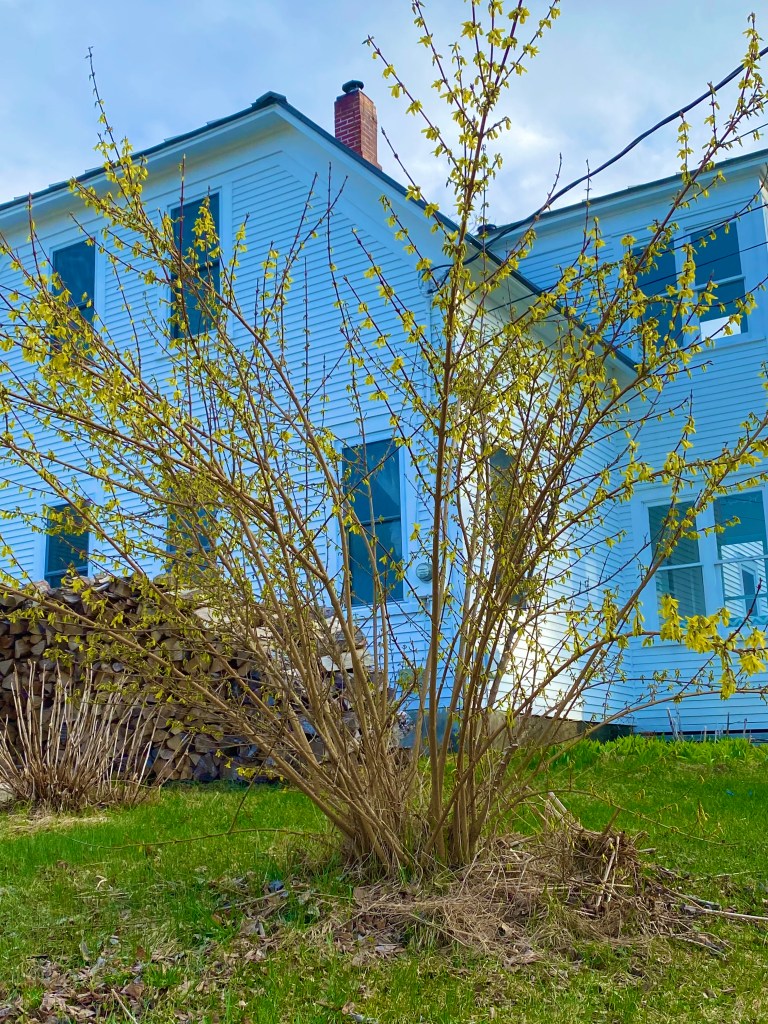
A few years ago, I bought a stick of a forsythia plant. The plant had withered in a nursery which hadn’t cared much for this plant, one of the three or four remaining perennials at the season’s end. For years, I had wanted to plant a forsythia with its cheery early-spring blooms, but I stood there and considered. The plant was about ten dollars. I eventually opened my wallet and took the admittedly meager risk.

The plant thrived. A few years later, I sold that house, dug up the forsythia, and carried the pot in the back of a friend’s pickup to my new house. The plant grew but never thrived, more stick and leaf than bloom.

This year, however, seven years into our life here, the blooms are abundant. I am not a Buddhist, not trained or schooled in any formal education at all, but here’s a thing. For a period of time after each of my daughters was born, I lived in a rarefied space, not of the common everyday world, but exposed and tender, as if the sky had opened up. I had labored to carry a six-pound baby into this mortal world. I had a foot in this world, and a foot still lingering in a gauzy undefined realm. But each day of nursing and crying, of meals of roast chicken and buttered toast, bricked up that entrance, planted me securely in this world again.

So, on the other end of mortality, I see my mother lingering yet with us, in profound and complicated manifestations, in the four of us — her husband and three children — and her four grandchildren as she drifts into her new realm.

In the house where I grew up, my mother and her neighbor bickered over ownership of an enormous forsythia that straddled their property line. As I walk around, planting and watering a lilac tree, stacking firewood, raking, I’m tugged to these delicate gold petals, so brief, such a long struggle, so miraculously splendid.

Darkness overtakes us on our way 

in my lodging the roof leaks 

weeping cherries in flower 

— Buson

Twilight Walk

On these warm spring evenings, my daughters and I often walk through the town forest and circle around back to town along Bridgeman Hill Road. The woods are the solace of living in town, sprinkled now with spring beauties and red trilliums and gold trout lilies.

At the high school, we watch a young teen drive a pickup around the parking lot with his father, the truck lurching into gear as the teen finds that sweet spot between clutch and gas. As the dusk drifts down, watching this kid seems almost wildly hopeful as he turns and loops back again around that long parking lot.

This whole walk I’d been trailing my daughters, listening to the evening birdsong in the treetops, for some reason remembering the man who coached basketball for many years at the high school. He’d dug a basement for my former husband and me, many years, when we bought that first eight acres. I’d run into him a few years ago when we were both pumping gas. As the world goes in little towns, we’d each heard small strands of gossip about each other, and we caught up about what we were each doing for work.

Then I turned the key to my car and asked if he would listen to a grinding sound in my car’s engine.

Water pump, he said, and then asked if I needed help fixing it.

I thanked him and said no, I was fine. He went into his day, and I into mine. On my way to work that morning, the water pump failed.

The teen turns on the headlights. Back at my car, my daughter gets in the driver’s seat, ready to drive — not home, but somewhere, anywhere.

I make her wait, though; I don’t get in the car. I stand there for a moment longer, the night sprinkling down, the peepers singing, and that boy making a long slow turn in the parking lot. Around us, the ineffable mystery of the world widens around those two spots of light.

Spiritual Crisis

Tanned and wearing overalls, a woman comes into my library and gathers a stack of library books for her children. For this moment, it’s just the two of us. She’s a woman who doesn’t usually check out books for herself, but she asks for a recommendation. I ask her what she wants — fiction or nonfiction? Something easy?

She pauses and then tells me, I need something good. I’m having a spiritual crisis. I’m turning forty and raising two kids and….

I add, And the world’s falling apart?

She laughs. Yes. That might be it.

I pull Maggie O’Farrell’s book off the shelf, and she doesn’t look at it, simply adds it to her pile while we keep talking. She’s a woman who seems, to me, to have been fortunate with finances, surrounded by family. We talk for a bit more, and then I offer that change is opportunity — painful as that might appear.

We step outside, take off our masks, and walk around the gardens, talking about cucumbers.

The things in life which don’t go to plan are usually more important, more formative, in the long run, than the things that do.

Maggie O’Farrell, I Am, I Am, I Am: Seventeen Brushes With Death

IMG_7865