Crossing Open Water

My canoeing experience, while somewhat lengthy, has always been confined to summery, pleasurable afternoons, on Vermont’s still lakes and ponds, often with swimming and almost always with kids. Only once, on my honeymoon, did I worry our canoe might flip.

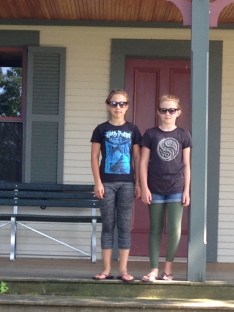
Oddly, I found myself on nearly those same waters in Lake Champlain this weekend, worrying again if I might roll the canoe. While the two cheerful and sunglasses-wearing 12-year-old girls waited for the ferry, I headed out to an island with a canoe loaded low with camping gear, not looking closely at the lake – a very large lake – rough with wind, torn up with the furled wakes of motorboats.

After I spun around, I gave myself a rapid crash course in reading the water washing near the low sides of my canoe, keeping my prow headed into the waves – those long curls might have delighted me swimming near the shore but frightened me with all this water around. The silver ferry passed by with my smiling girls, waving merrily in the sunlight.

On the return leg of the journey, after a few days of bicycling and card playing on an island magical with fiery sumac and twining vines, the water lay invitingly still, just me and the ducks and few gulls cavorting overhead.

It was then, on that crossing, that I remembered the children’s father and I had paddled in a rainstorm to this same stretch of beach, from an island further out, in a canoe we had borrowed from his parents that had no lifejackets. In a different version of my life story, I would have taken the ferry with the girls and he would have rowed the canoe – much stronger than myself and far savvier at reading wind. He would not have gotten stuck on the far side of the island as I did, and struggled against the current to round the rocky edge.

As I rowed, the lake lifted against my old red fiberglass boat, all that deep blue water, stretching far further than I could imagine, filled with darting fish and frond-waving plants, the shale-splintery islands, boats with white sparkling sails, sunlight profuse, with sunken ships and ancient fossils. I had been reading David Hinton’s The Wilds of Poetry, filled with narrative and a collection of stunning poems, from Rexroth to Robinson Jeffers, a stonemason apprentice who built his house at Carmel-by-the-Sea, all about motion and change. Kismet reading for sleeping on an island. I imagined how the gulls might see me, a small woman with a braid and a wooden oar with a broken handle, rowing home with a basket of dirty clothes, crumbles of crackers, softening cheese, a coffee pot and an unfinished sweater on knitting needles. I could not have wished to be anywhere else than there.

On the mainland again, I unloaded the canoe and walked along the high bluffs, waiting for the ferry. The wind was picking up then, and the day, the first of August, was bright with promise. The grass could not have been greener. I read the heartbreaking memorial marked for the boys who had died in the Second World War and then leaned against a bent cedar tree, one small woman in a landscape beyond time, myself just one living piece of its infinity.

When I met the ferry, its captain asked if the two girls alone were mine. Yes, indeed, I said and walked onto the rattling gangplank to greet them.

I have tried to write Paradise

Do not move
Let the wind speak
that is paradise.

Ezra Pound, from Cantos in Hinton’s The Wilds of Poetry: Adventures in Mind and Landscapes
IMG_1490

The Void and Story

One of the more harrowing experiences I had recently was offering up testimony in a county courthouse. In a large, wood-panelled room with no windows, separated from the landscape I know and love – my children and the dark-green mountains where I live, the world of singing crickets and flower petals easily frost-bit, the sky sprawled infinitely overhead, I was asked to give my story.

What’s in each of our own, unique stories, anyway? Breath, thought, memory: words from my larynx spun from the slender bends of my ribcage. To return to David Hinton’s Experience again, while speaking I realized how keenly our stories are presence surrounded by absence. Into this unknown world, I told my story of fear and love, my presence filling that space. In this 21st-century American world, we’re accustomed to defining ourselves in terms of our acquisitions: degrees we hold, a dwelling, occupation, the clothing we choose each day, political beliefs we cherish, whether we raise our own meat and vegetables or buy boxed foodstuffs at Price Chopper. Pushed up the against the razor’s edge of the void – through illness or a turn of misfortune we’ll all experience – we’re left with only a body created from carbon and calcium, and the immaterial thread of our story.

Our stories, always imperfectly told, are not a reflection or mirror of who we are. The stories are who we are. Hand-in-hand with telling our stories is that persistency of doubt. Is this true? Is my story worth telling? For a writer: why write, anyway? The answer, perhaps, may be as simple and raw-edged as this: because at our hearts, we are but the conjoining of body and story. In the face of the void that courthouse morning, my story hooked into strangers’ stories, as my story now weaves into yours, and yours winds into others.

In Chinese with its empty grammar, Absence appears as the space surrounding the ideograms, and ideograms emerge from that empty source exactly like Presence’s ten thousand things – a fact emphasized in the pictographic nature of ideograms, and no doubt the ultimate reason for that pictographic nature. Indeed, the ideograms are themselves infused with that emptiness, as they are images composed of lines and voids, Presence and Absence…

David Hinton, Experience: A Story


fullsizerender

Elm Street, Montpelier, Vermont

Why I Like Kids

I’m at a point in my life where I’m often more surrounded by kids than adults; fortunately, some of my kids’ friends are sweet, some witty, and all far more entertaining than annoying – a feature which goes a very long way with me, regardless of child or grownup.

I was thinking of this again when the neighbor boy stopped by on his bike today and cheerfully helped move a load of scrap metal. But what I was really thinking about was David Hinton’s book Existence I was reading extremely early this morning. When I asked the kids to pry open up a door in the sugarhouse that was seriously nailed shut, they said, Oh yeah, and scavenged around for a crowbar and maul. They accomplished the task, but, more precisely, they accomplished the task with gusto, and then each ate a Klondike bar, my younger daughter’s new culinary find. Who knew you could buy a six-pack of Klondike bars at the Hardwick Village Market? My daughter knew.

Maybe one of the reasons I enjoy these kids so much (besides their inherent lovableness) is that kids are often, hands down, better people than adults. Braver, certainly more honest, and generally right there. Reading David Hinton made me realize children are far nearer to Chinese sages, too.

…China’s ancient sages assumed that this immediate experience of empty awareness was the beginning place, that dwelling here in the beginning, free of thought and identity, is where we are most fundamentally ourselves, and also where deep insight in the nature of consciousness and reality logically begins….you can begin at the beginning anytime, anywhere. A simple room, for instance, morning sunlight through windows lighting the floor; a sidewalk cafe, empty wine glass on the table, trees rustling in a slight breeze, sunlit passersby; a routine walk through a park, late-autumn trees bare, rain clattering in fallen leaves.

– David Hinton, Experience

IMG_2273

Molly on a photography shoot, Craftsbury Common, Vermont


Writing Your Life

By this time of year in Vermont, much of what will come to fruition has been sowed and thrives. You’ve either had a crop of blueberries or not. The strawberries have long since gone by, only the verdant green remaining. Carrots, kale, squash, all should be well on their way.

What’s gone is gone. My chard, devoured by the woodchuck, will not grace my kitchen table this year. This digs at the question of poetry. I could turn my gaze and blind myself to how my garden lies at this time, weedy and gnawed in places, the peppers sweet and savory, the green ripening on the ear, the cucumbers proliferate. A metaphor for raising a child, acknowledging where wiser tending could have happened – or not. The elements of rain and cold and disease will thrust in.

But writing, perhaps, is a different endeavor than life. You get a rough draft; with diligence, you can rewrite and rework, burnishing your words. Easier, less risky, less dear.

Isn’t this all a matter of hunger, of desire in one raw form or another, a great maw of longing for satiation? The woodchuck to fill his belly. The carrots to thicken. A writer’s desire to reflect and hold the world’s mysterious complexity and beauty. A child’s yearning for growth and expansion.

A mountain can be a great teacher–not only because it manifests that cosmology of sincerity and restless hunger with such immediacy and drama, but also because it stands apart, at once elusive and magisterial…. (Walking up Hunger Mountain) reminds me yet again that things in and of themselves remain beyond us, even after… the most concise and penetrating poem.

–– David Hinton, HUNGER MOUNTAIN

DSCF0031 1

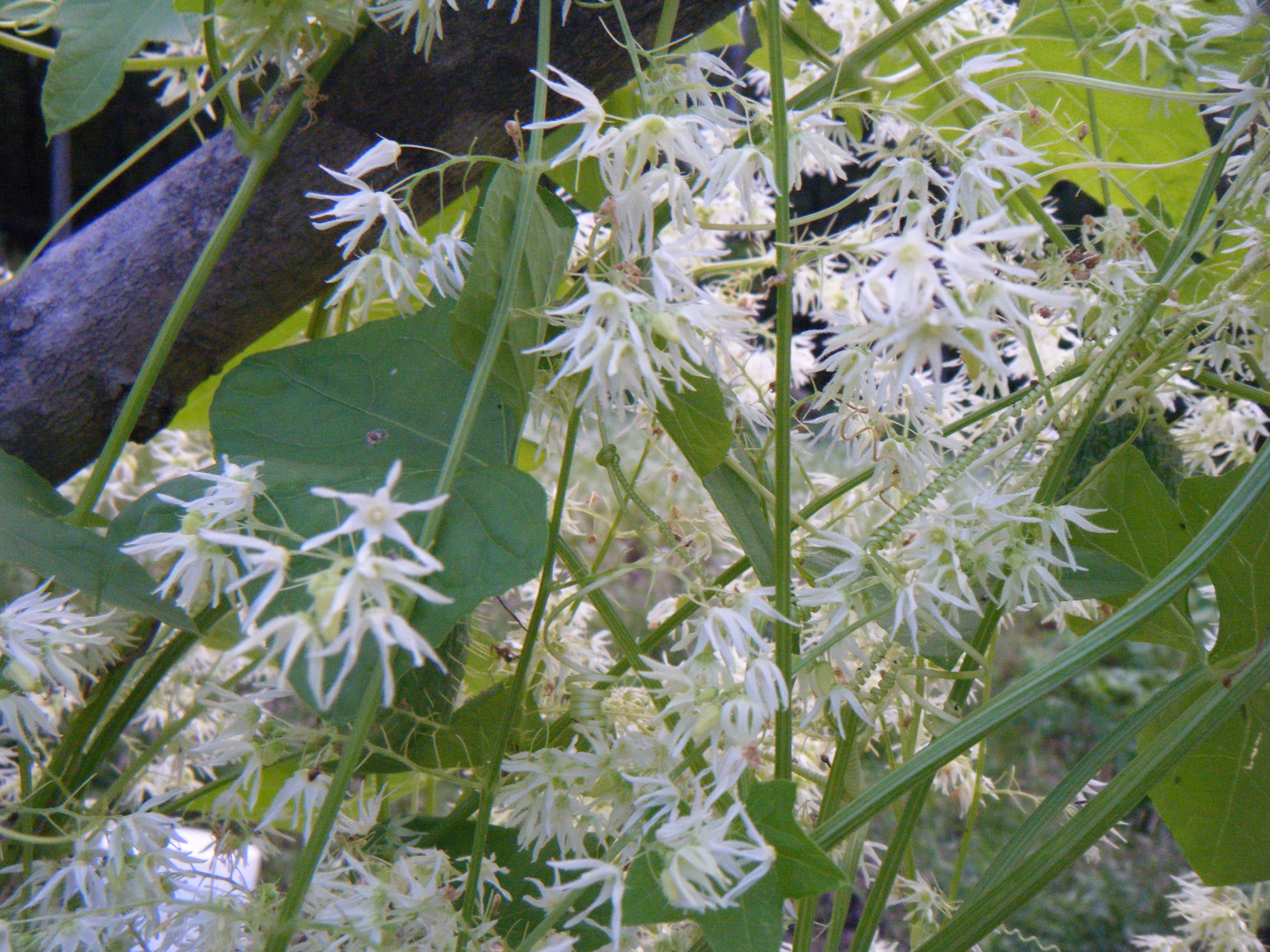
Wild cucumbers.

Flux

My daughter, picking peas in the garden, reached down and plucked a pod chewed ragged by tiny snails, the little creatures with their whorled homes still climbing on the green. Next bed over, a black swallowtail caterpillar munched the parsley. Early this morning, not long after dawn, as my daughters and I drove across Vermont, we saw a fawn sprawled over the pavement, two porcupines, a raccoon. Weeds, breeze, pollinators: the ten thousand things wildly grasp these long July days. Nothing still, nothing static. Even the children, asleep at last, lie breathing softly with dreams murmuring through their minds.

… the ten thousand things (are) in constant transformation, appearing and disappearing perennially through one another as cycles of birth and death unfurl their generations: inside becoming outside, outside inside. This is the deepest form of belonging, and it extends to consciousness, that mirrored opening in which a heron’s flight can become everything I am for a moment…

– David Hinton

DSC01028