A Starlit Night

Last night, my daughters and I walked the neighbor’s child home in the dark. We had been outside for a while, playing a variation of tag with flashlights and laughter, resulting in the older daughter slipping on ice and lying elbows-down in mud. With the flashlights off, we walked along the muddy road beneath the starlight. The night was balmy for mid-March, suffused with the scent of thawing earth: a rich odor so pervasive it was a constant companion. The moon, a white curve, shone a pure, yellow-white light.

On the way home, we saw our house through the bare hardwoods, the strings of little lights the girls nailed along the eaves twinkling. We passed just one house along our road where a single light shone; they must have been gone. It was just the girls and the star-and-moonlight and the mud and I. The peepers are not stirring yet, and none of the woodland creatures called. Beneath our boots, the earth shifted, softening, giving up its winter frost. My older daughter said, I could walk forever, on a night like this.

This morning, watching a single robin tugging at our lawn, I thought of my older daughter, and how, before long, this girl will be on her womanly journey, walking different patches of earth – in boots, or sandals, or heels – beneath this same exquisitely beautiful sky. I opened the window and listened for birdsong, relishing the season we’re in.

What a strange thing! to be alive beneath cherry blossoms.

– Issa

FullSizeRender

Vermont, Mach 2016

The Great Wide World

Early this morning, on what promised to be an incredibly balmy Vermont day, I read with intense fascination a few pages my father had emailed me. The pages were from Sherwin Nuland’s How We Die, about a horrific and bizarre murder of a young girl. Having two daughters myself, I read with agony. In this excerpt, Nuland clips in a lengthy written piece by the child’s mother. She described her own sensation of warmth at the murder scene, and a calmness in her dying child’s eyes, as though the actual event of dying had been cosseted – or eased–  in some inexplicable way for the child and the mother present at her violent death.

While I have been fortunate beyond measure never to experience that kind of trauma or grief, three times in my life I have had a wholly mystical experience at pivotal junctures.

At the caesarian birth of my second child, lying prone on the table, I had a forceful urge to rise up and leave the room, that I would suffocate imminently if I did not move. With the anesthesia, of course, I couldn’t do more than raise my arms and head, and then abruptly I was external to my body. With a clear understanding that I was drifting towards the ceiling, as if I were a helium balloon, the voices of the operating room lessened, words receding into murmurs. I had a profound sense of calm, and I had no regrets about slipping away. Then I heard an infant crying, a thin, plaintive wail, and I thought (this seems quite odd now), Whose baby is that, crying and alone? I thought how cold it was in that room for a baby. Later, I thought I had pity for that baby, but perhaps, more accurately, it was empathy. Abruptly, I realized that crying baby was mine, and instantaneously I was back in my body in the OR, begging to hold my newborn.

I first met this daughter through sound, not through the flesh of a vaginal birth or a wet and squirming infant laid against my bare breast. Yet the bond between the two of us is impermeable. My impulse to nourish and protect this child – to mother her – is as mighty as any universal law, consistent as gravity pulling falling apples to earth. Repeatedly over the years, I’ve thought of that Shakespearian line There are more things in heaven and earth, Horatio,/Than are dreamt of in your philosophy. Those wonders, certainly, are far more faceted than simple pleasure, in our world filled with such joy and such incredible grief. And yet, reading this morning, again I realized how wide is our universe, infinitely wiser than its players.

As a confirmed skeptic, I am bound by the conviction that we imust not only question all things but be willing to believe that all ithings are possible.

– Sherwin B. Nuland, How We Die

IMG_0811

Photo by Molly S./Burlington Airport, Vermont

Fire & Ice

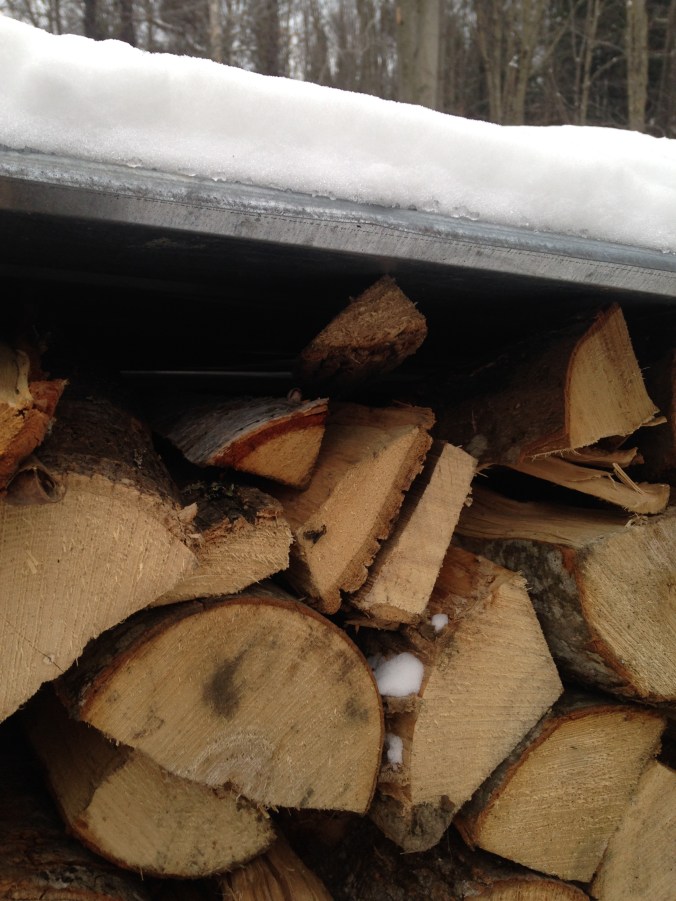
A few inches of loose snow cover the snow all around our house. Beneath this lies rock-hard ice. Maybe someday I’ll live again in a world of shoveled sidewalks, but for now, our footing changes all through the winter and even well into the spring, when mud begins its 10,000 variations. I carried out this morning’s ashes and made a trail to that essential woodpile. A gray dusting of ashes covered a bucket of gleaming coals that hissed, burning down through the ice and snow.

Fire and ice. Why I love Vermont could fill many pages, or simply these three words. The contents of my hearth lie cast out on the frozen ground, dying, while jays cull my compost pile. The girls replenish our woodbox, readying for another night.


Life is, in its very essence and character, a terrible mystery—this whole business of living by killing and eating. But it is a childish attitude to say no to life with all its pain, to say that this is something that should not have been.

– Joseph Campbell

IMG_0558

January, Vermont, 2016


Girls, Goodbye 2015, Walking

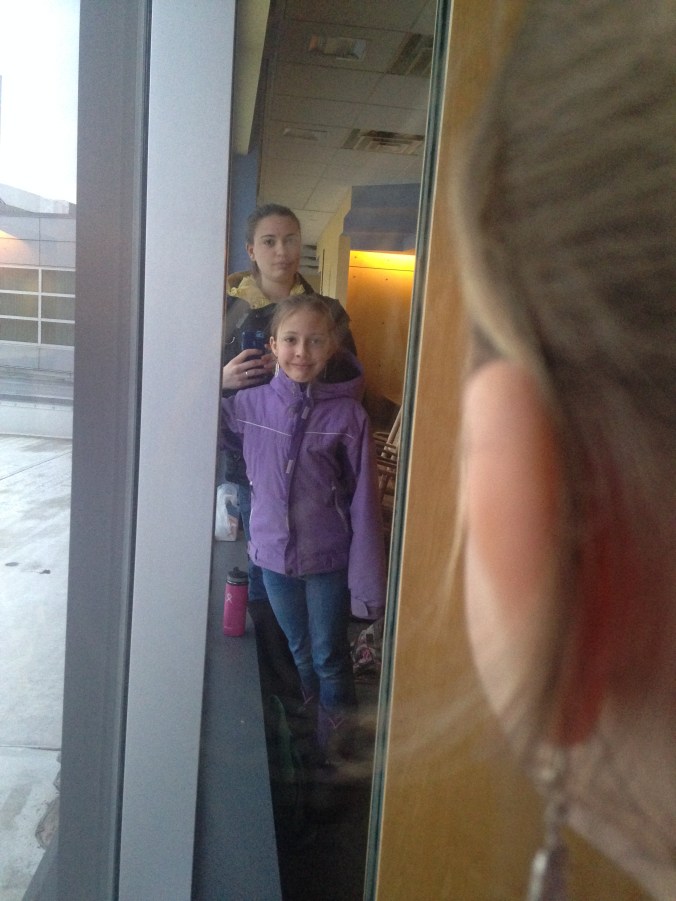
Around six this afternoon, in our Vermont dark, I stood on State Street in Montpelier, waiting outside a movie theatre for my teenage daughter and her friend. The downtown was all lit up with lights, and passersby were merry with the holiday. I was standing with my brother-in-law, and we were laughing about a mechanical music from some source we couldn’t determine, oddly mimicking what might have been the songs of angels. While the girls were at the movies, we had been talking in a crowded coffee shop, and I had seen people come and go that I had known, years ago.

My brother-in-law I’ve known since I was sixteen, before I began driving, before I read Plato, before I married and had two daughters and threw myself into my adult life. Here we stood, in this odd, brightly lit place, on the heartbeat of a new year, in a little bit where time might have simply stood still, for just one moment. We spoke about (what else?) our children. As I laughed about how much his older son ate at my house last summer, my daughter and her friend arrived, in their long lovely hair and earrings, smiling and filled with the happiness of seeing a movie and their own friendship. As we said our goodbyes, we said goodbye to 2015, too; in this evening, the whole unknown expanse of 2016 lies before us.

From behind me, I felt arms suddenly around my waist, and there was a little girl in a familiar iridescent blue jacket – dear companion of my younger daughter – this sweet girl hugging me and saying, Happy New Year! before she disappeared down the street, too.

May Light always surround you;
Hope kindle and rebound you.
May your Hurts turn to Healing;
Your Heart embrace Feeling.
May Wounds become Wisdom;
Every Kindness a Prism.
May Laughter infect you;
Your Passion resurrect you.
May Goodness inspire
your Deepest Desires.
Through all that you Reach For,
May your arms Never Tire.

D. Simone

FullSizeRender

Photo by Molly S./Montpelier, Vermont

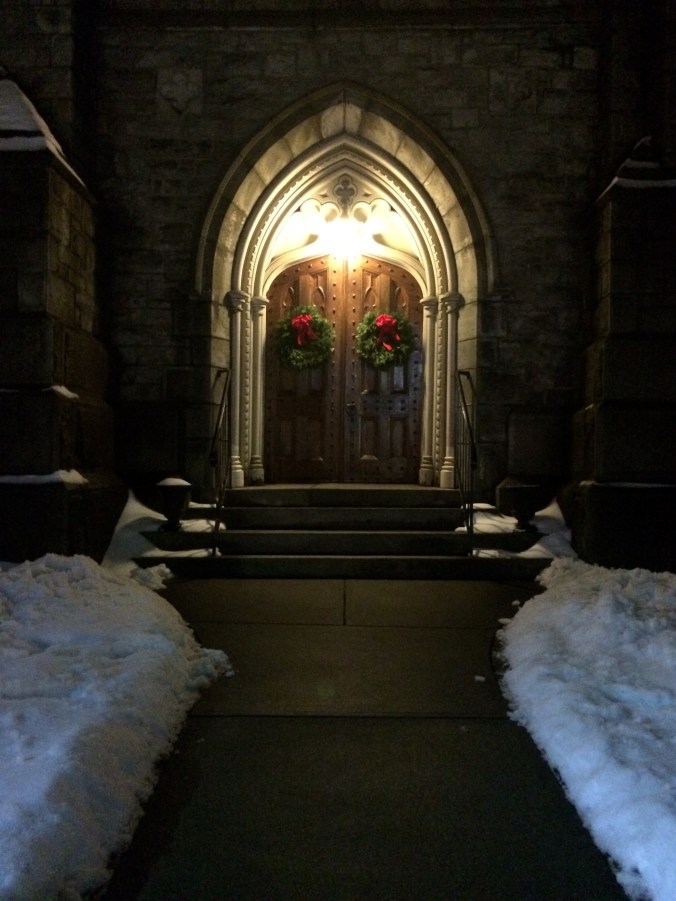
December Solstice

Having kids means, in part, passing through childhood again, but with an entirely different lens, a perspective deeply entrenched in childhood, yet wholly beyond childhood. One slight thing I’ve learned over these decades is that our world, as still and stagnant as it sometimes appears, is always moving, always in flux, our bodies shedding skin while simultaneously producing new cells.

On the edge of this December solstice, with the threads of worldwide violence thickening and spreading and our own good, green planet poisoned and ill, it’s worth remembering the universe we inhabit always, in perpetuity, rotates back toward the light.

What does the solstice mean? my daughter asked. How to answer this primal question? Cusp, I answer. The place to open your heart and eyes and lungs, and breathe in.

In darkness things merge, which might be how passion becomes love and how making love begets progeny of all natures and forms.

– Rebecca Solnit, The Faraway Nearby

FullSizeRender

West Woodbury, Vermont

Autumn Dusk

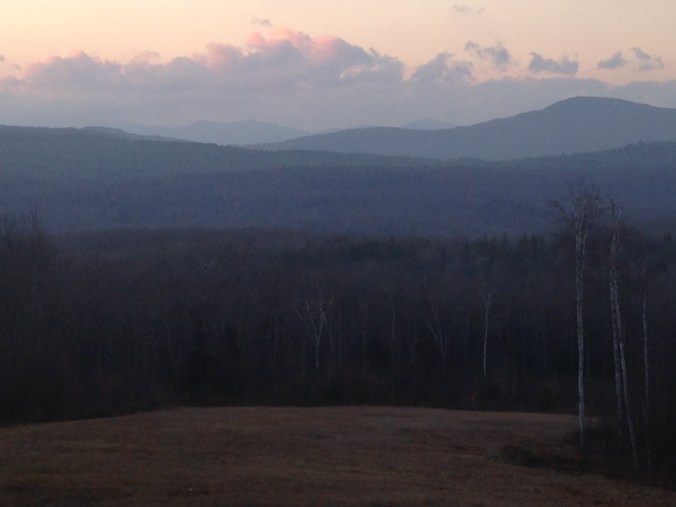
With no snow, our late autumn Vermont appears like coals burned out, none of our summer’s radiance, our snowy luminosity. This afternoon, not yet four, with the light already leaking away, I lay down in my daughter’s forest lair, dead logs propped up against an enormous white pine. While she wandered away, busily scavenging planks for a footbridge over a culvert with a running stream, I lay back on the pine needles and closed my eyes.

The afternoon was extraordinarily still, with not even a stir of wind, a chatter of chipmunk. I smelled mud, that thick, humusy scent of forest floor opened up. Still waiting, I opened my eyes and, through a part in the branches overhead, saw three crows traveling across the gray, cloudy sky, their wings steadily flapping, quite possibly not at all disturbed by the night falling down and the dearth of glow. And that, perhaps, might be the flight of autumn across our sliver of the world.

A lone crow
sits on a dead branch
this autumn eve

— Basho

IMG_0420