More Than the Whole

This afternoon, my daughters baked a raspberry tart, gathering like any craftswomen the pieces of their creation: oats, sugar, butter, fruit. Thinking over the book I’m writing, like any writer I gather my pieces – characters in their tangible and intangible complexities (a green and gold wool vest, a port wine birthmark, the memory of driving rashly along a rainy street), story, and language – shaping this creation.

But a book is greater than the sum of its pages and cover, and I kept thinking of Akenfield, a nonfiction book about a small Suffolk village in the 1960s, told primarily in the villagers’ own voices. The village, too, of course, is more than the sum of its people: nurse, blacksmith, head mistress, gravedigger, odd-job man.

Now that the tart is half-eaten, made in merriment by two sisters, I see that sweet delight is more than the sum of its parts, too.

… I am willing to forgo a lot of the things other people now take for granted in order to keep Akenfield, by which I mean the deep country. The power of wonder is here…. It is man’s rightful place to live in Nature and to be a part of it. He has to recognize the evidence of his relationship to the great natural pattern in such things as flowers, crops, water, stones, wild creatures. Where he destroys such evidence… he gradually destroys a part of himself.

From the village poet in Ronald Blythe, Akenfield
IMG_1682

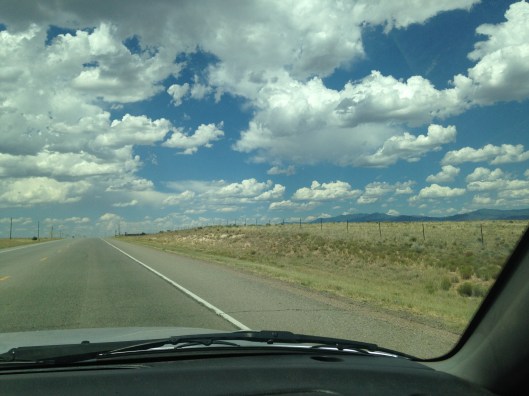
Galisteo, New Mexico

In my weekly commute to Burlington, some mornings I hit traffic, and some mornings I don’t. Today, waiting in a long line, I listened to Garrison Keillor read poetry.

“Despair” by Billy Collins

So much gloom and doubt in our poetry—
flowers wilting on the table,
the self regarding itself in a watery mirror….

Today, with the sun blazing in the trees,
my thoughts turn to the great
tenth-century celebrator of experience,

Wa-Hoo, whose delight in the smallest things
could hardly be restrained…..

Sitting alone in my little Toyota, I laughed out loud.

It’s the fragrant apple blossom season in Vermont. Dandelions are rampantly blooming. My teenager daughter texts me at work of her misery, the stark unfairness of the world. Of course, I text back, but go for a run. The ten-year-old skips on our evening walk. I’m just so happy, and I don’t know why.

How many decades has it taken me to relearn what I knew when I was ten? And to laugh about it? The black flies are out and biting fiercely, but the sparrows are singing mightily.

FullSizeRender.jpg

Slow Learner

At breakfast at the hotel, my ten-year-old is mesmerized by fruit loops. I’ve never tried those, she says, looking at the rainbow bits yearningly.

Go for it, I tell her.

Nearing the end of the milky bowl, she lays down her spoon and comments that Cheerios are better. Those colored rings have failed to hold up to their promised joy. It’s a loss she takes easily, mere observation. When her older sister was that age, I would have leapt forward to fill that moment: disappointed with a cereal? Try this. Or this. This time around, I let it lie. It’s the slightest sadness, and I just let it be. Second time around, I let her keep that sadness for herself.

That evening, she floats on her back in the hotel’s pool, then raises her dripping face and smiles radiantly, sparkling clean, thoroughly happy with buoyancy. I can’t help but stretch for her chlorine-scented hand, and then we flip over and float again, together.

Bring on winter, bring on

disease, & rot & fracture,
because the more broken

we become, the more music
we can spin out of our bones.

– Stephen Cramer, Bone Music

FullSizeRender.jpg

Woodbury, Vermont/April/Photo by Molly S.

Ah, Monet

When my older sister was a student at Williams College, I often rode the Greyhound and visited her. While she was in German or physics class, I walked to the Clark Art Museum. Entrance was free for students, so I could visit over and over. As I read a lot, too, I learned about Monet and his garden, and Renoir and his women.

Although I didn’t realize it at the time, I was learning art is a physical craft. None of the guards cared if I leaned into the paintings and admired brush strokes, bending in to see the raised curved of paint Sisley’s brush had left. I studied how a particular shade of yellow lent a certain light. I became a writer and not a painter, but those hours in the Clark were invaluable to me. I learned to step into light, to realize darkness as moving force, and to see what is there, rather than what I expected to be there.

Yesterday, I visited with my daughters. In a room suffused with natural light, filled with Impressionist beauties, my younger daughter walked to my most beloved painting in the whole museum – Monet’s ‘Geese in the Brook’ – a golden, sunlit beauty. This child, who had been more interested in the possibility of ice cream rather than Pissarros, said that was her favorite.

When I asked her why, she said, Because it’s beautiful. Look at it, mom.

Bingo, I thought to myself. That was worth the trip alone.

I was learning something from the painting of Cézanne that made writing simple true sentences far from enough to make the stories have the dimensions that I was trying to put in them. I was learning very much from him but I was not articulate enough to explain it to anyone. Besides it was a secret.

Ernest Hemingway, A Moveable Feast

FullSizeRender

Williamstown, MA


Frog Chorus

I hate it when my daughters bicker.

Stop, stop, stop, I demand. Are you listening to yourselves?

They look at me oddly, and insist, This isn’t fighting, mom.

Recently, I’ve been forcing myself to close my eyes and simply listen to the cadence of their voices. Not the words, not even the tone, but only the rhythm and motion of their voices together. They pick at each other; they laugh; their voices dive at each other again.

Late this afternoon, I walked to our woods pond. Before I could even see the water, I heard the cacophony of frogs, so rusty this early in the season I might have mistaken it for a few stray geese. When the frogs heard my footsteps on dried leaves, they vanished under the water. I remained crouched for a good long while before the frog-chatter chorus cranked up again, a tentative bleat here, then another.

Walking back, I challenged myself to think of my daughters as those calling creatures and listen carefully to the song beneath their singing.

Old pond…
a frog jumps in
water’s sound.

– Basho

FullSizeRender

Woodbury, Vermont

Daughters

In my usual, take-your-kids-to-work-with-you way, the girls came, too, when I read at Vermont’s Norwich Bookstore, in the first real sunny day of spring.

Afterward, my daughters and I walked around Dartmouth College, where the enormous green was filled with students and flying frisbees. The young women wore strappy dresses; the daffodils spread their buttery petals; we ate homemade cherry gelato. All was budding and new in the world. Driving back along Vermont’s sparsely travelled interstate, we passed fields turning toward emerald from the dull brown they’ve held for weeks. The rivers and lakes had thawed, and flocks of birds darted in quick waves.

All the way home, needing no map, we laughed and told stories.

…You are born a woman
for the sheer glory of it,
little redhead, beautiful screamer.
You are no second sex,
but the first of the first;
& when the moon’s phases
fill out the cycle
of your life,
you will crow
for the joy
of being a woman,
telling the pallid moon
to go drown herself
in the blue ocean,
& glorying, glorying, glorying
in the rosy wonder
of your sunshining wondrous
self.

– Erica Jong

FullSizeRender.jpg

Hanover, New Hampshire