Vectoring….

Autumn has stretched out in Vermont into days of balminess, the warm air shot-through with the gold that lingers on the trees. It’s so warm, I keep at my makeshift back porch deck, a table I moved out this summer that’s become a place of succor, resting my bare feet on a wooden crate of those onions I pulled from the garden.

I’m taking a class with the unmatchable Lauren Markham about structure in writing, one of the hardest challenges. Online, there’s attendees from California (what? you get sun and ocean?) and Phoenix and Boston. Signing in, I leave my laptop camera on. I throw a chunk of wood in my stove from sheer laziness so I won’t need to rekindle the fire as the colder night creeps in, but I open the back window so my cats can sit on the sill and enjoy this sweet October breeze. When I join, the group is admiring the view of my clapboard house and frost-killed morning glories vines. I tell them my chore which doubtlessly immediately marks me as…. quaint rural.

Late afternoon, I pull out the dead basil plants and then lie down under an apple tree. Her leaves, blacked with frost spots, spiral down, one by one, to the unmown grass. It wasn’t until I had babies and was forced to slow down (all those nursing hours beneath apple trees, milk-sweet baby in my arms) that I realized every leaf takes its own precise trajectory, from spring bud to the autumn dive earthward. Around me, rotting apples, persistent slow-flying wasps.

I might have slept; when I open my eyes, the sky is already draining of blue. Thinking of Markham’s words, I suddenly see the taunt arc of this fourth, yet unfinished book, the map that holds this story, the treasure at the reader’s end far from a Hallmark card. Vector is the word she used. Indeed, all story, all life, is motion. The chill rising up from the earth, I vector myself indoors….

A great many, who have spent their lives in cities, and have never chanced to come into the country at this season, have never seen this, the flower, or rather the ripe fruit, of the year. I remember riding with one such citizen, who, though a fortnight too late for the most brilliant tints, was taken by surprise, and would not believe that there had been any brighter. He had never heard of this phenomenon before. 

— Thoreau
‘Eat all the plums from all the iceboxes. Apologize to no one.’

Not a spoiler alert — an eclipse is headed our planet’s way — and we live in the path of totality. Over the past few years, it feels like the state has prepared for so many things: snowstorms and windstorms, floods. Now, a river of people streaming in for The Awesome.

Meanwhile, lives churn on. I spend a pleasant and snowy afternoon writing a spreadsheet, followed by a ranting email which I (wisely) delete before I send. I write and write. A short excerpt of my novel is picked up for publication in May. I’m given a green folder and a white folder of old letters and documents and site map for an article I’m writing. The housecats twitch at the juncos in the feeder.

Ryan Champan’s advice on writing a novel:

56. If you’re struggling with revision, print out the draft. Cut each sentence into individual strips and papier mâché them into a sculpture of your head, scaled 2x. Once it’s dried, place the sculpture over your head—create eye holes at your discretion—and just sit like that.

And another:

15. Llosa again, on writing one’s first novel: “Those writers who shun their own demons and set themselves themes because they believe their own aren’t original or appealing enough are making an enormous mistake. In and of itself, no literary theme is good or bad. Any themes can be either, and the verdict depends not on the theme itself but rather on what it becomes when the application of form—narrative style and structure—makes it a novel.”

Read the whole 1oo here. Surely a few gems for anyone…

“Writing is about breaking down…”

A book of Knausgaard’s essays makes its way into my house. On a snowy day, the cats and I finish putting together my taxes, then read. The snow piles and drifts. The next day, the snow melts and melts, running in sun-sparkling rivulets. Readers either love Knausgaard or despise him, like readers understand Halldór Laxness, or don’t, much in the same way that I have never understood Jane Austen. When I began reading Knausgaard’s Struggle books, a neighbor read at my breakneck pace, loving his words. She and I have long since traveled our own different lives. But reading these essays reminds me of her, how profoundly she believed in beauty as a force. Whichever way she’s traveled, I wonder how that’s worked out for her.

Writing is about breaking down what you can do and what you’ve learned, something that would be inconceivable to a craftsman, a cabinetmaker, for instance, who can’t possibly start from scratch every time.

— Karl Ove Knausgaard

Revision.

On the most perfect spring morning, I’m driving along route 107, a stretch of highway I’ve always loved that curves along the river. I’m listening to a This American Life story about two boys (and if you listen, listen all the way to the end, please), when the revision path for my novel abruptly unfolds before me, like a Jacob’s Ladder toy.

I’m in somewhat familiar territory, and so I pull over and scrawl down a few sentences. The day is suffused with dandelions and violets. I get a little lost to where I’m going, but not too lost. Later, I take a different road home, up route 100 along the White River Valley. Last year’s corn stubble patterns black fields that stretch to mountains where leaves freshen the gray with new green. The fruit trees are blossoming. I stop and finish the remains of my sandwich —pickles and sprouts and a coarse sharp mustard — keeping company with pink petals and pollinators.

My lunch companion remarked how a forest will do what a forest will. As I eat, I remember how poet David Budbill railed against writers taking themselves too seriously. He wrote, wrote hard, wrote productively, and revered the mystery of the imagination, the murkiness of creativity. His advice to writers, “Don’t think. Listen.”

On my way home, I listen to another This American Life story about a bird who sang to itself. I’m not making this up.

Snow, Yarn, Patterns.

Snow notwithstanding, the temperature is solidly spring for January. My neighbors and I stand at the end of our dead-end road, talking about the escalating price of food and raising kids, the random things that three tired parents share. It’s not cabin fever, not a chafing against the cold, not the dreariness of winter gone on too long. It takes me a little while to figure out what it is, and then I realize it’s nothing more than simple camaraderie.

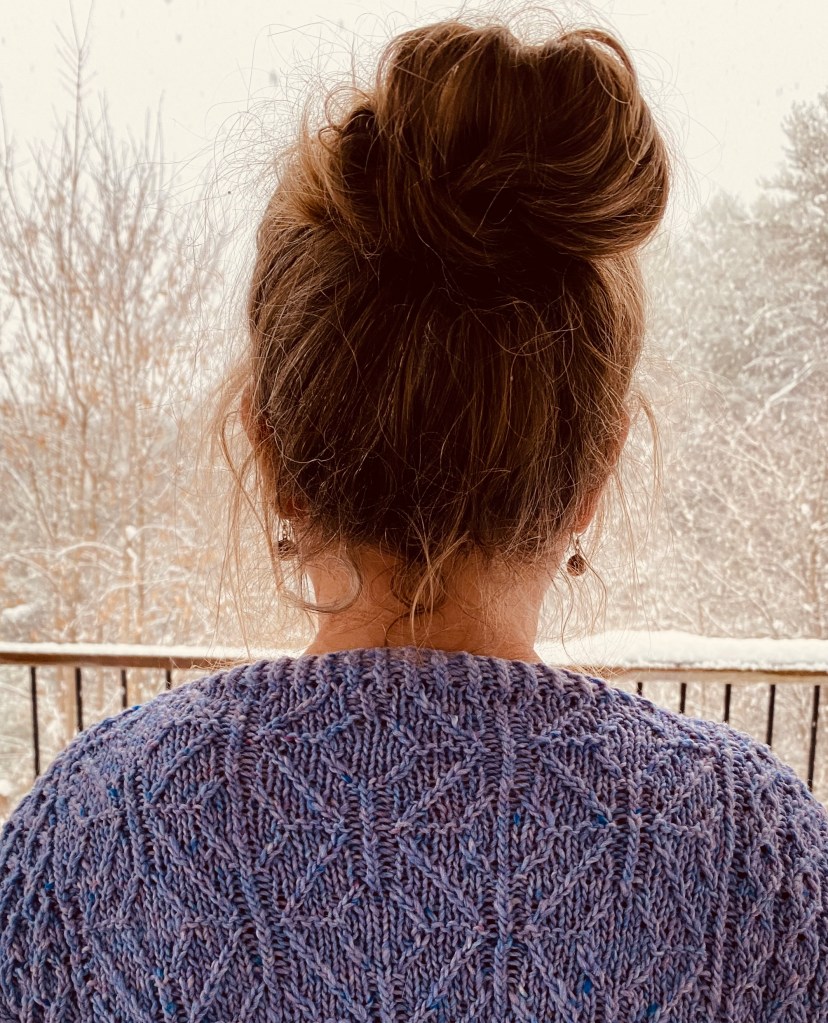
So here’s the thing about knitting — I resisted knitting for so long because I considered knitting old-lady-ish, an occupation for those who had nothing better to do. Oh, how those sentiments smote me now. Sure, men knit, but knitting is generally the terrain of women. At work the other day, a stranger asked me about a fair isle sweater I had knit. Without thinking, I pulled off my sweater, flipped it inside out, and laid it on my desk. The two of us talked tension, seaming, yarn. Cables. The pleasures of putting your hands to wool.

“No two people knit alike, look alike, think alike; why should their projects be alike? Your sweater should be like your own favorite original recipes — like nobody else’s on earth. 
And a good thing too.” 

— Elizabeth Zimmermann

The Mail is a Real Thing.

Our post office box is crammed with mail. It’s been a few days, and I tug the mail out to see what’s there. Late afternoon, the PO has a steady stream of locals, some shuffling, others rushing. I take my turn at the table in the corner, chucking away what I didn’t request and don’t want, the sale flyers and offers. I keep a holiday card and the electric bill, The New Yorker. While I wait in line for two packages, the woman beside me strikes up a conversation about knitting hats and then we’re in the world of cables and color and yarn weight.

The PO is in the post office’s standard squat brick building, not at all quaint or cutesy. When staff changed over a few years ago, someone planted a flower garden in the front bed. By late summer, I kept admiring the flowering elecampane, taller than my head, bristly and mighty, a flower after my own heart. Late July is a long way off, but still. Elecampane is lodged in my garden plan.

“No two people knit alike, look alike, think alike; why should their projects be alike? Your sweater should be like your own favorite original recipes – like nobody else’s on earth. 
And a good thing too.” 

— Elizabeth Zimmerman